Fort Myer in Arlington in Arlington County, Virginia — The American South (Mid-Atlantic)
The Gray Family
Arlington House, The Robert E. Lee Memorial
| — | George Washington Memorial Parkway | — |
Photographed by Connor Olson, March 21, 2022
1. The Gray Family Marker
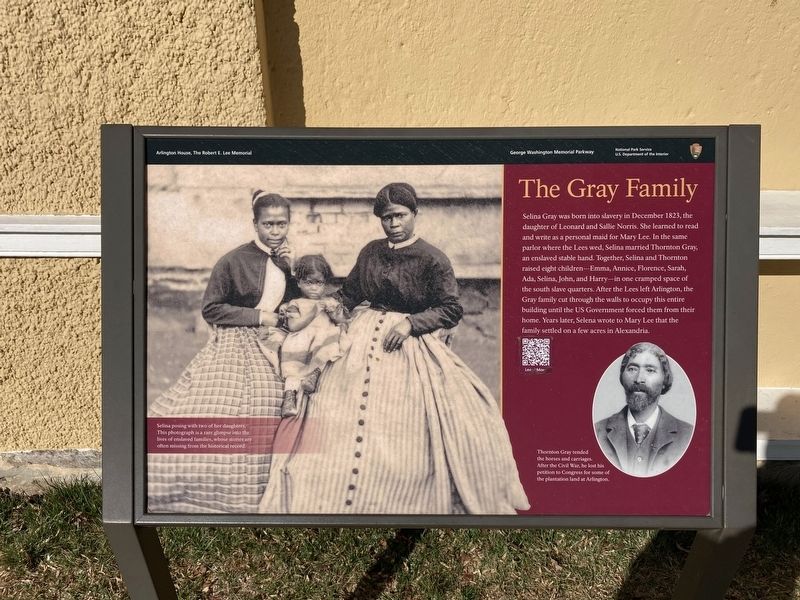
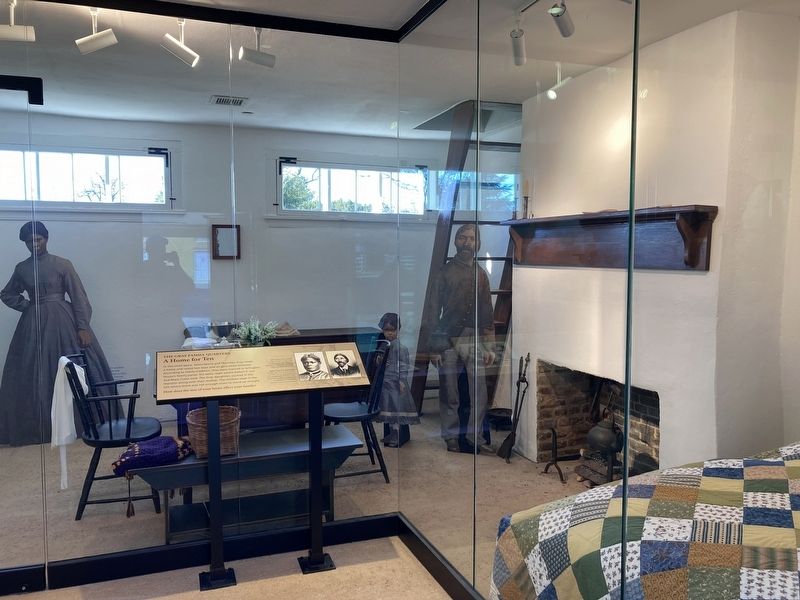
Selena Gray was born into slavery in December 1823, the daughter of Leonard and Sallie Norris. She learned to read and write as a personal maid for Mary Lee. In the same parlor where the Lees wed, Selena married Thornton Gray, and enslaved stable hand. Together, Selena and Thornton raised eight children—Emma, Annice, Florence, Sarah, Ada, Selena, John, and Harry—in one cramped space of the south slave quarters. After the Lees left Arlington, the gray family cut through the walls to occupy this entire building until the US government forced them from their home. Years later, Selena wrote to Mary Lee after the family settled on a few acres in Alexandria.
(Captions)
Selena posing with two of her daughters. This photograph is a rare glimpse into the lives of enslaved families, whose stories are often missing from the historical record.
Thornton Gray tended the horses and carriages. After the Civil War, he lost his petition to Congress for some of the plantation land at Arlington.
Erected by National Park Service, U.S. Department of the Interior.
Topics. This historical marker is listed in these topic lists:
this page online
Location. 38° 52.857′ N, 77° 4.37′ W. Marker is in Arlington, Virginia, in Arlington County. It is in Fort Myer. It can be reached from Sherman Drive 0.2 miles south of Lincoln Drive, on the left when traveling south. Touch for map. Marker is at or near this postal address: 319 Sherman Dr, Fort Myer VA 22211, United States of America. Touch for directions.

Regionally, this marker is in the Washington Metropolitan Area and in Northern Virginia. It is also in the American South, specifically in the Upper South, in the Mid-Atlantic, and on the Eastern Seaboard. Globally, it is in the North Atlantic Region, North America, the Western Hemisphere, the Western World, and the Anglosphere. Historically, it finds itself in what was once the territory of the Mississippian Culture, one of the original Thirteen Colonies, one of the Confederate States of America, and the Antebellum South.
Other nearby markers. At least 8 other markers are within walking distance of this marker: A Place of Division and Reunification (a few steps from this marker);
Photographed by Connor Olson, March 21, 2022
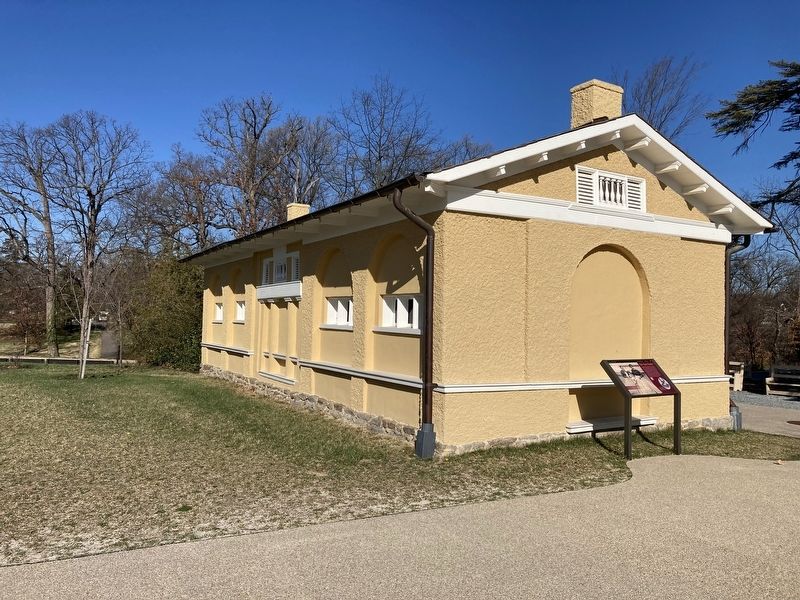
2. The Gray Family Marker in front of the south slave quarters
Other markers no longer nearby. Selina Gray (was a few steps from this marker but has been replaced with another marker now near it); Guardian of a Nation's Heritage (was a few steps from this marker but has been permanently removed); The Kingdom of My Childhood (was a few steps from this marker but has been replaced with another marker now near it); The Flower Garden (was within shouting distance of this marker but has been replaced with another marker now near it); Arlington House, 1864 (was within shouting distance of this marker but has been confirmed missing); The Arlington Woodlands (was within shouting distance of this marker but has been permanently removed).
Also see . . . Arlington House, The Robert E. Lee Memorial.
Photographed by Connor Olson, March 21, 2022
3. Recreation of Gray Family Quarters
Credits. This page was last revised on November 8, 2024. It was originally submitted on March 27, 2022, by Connor Olson of Menomonee Falls, Wisconsin. This page has been viewed 579 times since then and 59 times this year. Last updated on January 7, 2023, by Bruce Guthrie of Silver Spring, Maryland. Photos: 1, 2, 3. submitted on March 27, 2022, by Connor Olson of Menomonee Falls, Wisconsin. • Bernard Fisher was the editor who published this page.
