Society Hill in Philadelphia in Philadelphia County, Pennsylvania — The American Northeast (Mid-Atlantic)
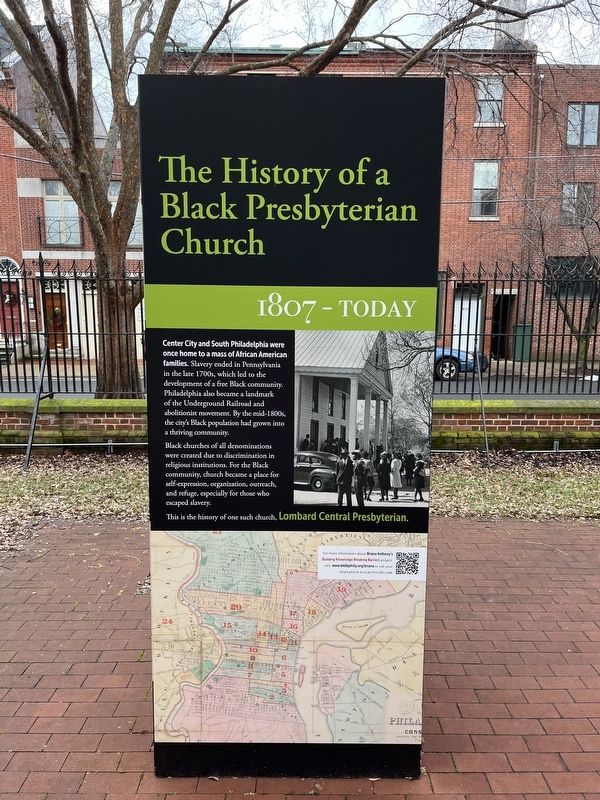
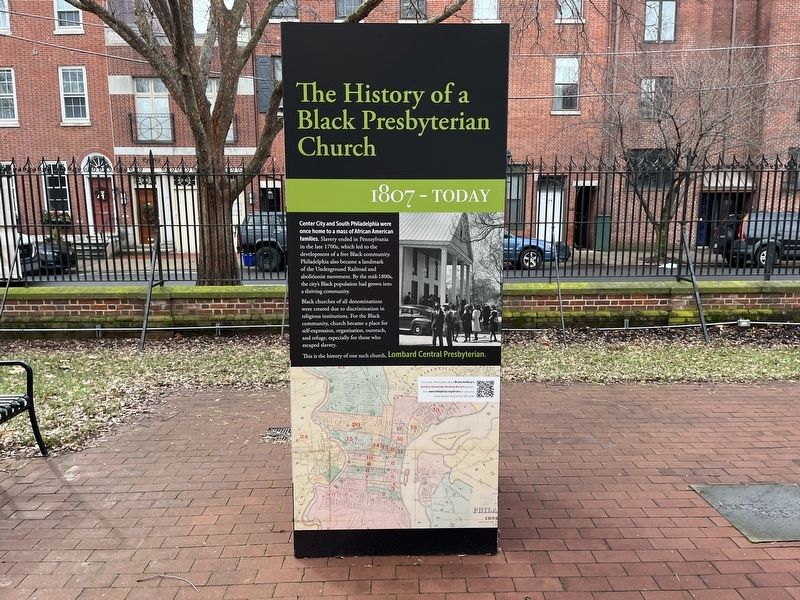
The History of a Black Presbyterian Church
Photographed by Devry Becker Jones (CC0), January 13, 2023
1. The History of a Black Presbyterian Church Marker
1807 - Today
Center City and South Philadelphia were once home to a mass of African American families. Slavery ended in Pennsylvania in the late 1700s, which led to the development of a Free Black community. Philadelphia also became a landmark of the Underground Railroad and abolitionist movement. By the mid-1800s, the city's Black population had grown into a thriving community.
Black churches of all denominations were created due to discrimination in religious institutions. For the Black community, church became a place for self-expression, organization, outreach, and refuge, especially for those who escaped slavery.
This is the history of one such church, Lombard Central Presbyterian.
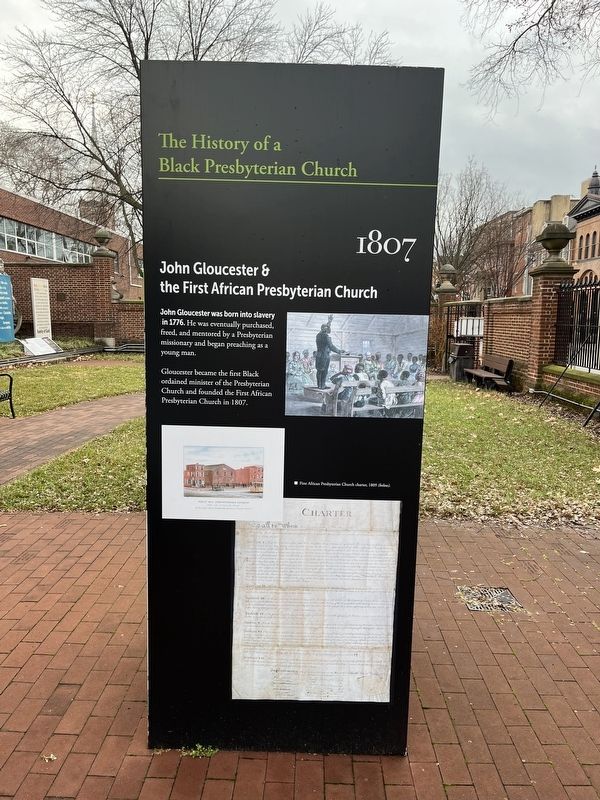
1807
John Gloucester & the First African Presbyterian Church
John Gloucester was born into slavery in 1776. He was eventually purchased, freed, and mentored by a Presbyterian missionary and began preaching as a young man.
Gloucester became the first Black ordained minister of the Presbyterian Church and founded the First African Presbyterian Church in 1807.
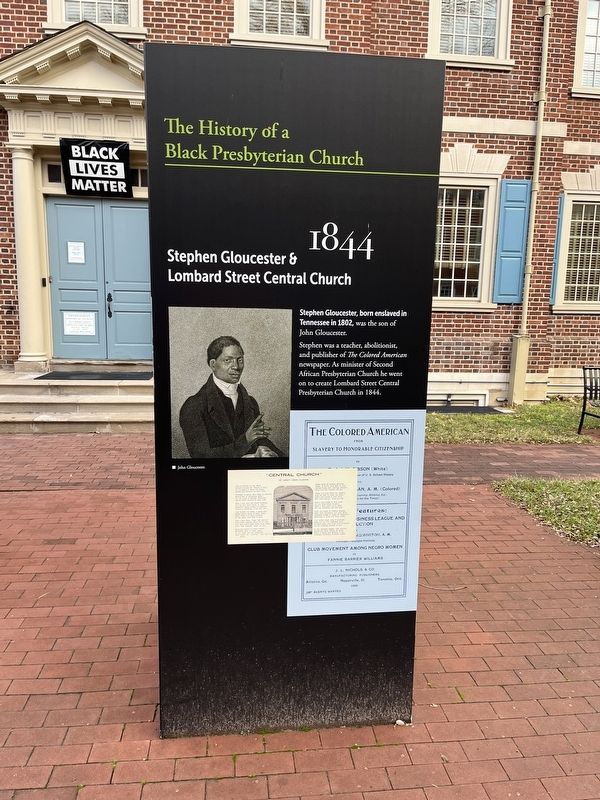
1844
Stephen Gloucester & Lombard Street Central Church
Stephen Gloucester, born enslaved in Tennessee in 1802,
this page online
Stephen was a teacher, abolitionist, and publisher of The Colored American newspaper. A minister of Second African Presbyterian Church he went on to create Lombard Street Central Presbyterian Church in 1844.
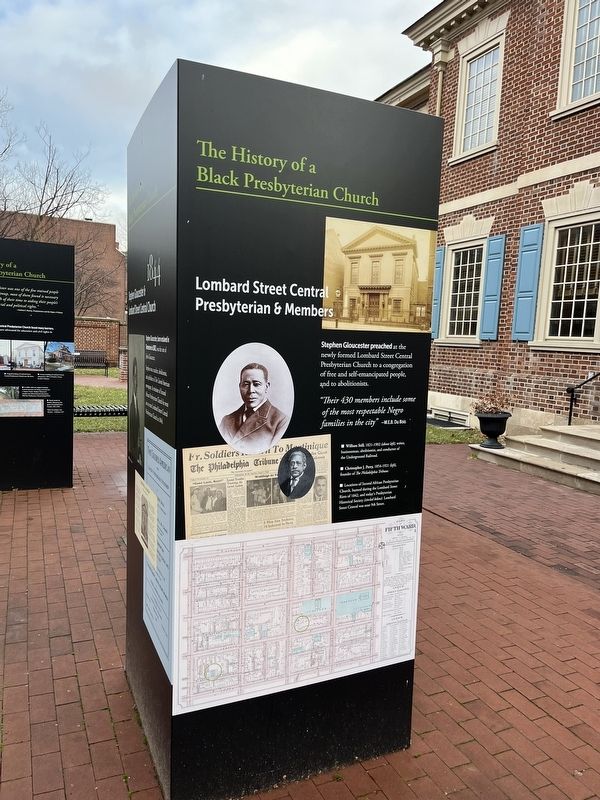
Lombard Street Central Presbyterian & Members
Stephen Gloucester preached at the newly formed Lombard Street Central Presbyterian Church to a congregation of free and self-emancipated people, and to abolitionists.
"Their 430 members include some of the most respectable Negro families in the city" — W.E.B. Du Bois
[Captions:]
■ William Still, 1821-1902 (above left), writer, businessman, abolitionist, and conductor of the Underground Railroad.
■ Christopher J. Perry, 1854-1921 (left) founder of The Philadelphia Tribune.
■ Locations of Second African Presbyterian Church, burned during the Lombard Street Riots of 1842, and today's Presbyterian Historical Society (circled below). Lombard Street Central was near 9th Street.
Erected 2020 by Presbyterian Historical Society.
Topics. This historical marker is listed in these topic lists: Abolition & Underground RR
Photographed by Devry Becker Jones (CC0), January 13, 2023
2. The History of a Black Presbyterian Church Marker
Location. 39° 56.572′ N, 75° 8.997′ W. Marker is in Philadelphia, Pennsylvania, in Philadelphia County. It is in Society Hill. It is on Lombard Street east of South 5th Street, on the right when traveling west. Touch for map. Marker is at or near this postal address: 425 Lombard St, Philadelphia PA 19147, United States of America. Touch for directions.

Regionally, this marker is in Southeast Pennsylvania. It is also in the American Northeast and in the Mid-Atlantic. Globally, it is in North America, the Western Hemisphere, the Western World, and the Anglosphere. Historically, it finds itself in what was once the Haudenosaunee (Iroquois) Confederacy, New Netherland, and one of the original Thirteen Colonies.
Other nearby markers. At least 8 other markers are within walking distance of this marker: The Great Migration (here, next to this marker); Urban Renewal & Gentrification (here, next to this marker); Calder Statues (here, next to this marker); Why Bettie? / Building Knowledge; Breaking Barriers
Photographed by Devry Becker Jones (CC0), January 13, 2023
3. The History of a Black Presbyterian Church Marker
Photographed by Devry Becker Jones (CC0), January 13, 2023
4. The History of a Black Presbyterian Church Marker
Photographed by Devry Becker Jones (CC0), January 13, 2023
5. The History of a Black Presbyterian Church Marker
Credits. This page was last revised on February 2, 2023. It was originally submitted on January 16, 2023, by Devry Becker Jones of Washington, District of Columbia. This page has been viewed 630 times since then and 67 times this year. Photos: 1, 2, 3, 4, 5. submitted on January 16, 2023, by Devry Becker Jones of Washington, District of Columbia.
