Langdon in Cavalier County, North Dakota — The American Midwest (Upper Plains)
Construction, System Components, and Deployment
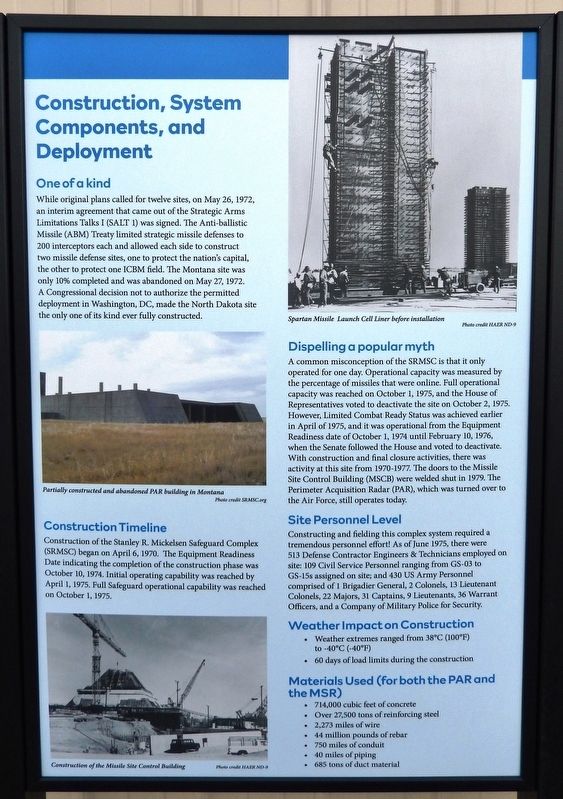
Pyramids on the Prairie
Photographed by Cosmos Mariner, August 28, 2022
1. Construction, System Components, and Deployment Marker
One of a kind
While original plans called for twelve sites, on May 26, 1972, an interim agreement that came out of the Strategic Arms Limitations Talks I (SALT 1) was signed. The Anti-ballistic Missile (ABM) Treaty limited strategic missile defenses to 200 interceptors each and allowed each side to construct two missile defense sites, one to protect the nation's capital, the other to protect one ICBM field. The Montana site was only 10% completed and was abandoned on May 27, 1972. A Congressional decision not to authorize the permitted deployment in Washington, DC, made the North Dakota site the only one of its kind ever fully constructed.
Construction Timeline
Construction of the Stanley R. Mickelsen Safeguard Complex (SRMSC) began on April 6, 1970. The Equipment Readiness Date indicating the completion of the construction phase was October 10, 1974. Initial operating capability was reached by April 1, 1975. Full Safeguard operational capability was reached on October 1, 1975.
Dispelling a popular myth
A common misconception of the SRMSC is that it only operated for one day. Operational capacity was measured by the percentage
this page online
Site Personnel Level
Constructing and fielding this complex system required a tremendous personnel effort! As of June 1975, there were 513 Defense Contractor Engineers & Technicians employed on site; 109 Civil Service Personnel ranging from GS-03 to GS-15s assigned on site; and 430 US Army Personnel comprised of 1 Brigadier General, 2 Colonels, 13 Lieutenant Colonels, 22 Majors, 31 Captains, 9 Lieutenants, 36 Warrant Officers, and a Company of Military Police for

Courtesy srmsc.org
2. Marker detail: Partially constructed and abandoned PAR building in Montana
Weather Impact on Construction
• Weather extremes ranged from 38°C (100°F) to -40°C (-40°F)
• 60 days of load limits during the construction
Materials Used (for both the PAR and the MSR)
• 714,000 cubic feet of concrete
• Over 27,500 tons of reinforcing steel
• 2,273 miles of wire
• 44 million pounds of rebar
• 750 miles of conduit
• 40 miles of piping
• 685 tons of duct material
Topics. This historical marker is listed in these topic lists: Air & Space • Architecture • War, Cold. A significant historical date for this entry is May 26, 1972.
Location. 48° 45.623′ N, 98° 22.072′ W. Marker is in Langdon, North Dakota, in Cavalier County. It is at the intersection of 8th Avenue and 3rd Street, on the right when traveling west on 8th Avenue. Marker is located in Boyd Block Plaza. Touch for map. Marker is at or near this postal address: 801 3rd Street, Langdon ND 58249, United States of America. Touch for directions.

Regionally, this marker is in the Red River Valley and in the Turtle Mountains. It is also in the American Lewis & Clark Corridor, on the prairies, and on the Northern Plains. Globally, it is in North America, the

Courtesy HAER ND-9
3. Marker detail: Construction of the Missile Site Control Building
Other nearby markers. At least 8 other markers are within walking distance of this marker: Safeguard (here, next to this marker); Scenarios of an Intercontinental Missile (ICBM) Attack (here, next to this marker); Local Impact (here, next to this marker); Progress on the Prairie (here, next to this marker); Cavalier County Agriculture (here, next to this marker); Cavalier County Places (here, next to this marker); Early History (here, next to this marker); Cavalier County Timeline (here, next to this marker). Touch for a list and map of all markers in Langdon.
Related markers. Click here for a list of markers that are related to this marker.
Also see . . . Stanley R. Mickelsen Safeguard Complex.
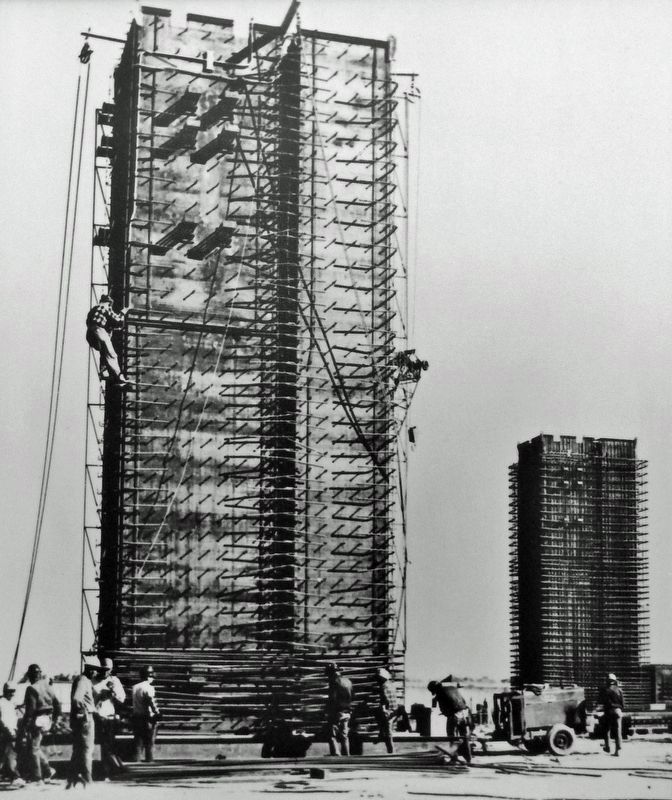
A cluster of military facilities near Langdon, North Dakota, that supported the United States Army's Safeguard anti-ballistic missile program. The complex provided launch and control for 30 LIM-49 Spartan anti-ballistic missiles, and 70 shorter-range Sprint anti-ballistic(Submitted on January 20, 2023, by Cosmos Mariner of Cape Canaveral, Florida.)missiles. On 2 October 1975, the House of Representatives voted to decommission the project, after they deemed it ineffective.Courtesy HAER ND-94. Marker detail: Spartan Missile Launch Cell Liner before installationThe complex was centered on the Missile Site Radar (MSR) site, near to Nekoma, North Dakota, home to the Missile Site Radar itself, as well as the 30 Spartan missiles and 16 of the shorter-range Sprints. All missiles were held in underground launch silos.
The Perimeter Acquisition Radar (PAR) was a separately sited phased array radar intended to detect incoming targets. The radar and site remain in service today as the Perimeter Acquisition Radar Characterization System (PARCS), located at Cavalier Air Force Station.

Photographed by Cosmos Mariner, August 28, 2022
5. Construction, System Components, and Deployment Marker

Photographed by Cosmos Mariner, August 28, 2022
6. Boyd Block Plaza • History Panels
Credits. This page was last revised on January 20, 2023. It was originally submitted on January 16, 2023, by Cosmos Mariner of Cape Canaveral, Florida. This page has been viewed 485 times since then and 62 times this year. Photos: 1, 2, 3, 4, 5, 6. submitted on January 20, 2023, by Cosmos Mariner of Cape Canaveral, Florida.
