Herndon in Fairfax County, Virginia — The American South (Mid-Atlantic)
Herndon Station Raid
"My loss was nothing"
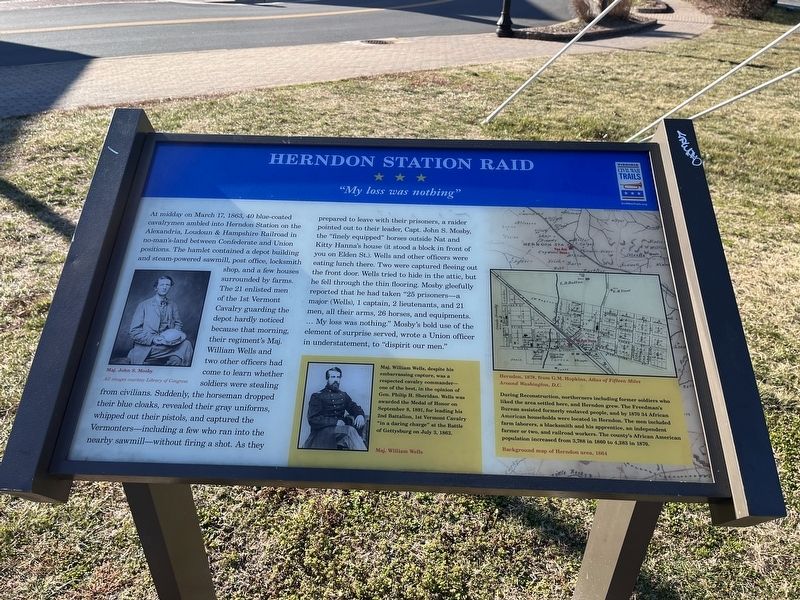
At midday on March 17, 1863, 40 blue-coated cavalrymen ambled into Herndon Station on the Alexandria, Loudoun & Hampshire Railroad in no-man's-land between Confederate and Union positions. The hamlet contained a depot building and steam-powered sawmill, post office, locksmith shop, and a few houses surrounded by farms. The 21 enlisted men of the 1st Vermont Cavalry guarding the depot hardly noticed because that morning, their regiment's Maj. William Wells and two other officers had come to learn whether soldiers were stealing from civilians. Suddenly, the horesman dropped their blue cloaks, revealed their gray uniforms, whipped out their pistols, and captured the Vermonters—including a few who ran into the nearby sawmill—without firing a shot. As they prepared to leave with their prisoners, a raider pointed out to their leader, Capt. John S. Mosby the "finely equipped" horses outside Nat and Kitty Hanna's house (it stood a block in front of you on Elden St.). Wells and other officers were eating lunch there. Two were captured fleeing out the front door. Wells tried to hide in the attic, but he fell through the thin flooring.
this page online
[Captions:]
Maj. William Wells, despite his embarrassing capture, was a respected cavalry commander—one of the best, in the opinion of Gen Philip H. Sheridan. Wells was awarded the Medal of Honor on September 8, 1891, for leading his 2nd Battalion, 1st Vermont Cavalry "in a daring charge at the Battle of Gettysburg on July 3, 1863.
During Reconstruction, northerners including former soldiers who liked the area settled here, and Herndon grew. The Freedmen's Bureau assisted formerly enslaved people, and by 1870 34 African American households were located in Herndon. The men included farm laborers, a blacksmith and his apprentice, an independent farmer or two, and railroad workers. The county's African American population increased from 3,788 in 1860 to 4,283 in 1870.
Erected by Virginia Civil War Trails.
Topics and series. This
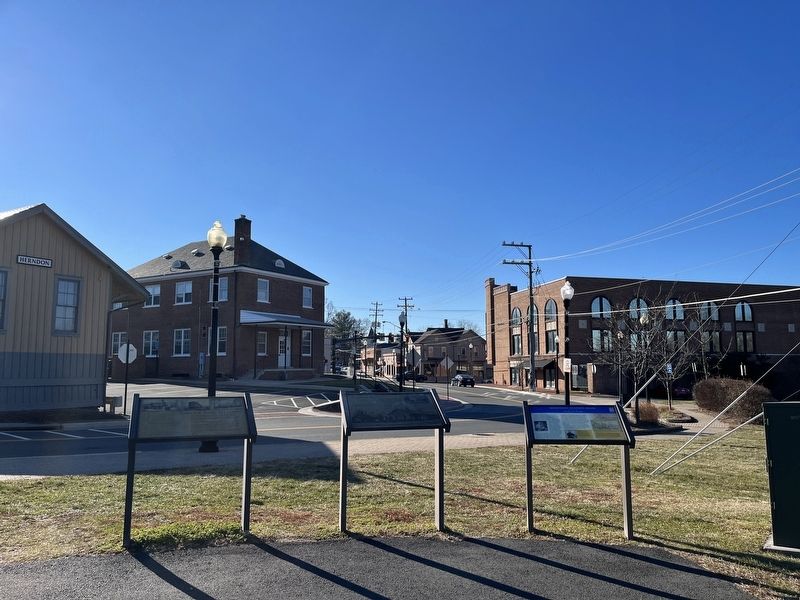
Location. 38° 58.227′ N, 77° 23.159′ W. Marker is in Herndon, Virginia, in Fairfax County. It is at the intersection of Washington and Old Dominion Trail and Station Street, on the right when traveling south on Washington and Old Dominion Trail. Touch for map. Marker is at or near this postal address: 700 Block Lynn St, Herndon VA 20170, United States of America. Touch for directions.

Regionally, this marker is in the Washington Metropolitan Area and in Northern Virginia. It is also in the American South, specifically in the Upper South, in the Mid-Atlantic, and on the Eastern Seaboard. Globally, it is in the North Atlantic Region, North America, the Western Hemisphere, the Western World, and the Anglosphere. Historically, it finds itself in what was once the territory of the Mississippian Culture, one of the original Thirteen Colonies, one of the Confederate States of America, and the Antebellum South.
Other nearby markers. At least 8 other markers are within walking distance of this marker: Herndon Station (here, next to this marker); Tracks Into History (here, next to this marker); Southern Railway Whistle Post (a few steps from this marker); The W&OD Railway and Jim Crow Laws (within shouting distance of this marker); In Memory of George Moore (within shouting distance of this marker); This is W&OD Trail: Herndon! (within shouting distance of this marker); Herndon Dairy Farming (within shouting distance of this marker); World War II Memorial (within shouting distance of this marker). Touch for a list and map of all markers in Herndon.
Another marker is no longer nearby. Mosby’s Herndon Station Raid (was here, next to this marker but has been replaced with another marker now near it).
Related marker. Click here for another marker that is related to this marker. This marker replaces the linked marker.
Credits. This page was last revised on January 17, 2023. It was originally submitted on January 17, 2023, by Devry Becker Jones of Washington, District of Columbia. This page has been viewed 523 times since then and 46 times this year. Photos: 1, 2. submitted on January 17, 2023, by Devry Becker Jones of Washington, District of Columbia.
