Manassas, Virginia — The American South (Mid-Atlantic)
The Brown School
1869 - 1954
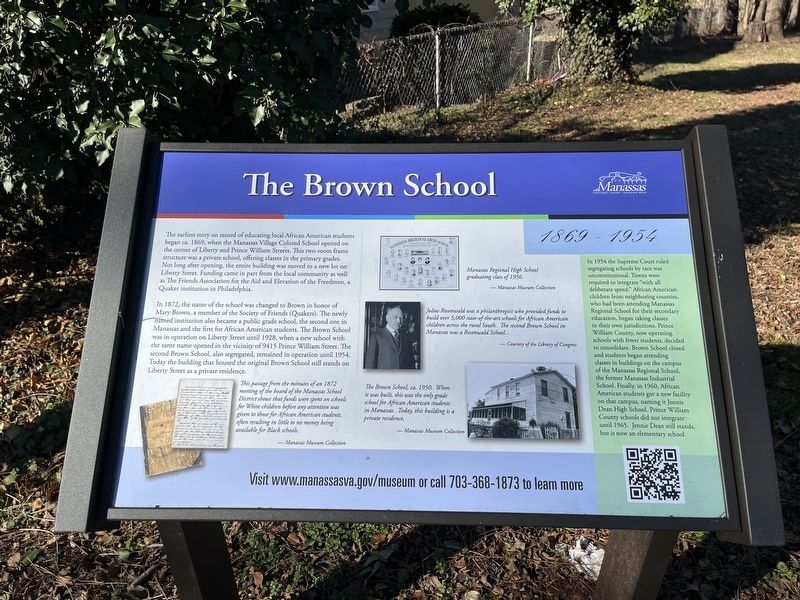
The earliest story on record of educating local African American students began ca. 1869, when the Manassas Village Colored School opened on the corner of Liberty and Prince William Streets. This two-room frame structure was a private school, offering classes in the primary grades. Not long after opening, the entire building was moved to a new lot on Liberty Street. Funding came in part from the local community as well as The Friends Association for the Aid and Elevation of the Freedmen, a Quaker institution in Philadelphia.
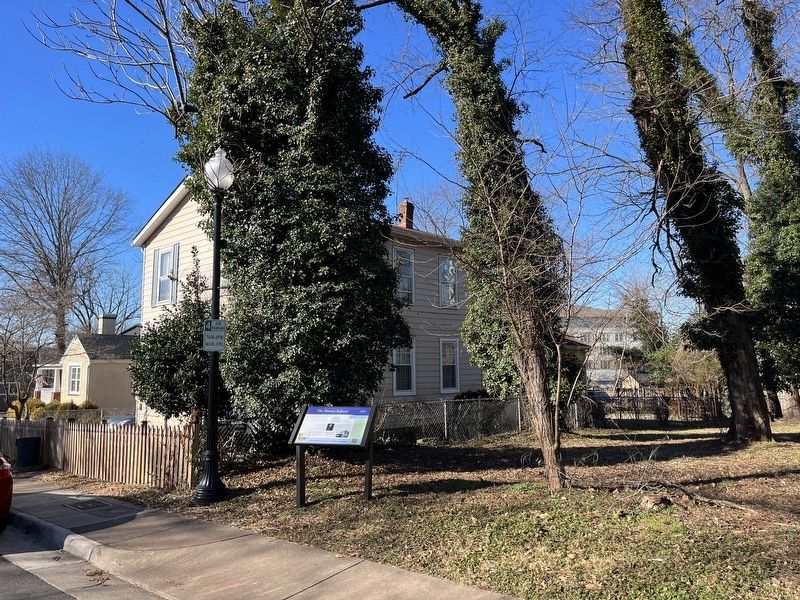
In 1872, the name of the school was changed to Brown in honor of Mary Brown, a member of the Society of Friends (Quakers). The newly named institution also became a public grade school, the second one in Manassas and the first for African American students. The Brown School was in operation on Liberty Street until 1928, when a new school with the same name opened in the vicinity of 9415 Prince William Street. The second Brown School, also segregated, remained in operation until 1954. Today the building that housed the original Brown School still stands on Liberty Street as a private residence.
[Sidebar:]
In
this page online
[Captions:]
This passage from the minutes of an 1872 meeting of the board of the Manassas School District shows that funds were spent on schools for White children before any attention was given to those for African American students, often resulting in no money being available for Black schools.
Manassas Regional High School graduating class of 1956.
Julius Rosenwald was a philanthropist who provided funds to build over 5,000 state-of-the-art schools for African American children across the rural South. The second Brown School in Manassas was a Rosenwald School.
,br> The Brown School, ca. 1950. When it was built, this was the only grade school for African American students in Manassas. Today, this building is a private residence.
Erected by City
Topics and series. This historical marker is listed in these topic lists: African Americans • Civil Rights • Education. In addition, it is included in the Quakerism, the Rosenwald Schools, and the Virginia, City of Manassas series lists. A significant historical year for this entry is 1869.
Location. This marker has been replaced by another marker nearby. It was located near 38° 44.921′ N, 77° 28.401′ W. Marker was in Manassas, Virginia. It was on Liberty Street north of Grant Avenue (Virginia Route 234), on the right when traveling north. Touch for map. Marker was at or near this postal address: 9504 Liberty St, Manassas VA 20110, United States of America. Touch for directions.

Regionally, this marker was in the Washington Metropolitan Area and in Northern Virginia. It was also in the American South, specifically in the Upper South, and in the Mid-Atlantic. Globally, it was in North America, the Western Hemisphere, the Western World, and the Anglosphere. Historically, it found itself in what was once the territory of the Mississippian Culture, one of the original Thirteen Colonies, one of the Confederate States of America, and the Antebellum South.
Other nearby markers. At least 8 other markers are within walking distance of this location: A different marker also named The Brown School (a few steps from this marker); Liberty Street / First African-American School (within shouting distance of this marker); Occupation or Liberation (about 400 feet away, measured in a direct line); The Museum Garden (about 500 feet away); Manassas (about 500 feet away); Jackson's Raid (about 500 feet away); a different marker also named War on the Landscape (about 500 feet away); a different marker also named Wartime Manassas (about 500 feet away). Touch for a list and map of all markers in Manassas.
Other markers no longer nearby. War on the Landscape (was about 500 feet away but has been replaced with another marker now near it); The Manassas Museum (was about 500 feet away but has been replaced with another marker now near it); Wartime Manassas (was about 500 feet away but has been replaced with another marker now near it); a different marker also named Manassas (was about 500 feet away but has been replaced with another marker now near it).
Related marker. Click here for another marker that is related to this marker. This marker has been replaced with the linked marker. There are minor differences in the inscriptions.
Credits. This page was last revised on July 12, 2026. It was originally submitted on January 17, 2023, by Devry Becker Jones of Washington, District of Columbia. This page has been viewed 947 times since then and 95 times this year. Photos: 1, 2. submitted on January 17, 2023, by Devry Becker Jones of Washington, District of Columbia.
