Leesburg in Loudoun County, Virginia — The American South (Mid-Atlantic)
The W&OD Railway and Jim Crow Laws
Photographed by Devry Becker Jones (CC0), January 21, 2023
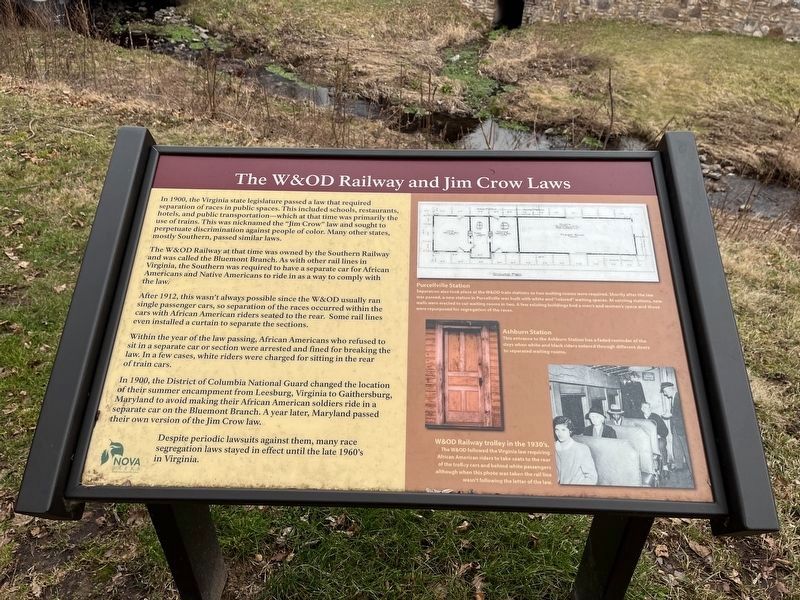
1. The W&OD Railway and Jim Crow Laws Marker
In 1900, the Virginia state legislature passed a law that required separation of races in public spaces. This included schools, restaurants, hotels and public transportation—which at that time was primarily the use of trains. This was nicknamed the "Jim Crow" law and sought to perpetuate discrimination against people of color. Many other states, mostly Southern, passed similar laws.
The W&OD Railway at that time was owned by the Southern Railway and was called the Bluemont Branch. As with other rail lines in Virginia, the Southern was required to have a separate car for African Americans and Native Americans to ride in as a way to comply with the law.
After 1912, this wasn't always possible since the W&OD usually ran single passenger cars, so separation of the races occurred within the cars with African American riders seated to the rear. Some rail lines even installed a curtain to separate the sections.
Within the year of the law passing, African Americans who refused to sit in a separate car or section were arrested and fined for breaking the law. In a few cases, white riders were charged for sitting in the
this page online
In 1900, the District of Columbia National Guard changed the location of their summer encampment from Leesburg, Virginia to Gaithersburg, Maryland to avoid making their African American soldiers ride in a separate car on the Bluemont Branch. A year later, Maryland passed their own version of the Jim Crow law.
Despite periodic lawsuits against them, many race segregation laws stayed in effect until the late 1960's in Virginia.
[Sidebar:]
Purcellville Station
Separation also took place at the W&OD train stations so two waiting rooms were required. Shortly after the law was passed, a new station in Purcellville was built with white and "colored" waiting spaces. At existing stations, new walls were erected to cut waiting rooms in two. A few existing buildings had a men's and women's space and those were repurposed for segregation of the races.
Ashburn Station
This entrance to the Ashburn Station has a faded reminder of the days when white and black riders entered through different doors to separated waiting rooms.
W&OD Railway trolley in the 1930's.
The W&OD followed the Virginia law requiring African American riders to take seats to the rear of the trolley cars and behind white passengers although when this photo was taken the rail line wasn't following the letter of the law.
Erected by NOVA
Photographed by Devry Becker Jones (CC0), January 21, 2023
2. The W&OD Railway and Jim Crow Laws Marker
Topics and series. This historical marker is listed in these topic lists: African Americans • Civil Rights • Military • Railroads & Streetcars. In addition, it is included in the NOVA Parks, and the Washington and Old Dominion (W&OD) Railroad series lists. A significant historical year for this entry is 1900.
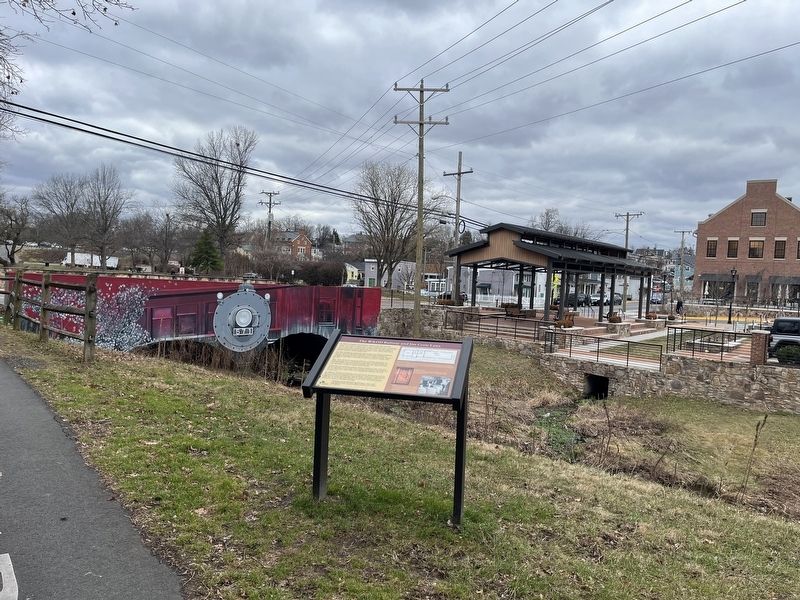
Location. 39° 6.713′ N, 77° 33.949′ W. Marker is in Leesburg, Virginia, in Loudoun County. It is on Washington and Old Dominion Trail just east of King Street (Business U.S. 15), on the right when traveling west. Touch for map. Marker is at or near this postal address: 302 S King St, Leesburg VA 20175, United States of America. Touch for directions.

Regionally, this marker is in the Washington Metropolitan Area and in Northern Virginia. It is also in the American South, specifically in the Upper South, and in the Mid-Atlantic. Globally, it is in North America, the Western Hemisphere, the Western World, and the Anglosphere. Historically, it finds itself in what was once the territory of the Mississippian Culture, one of the original Thirteen Colonies, one of the Confederate States of America, and the Antebellum South.
Other nearby markers. At least 8 other markers are within walking distance of this marker: Leesburg Passenger Station (within shouting distance of this marker); Georgetown Park (within shouting distance of this marker); The Tolbert Building (about 600 feet away, measured in a direct line); Norman-Harding Barn (about 700 feet away); The Orion Anderson Story (about 700 feet away); Log House (about 700 feet away); Leesburg Freight Station (about 800 feet away); Dairy Barn (about 800 feet away). Touch for a list and map of all markers in Leesburg.
Credits. This page was last revised on January 21, 2023. It was originally submitted on January 21, 2023, by Devry Becker Jones of Washington, District of Columbia. This page has been viewed 295 times since then and 32 times this year. Photos: 1, 2. submitted on January 21, 2023, by Devry Becker Jones of Washington, District of Columbia.
