Cortes in Madrid, Spain — Southwestern Europe (Iberian Peninsula)
Miguel Cervantes Saavedra
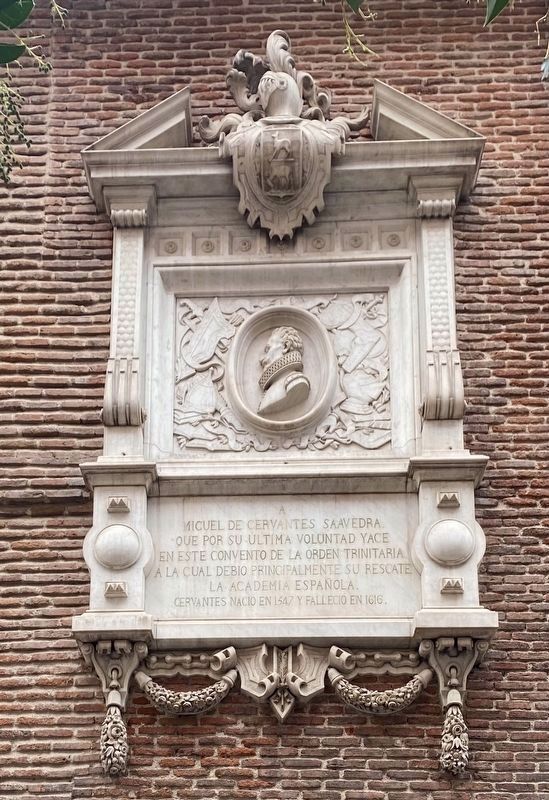
Photographed by Andrew Ruppenstein, November 8, 2022
1. Miguel Cervantes Saavedra Marker

A Miguel de Cervantes Saavedra que por su ultima voluntad yace en este Convento de la Orden Trinitaria a la cual debio principalmente su rescate
Cervantes nacio en 1547 y fallecio en 1616.
In honor of Miguel de Cervantes Saavedra who by his last will lies in this Convent of the Trinitarian Order to which he mainly owed his rescue. Cervantes was born in 1547 and died in 1616.
Erected by La Academia Española.
Topics. This historical marker is listed in these topic lists: Arts, Letters, Music • Cemeteries & Burial Sites • Entertainment. A significant historical date for this entry is April 22, 1616.
Location. 40° 24.82′ N, 3° 41.838′ W. Marker is in Madrid. It is in Cortes. It is on Calle de Lope de Vega west of Calle de San Agustín, on the right when traveling east. Touch for map. Marker is in this post office area: Madrid 28014, Spain. Touch for directions.

Regionally, it is in the North Atlantic Region, in Europe, in the European Union, in Atlantic Europe, on the Iberian Peninsula, in the Schengen Area, in a coastal Mediterranean country, and in the Western World. Historically, it finds itself in what was once the Roman Empire.
Other nearby markers. At least 8 other markers are within walking distance of this marker: Sor Marcela de San Félix (within shouting distance of this marker); Don Francisco de Quevedo Villegas (within shouting distance of this marker); José Echegaray (within shouting distance of this marker); Félix Lope de Vega (Madrid, 1562 - 1635) (within shouting distance of this marker); Ricardo Becerro de Bengoa (within shouting distance of this marker); Francisco de Quevedo y Villegas (within shouting distance of this marker); Elena Fortún (within shouting distance of this marker); Luisa Carnés (within shouting distance of this marker).
this page online
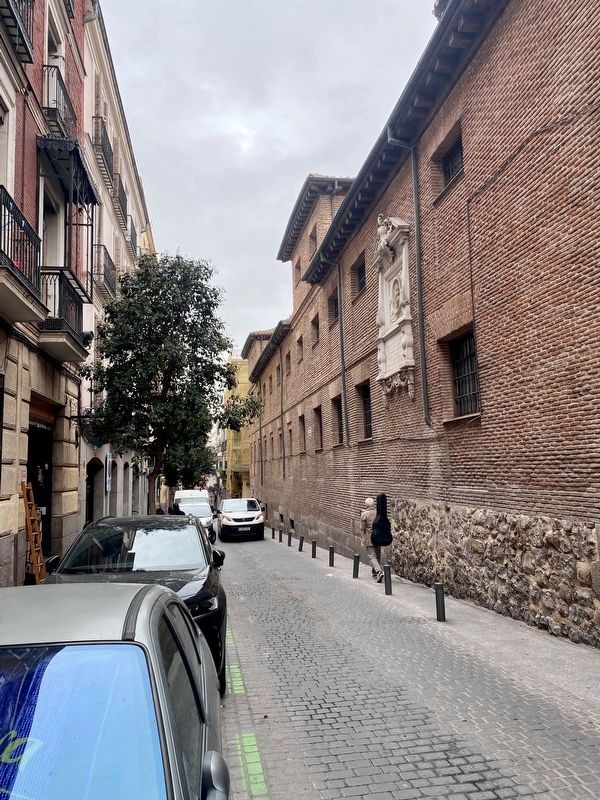
More about this marker. The marker is located on the north side of the Convent of the Barefoot Trinitarians.
Also see . . .
1. Miguel de Cervantes (Wikipedia).
Overview: Miguel de Cervantes Saavedra (29 September 1547 (assumed) – 22 April 1616 NS) was an Early Modern Spanish writer widely regarded as the greatest writer in the Spanish language and one of the world's pre-eminent novelists. He is best known for his novel Don Quixote, a work often cited as both the first modern novel and "the first great novel of world literature". A 2002 poll of around 100 well-known authors voted it the "most meaningful book of all time", from among the "best and most central works in world literature".(Submitted on January 22, 2023.)
Much of his life was spent in poverty and obscurity, which led to many of his early works being lost. Despite this, his influence and literary contribution are reflected by the fact that Spanish is often referred to as "the language of Cervantes".
2. Convent of the Barefoot Trinitarians (Wikipedia).
On Cervantes’ remains: Writer Miguel(Submitted on January 22, 2023.)de Cervantes was buried at the convent in 1616. His remains were temporarily transferred elsewhere in 1673 during rebuilding, and were then lost until forensic scientists discovered them in 2015.Photographed by Andrew Ruppenstein, November 8, 20222. Miguel Cervantes Saavedra Marker - wide view, looking east on Calle de Lope de Vega
3. The Reason Cervantes Asked To Be Buried Under A Convent (NPR).
On why Cervantes wanted to be buried at the convent: It was Miguel de Cervantes' dying wish to be buried inside the walls of Madrid's Convento de las Trinitarias Descalzas - the Convent of the Barefoot Trinitarians — where a dozen cloistered nuns still live today, nearly 400 years later. Cervantes, born in 1547, is the most famous writer in the Spanish language. But the world would never have read his literature if it weren't for the Trinitarian nuns. Cervantes believed he owed his life to them.(Submitted on January 22, 2023.)
What the Convent did for him after his capture by Algerian pirates: …And it was only then that he got kidnapped by Algerian pirates. "He was taken prisoner. He spent five years — five terrible years — as a slave, as a captive," says historian Fernando del Prado, who has devoted his life to studying Cervantes…. With Cervantes enslaved in Africa, his family appealed to the Trinitarian nuns. They managed to raise a ransom and deliver it to the pirates — which won Cervantes his freedom.
Credits. This page was last revised on February 2, 2023. It was originally submitted on January 22, 2023, by Andrew Ruppenstein of Lamorinda, California. This page has been viewed 378 times since then and 91 times this year. Photos: 1, 2. submitted on January 22, 2023, by Andrew Ruppenstein of Lamorinda, California.
