Near Hope in Vinton County, Ohio — The American Midwest (Great Lakes)
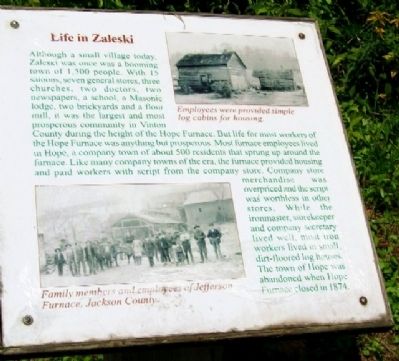
Life in Zaleski
Photographed by William Fischer, Jr., August 15, 2009
1. Life in Zaleski Marker
Although a small village today, Zaleski was once was a booming town of 1,500 people. With 15 saloons, seven general stores, three churches, two doctors, two newspapers, a school, a Masonic lodge, two brickyards and a flour mill, it was the largest and most prosperous community in Vinton County during the height of the Hope Furnace. But life for most workers of the Hope Furnace was anything but prosperous. Most furnace employees lived in Hope, a company town of about 500 residents that sprung up around the furnace. Like many company towns of the era, the furnace provided housing and paid workers with script from the company store. Company store merchandise was overpriced and the script was worthless in other stores. While the ironmaster, storekeeper and company secretary lived well, most iron workers lived in small, dirt-floored log houses. The town of Hope was abandoned when Hope Furnace closed in 1874.
Erected 2005 by Make A Difference Day Ohio and Others.
Topics. This historical marker is listed in these topic lists: Industry & Commerce • Man-Made Features • Natural Resources • Settlements & Settlers. A significant historical year for this entry is 1874.
Location. Marker
this page online
We have been informed that this marker is no longer there and will not be replaced. This page is an archival view of what was.
Regionally, this marker was in the Hocking Hills and in Southern Ohio Hill Country. It was also in the American Midwest, in Appalachia, and specifically in Northern Appalachia. Globally, it was in North America, the Western Hemisphere, the Western World, and the Anglosphere. Historically, it found itself in what was once the Haudenosaunee (Iroquois) Confederacy, the territory of the Mississippian Culture, and the Northwest Territory.

Other nearby markers. At least 8 other markers are within 2 miles
Photographed by William Fischer, Jr., August 15, 2009
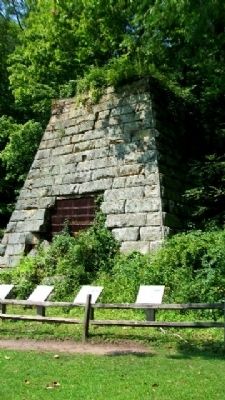
2. Life in Zaleski Marker
Hope Furnace in background.
Other markers no longer nearby. The Hanging Rock Blast Furnace (was here, next to this marker but has been permanently removed); From Forest to Furnace (was here, next to this marker but has been permanently removed); The Furnace Legacy (was here, next to this marker but has been permanently removed); The Hanging Rock Iron Region (was here, next to this marker but has been permanently removed); Hope Furnace Ruins (was a few steps from this marker but has been confirmed missing).
Photographed by William Fischer, Jr., August 15, 2009
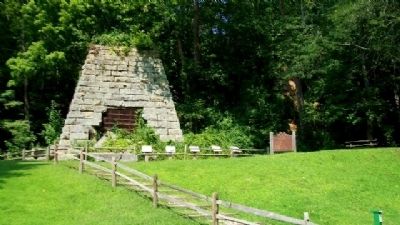
3. Life in Zaleski Marker
Hope Furnace in background.
Credits. This page was last revised on June 1, 2024. It was originally submitted on January 16, 2010, by William Fischer, Jr. of Reynoldsburg, Ohio. This page has been viewed 2,081 times since then and 121 times this year. Last updated on January 22, 2023, by Craig Doda of Napoleon, Ohio. Photos: 1, 2, 3. submitted on January 16, 2010, by William Fischer, Jr. of Reynoldsburg, Ohio. • Devry Becker Jones was the editor who published this page.
