Near La Fontaine in Wabash County, Indiana — The American Midwest (Great Lakes)
Miami Indian Memorial
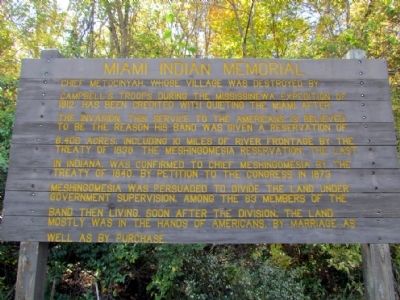
Photographed by Duane Hall, October 8, 2011
1. Miami Indian Memorial Marker
Chief Metocinyah, whose village was destroyed by Campbell's troops during the Mississinewa Expedition of 1812, has been credited with quieting the Miami after the invasion. This service to the Americans is believed to be the reason his band was given a reservation of 6,400 acres, including 10 miles of river frontage by the Treaty of 1838. The Meshingomesia Reservation, the last in Indiana, was confirmed to Chief Meshingomesia by the Treaty of 1840. By petition to the Congress in 1873 Meshingomesia was persuaded to divide the land under government supervision, among the 63 members of the band then living. Soon after the division, the land mostly was in the hand of Americans, by marriage as well as by purchase.
Topics. This historical marker and memorial is listed in these topic lists: Indigenous Peoples and Communities • War of 1812. A significant historical year for this entry is 1812.
Location. 40° 39.397′ N, 85° 44.999′ W. Marker is near La Fontaine, Indiana, in Wabash County. It is on S. Bruner Road (County Road E1100 S) 1.9 miles west of County Road S 350 E, on the left when traveling north. Touch for map. Marker
this page online

Regionally, this marker and memorial is in Northern Indiana. It is also in the American Midwest and in the Corn Belt. Globally, it is in North America, the Western Hemisphere, the Western World, and the Anglosphere. Historically, it finds itself in what was once the territory of the Mississippian Culture and also the Northwest Territory.
Other nearby markers. At least 8 other markers are within 2 miles of this marker, measured as the crow flies: Metocinyah's Village (approx. 0.2 miles away); Chief Meshingomesia (approx. 1½ miles away); Miami Indian Cemetery (approx. 1½ miles away); La Fontaine Veterans Memorial (approx. 1.7 miles away); a different marker also named La Fontaine Veterans Memorial (approx. 1.9 miles away); Mississinewa Battlefield (approx. 2 miles away); Here on December 17-18, 1812 (approx. 2 miles away); Conner's Mill (approx. 2.1 miles away). Touch for a list and map of all markers in La Fontaine.
Additional commentary.
1. Memory of Indian School
My great-grandfather Ivan Loer was born in 1895 and raised
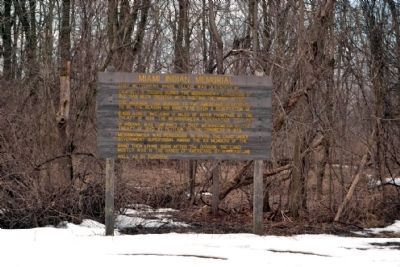
Photographed by Duane Hall, March 18, 2014
2. Miami Indian Memorial Marker
Once in a while we would visit the Indian school, about two miles away at the Indian Village. The Indians children were really smart and could usually beat us in spelling and ciphering. There was not much left of the Indian Village, only a school, a church, and the graveyard. The Indians lived on their farms in the surrounding country. Homer and Guy Hummel told me that the Indians used to have powwows. They sneaked up on them one time to see what was going on, but suddenly there was an Indian standing right over them. They broke and ran home as fast as they could.These Indians were of the Miami Tribe, and nearby the village was fought one the last Indians battles.
— Submitted July 14, 2025, by Katherine Newman of Roseburg, Oregon.
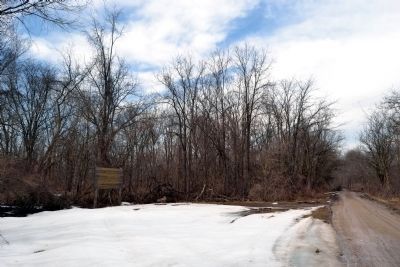
Photographed by Duane Hall, March 18, 2014
3. Miami Indian Memorial Marker
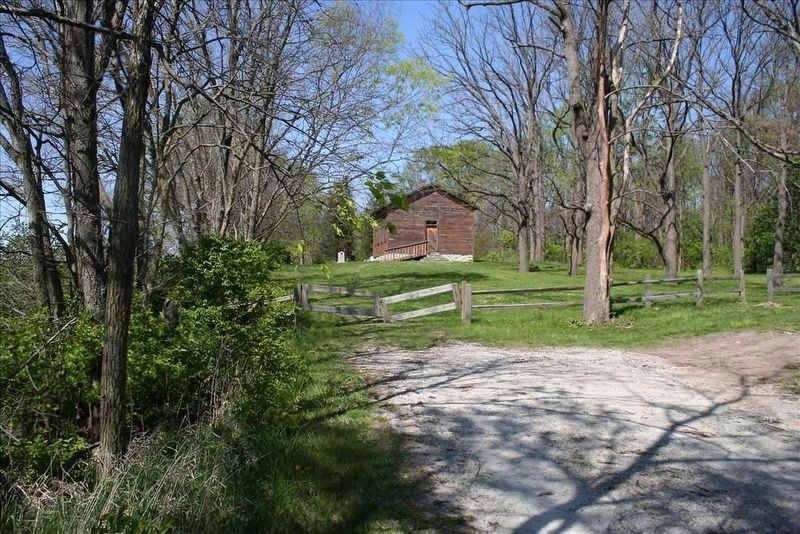
via NPS
4. Meshingomesia (Mihsiinkweemisa) Cemetery and Indian School Historic District
NPGallery: Digital Asset Management System website entry
Click for more information.
Click for more information.
Credits. This page was last revised on July 23, 2025. It was originally submitted on January 16, 2014, by Duane Hall of Abilene, Texas. This page has been viewed 1,545 times since then and 95 times this year. Last updated on January 29, 2023, by Craig Doda of Napoleon, Ohio. Photos: 1. submitted on January 16, 2014, by Duane Hall of Abilene, Texas. 2, 3. submitted on March 18, 2014, by Duane Hall of Abilene, Texas. 4. submitted on November 29, 2021, by Larry Gertner of New York, New York. • J. Makali Bruton was the editor who published this page.
