Sorbonne in Paris in Département de Paris, Île-de-France, France — Western Europe
Claude Bernard
Photographed by Andrew Ruppenstein, July 27, 2022
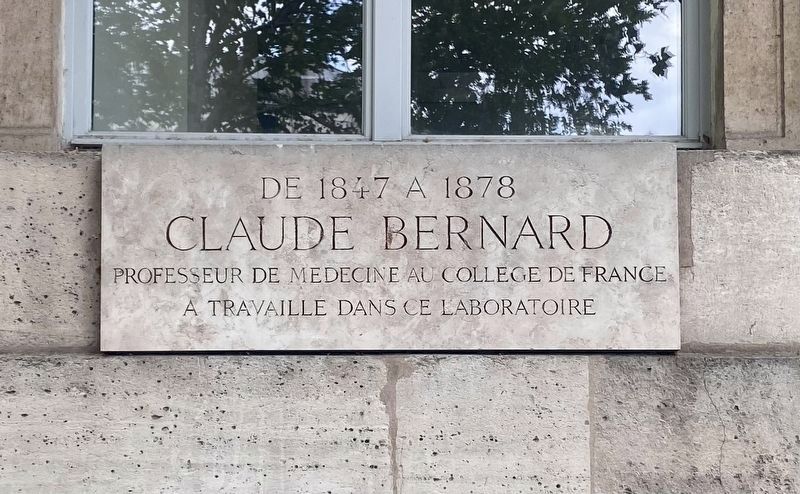
1. Claude Bernard Marker

De 1847 a 1878
Claude Bernard
Professeur de Medecine au College de France
a travaille dans ce laboratoire
From 1847 to 1878 Claude Bernard, Professor of Medicine at the College de France, worked at this laboratory.
Topics. This historical marker is listed in these topic lists: Education • Science & Medicine. A significant historical year for this entry is 1847.
Location. 48° 50.955′ N, 2° 20.693′ E. Marker is in Paris, Île-de-France, in Département de Paris. It is in Sorbonne. It is at the intersection of Rue Saint-Jacques and Place Martelin Berthelot, on the left when traveling south on Rue Saint-Jacques. Touch for map. Marker is at or near this postal address: 79 Rue Saint-Jacques, Paris, Île-de-France 75005, France. Touch for directions.

Regionally, it is in the North Atlantic Region, Europe, the European Union, Atlantic Europe, the Schengen Area, Western Europe, a coastal Mediterranean country, and the Western World. Historically, it finds itself in what was once a French colony and also the Roman Empire.
Other nearby markers. At least 8 other markers are within walking distance of this marker: Le Collège de France (within shouting distance of this marker); Jean Dausset (about 90 meters away, measured in a direct line); Square Samuel Paty (1900) (about 120 meters away); Georges Guerin
this page online
Also see . . . Claude Bernard (Britannica).
Overview: Claude Bernard, (born July 12, 1813, Saint-Julien, France—died Feb. 10, 1878, Paris), French physiologist known chiefly for his discoveries concerning the role of the pancreas in digestion, the glycogenic function of the liver, and the regulation of the blood supply by the vasomotor nerves. On a broader stage, Bernard played a role in establishing the principles of experimentation in the life sciences, advancing beyond the vitalism and indeterminism of earlier physiologists to become one of the founders of experimental medicine. His most seminal contribution was his concept of the internal environment of the organism, which led to the present understanding of homeostasis—i.e., the self-regulation of vital processes.(Submitted on January 30, 2023.)
Photographed by Andrew Ruppenstein, July 27, 2022
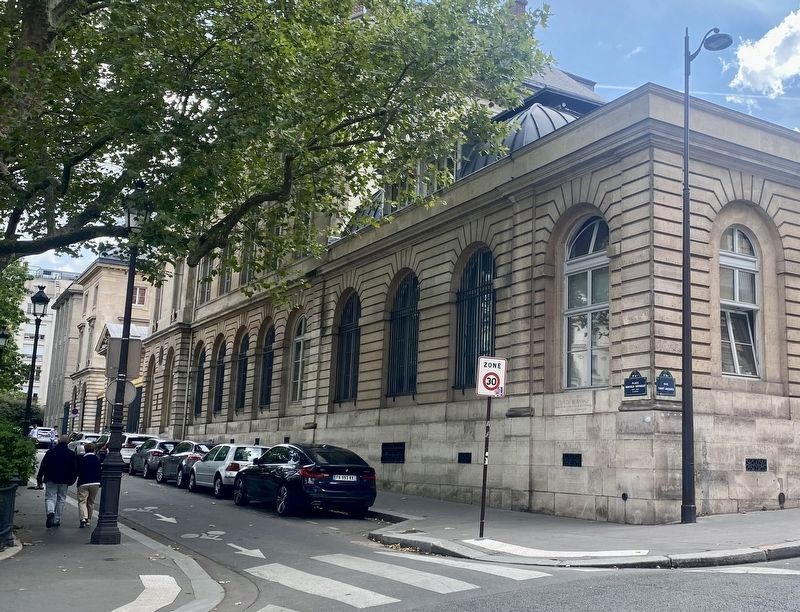
2. Claude Bernard Marker - wide view
The marker is visible here just below the window on the corner of the building.

Photographed by Andrew Ruppenstein, July 27, 2022
3. Claude Bernard statue (within shouting distance of the marker)
Courtesy of Wikimedia Commons
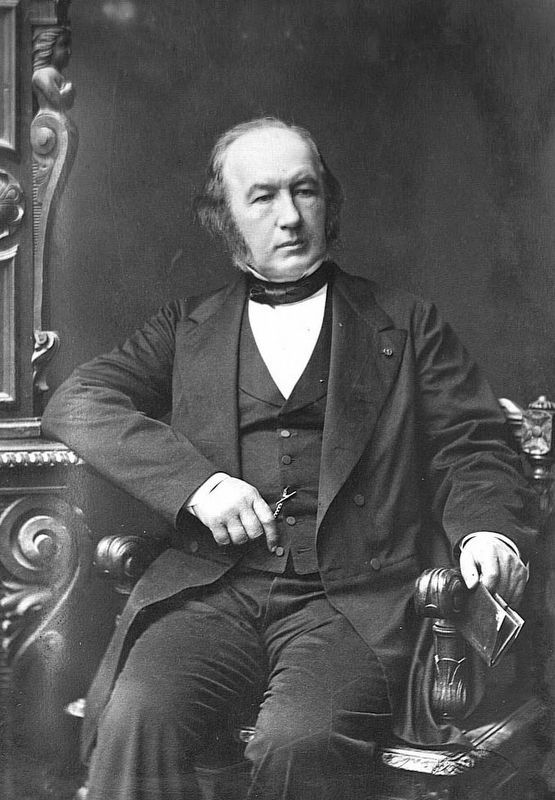
4. Claude Bernard
Credits. This page was last revised on January 30, 2023. It was originally submitted on January 30, 2023, by Andrew Ruppenstein of Lamorinda, California. This page has been viewed 128 times since then and 12 times this year. Photos: 1, 2, 3, 4. submitted on January 30, 2023, by Andrew Ruppenstein of Lamorinda, California.
