Coloma in El Dorado County, California — The American West (Pacific Coastal)
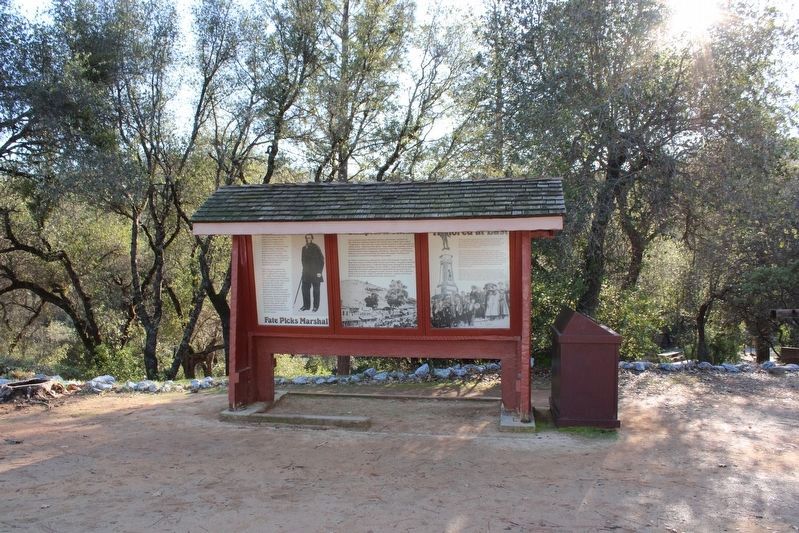
Fate Picks Marshall

Photographed by Joseph Alvarado, January 21, 2023
1. Fate Picks Marshall Marker
New Jersey-born James Wilson Marshall came to John Sutter’s fort at Sacramento in July 1845, just a year before the American conquest of California. Trained as a carpenter and wheelwright by his father, Marshall quickly found work at the Swiss pioneer’s busy settlement. Following the U.S. takeover, Marshall and Sutter became partners in building the famous sawmill at Coloma.
For just a few moments after finding gold in the mill’s tailrace on January 24, 1848, Marshall kept his exciting secret. But the urge to share the discovery proved too much, and he soon shouted the new to the Mormon workers building the mill. Marshall’s words echoed across the Pacific to Hawaii and China, down to Mexico and South America, and to all parts of the United States. The gold rush, brining thousands of restless young men, was on. California would never be the same.
Panel Two:
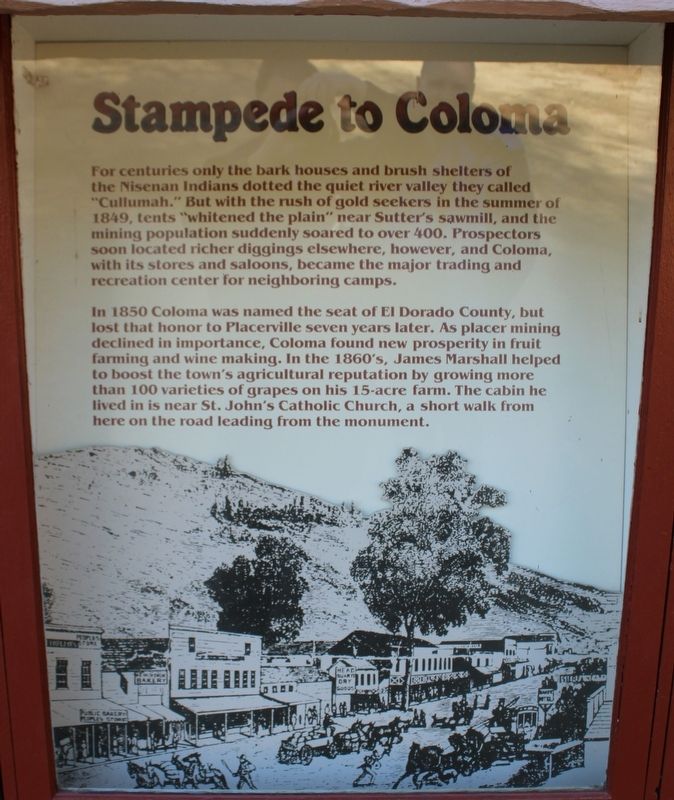
Stampede to Coloma
For centuries only the bark houses and brush shelters of the Nisenan Indians dotted the quiet river valley they called “Cullumah.” But with the rush of gold seekers in the summer of 1849, tents “whitened the plain” near Sutter’s sawmill,
this page online
In 1850 Coloma was named the seat of El Dorado County, but lost that honor to Placerville seven years later. As placer mining declined in importance, Coloma found new prosperity in fruit farming and wine making. In the 1860’s, James Marshall helped to boost the town’s agricultural reputation by growing more then 100 varieties of grapes on his 15-acre farm. The cabin he lived in is near St. John’s Catholic Church, a short walk from here on the road leading from the monument.
Panel Three:
Honored at Last
Never a good businessman, James Marshall failed to profit from the many opportunities the gold rush offered. He ended his days as a carpenter and blacksmith in Kelsey, unrecognized officially for his unique role in history.
After Marshall’s death in 1885, local and state figures made plans to honor that role. Originating with the Placerville Parlor of Native Sons, the idea of a monument was suggested to the
Photographed by Joseph Alvarado, January 21, 2023
2. Stampede to Coloma Marker
Panel Four
California’s Mother Lode
Map of the area on an animal hide
Panel Five:
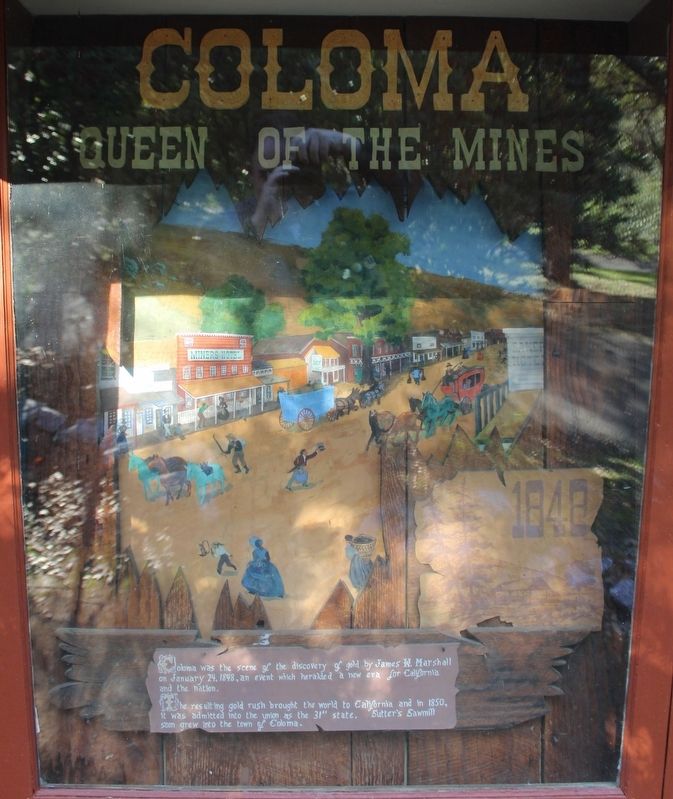
Coloma – Queen of the Mines
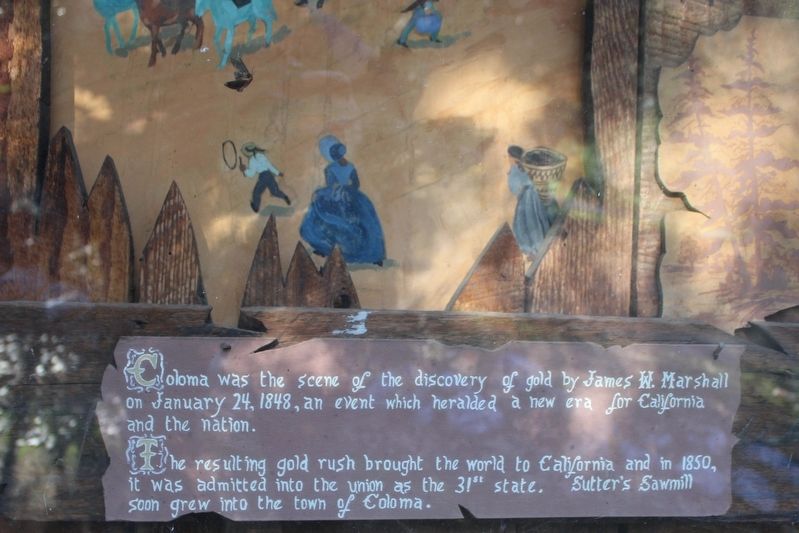
Coloma was the scene of the discovery of gold by James W. Marshall on January 24, 1848, and event which heralded a new era for California and the nation.
The resulting gold rush brought the world to California and in 1850, it was admitted into the union as the 31st state. Sutter’s Sawmill soon grew into the town of Coloma.
Panel Six:
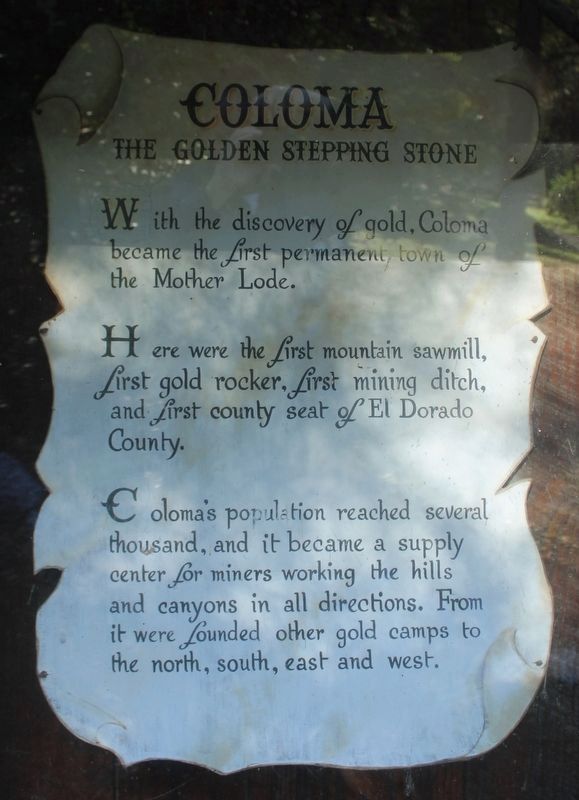
Coloma - The Golden Stepping Stone
With the discovery of gold, Coloma became the first permanent town of the Mother Lode.
Here were the first mountain sawmill, first gold rocker, first mining ditch, and first county seat of El Dorado County.
Coloma’s population reached several thousand, and it became a supply center for miners working the hills and canyons in all directions. From it were founded other gold camps to the north, south, east and

Photographed by Joseph Alvarado, January 21, 2023
3. Honored at Last Marker
Topics. This historical marker is listed in these topic lists: Exploration • Immigration • Industry & Commerce • Settlements & Settlers. A significant historical date for this entry is January 24, 1848.
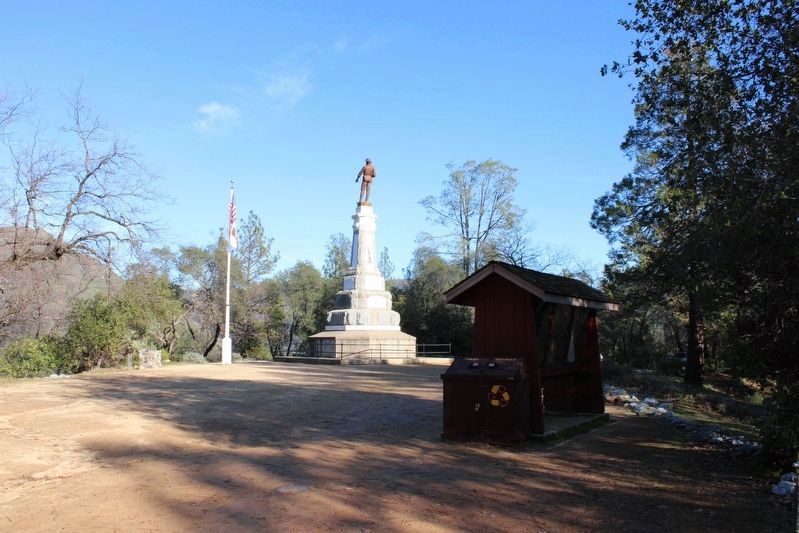
Location. 38° 47.798′ N, 120° 53.669′ W. Marker is in Coloma, California, in El Dorado County. It is at the intersection of Monument Road (California Route 153) and Marshall Park Way on Monument Road. The markers are in an enclosed kiosk at the James Marshall Monument site. Touch for map. Marker is at or near this postal address: 220 Monument Road, Coloma CA 95613, United States of America. Touch for directions.

Regionally, it is in North America, on the Ring of Fire, on the Pacific Rim, in the Western Hemisphere, in the Western World, and in the Anglosphere. Historically, it finds itself in what was once New Spain and also Mexico’s Alta California.
Other nearby markers. At least 8 other markers are within walking distance of this marker: 200th Anniversary of James W. Marshall's Birth (a few steps from this marker); James W. Marshall (within shouting distance of this marker); Marshall's Cabin (about 400 feet away, measured

Photographed by Joseph Alvarado, January 21, 2023
4. California's Mother Lode Map
Related marker. Click here for another marker that is related to this marker. James W. Marshall Monument erected by the Native Sons of the Golden West
Photographed by Joseph Alvarado, January 21, 2023
5. Coloma - Queen of the Mines Marker
Photographed by Joseph Alvarado, January 21, 2023
6. Coloma - Queen of the Mines Marker
Photographed by Joseph Alvarado, January 21, 2023
7. Coloma - The Golden Stepping Stone Marker
Photographed by Joseph Alvarado, January 21, 2023
8. Fate Picks Marshall Marker
Photographed by Joseph Alvarado, January 21, 2023
9. Fate Picks Marshall Marker

Photographed by Joseph Alvarado, January 21, 2023
10. Rear of James W. Marshall Monument

Photographed by Joseph Alvarado, January 21, 2023
11. Front of James W. Marshall Monument
Credits. This page was last revised on February 4, 2023. It was originally submitted on February 3, 2023, by Joseph Alvarado of Livermore, California. This page has been viewed 254 times since then and 28 times this year. Photos: 1. submitted on February 3, 2023, by Joseph Alvarado of Livermore, California. 2, 3, 4, 5, 6, 7, 8, 9, 10, 11. submitted on February 4, 2023, by Joseph Alvarado of Livermore, California.
