South Boston Waterfront in Suffolk County, Massachusetts — The American Northeast (New England)
Fan Pier.
1900 - 2000
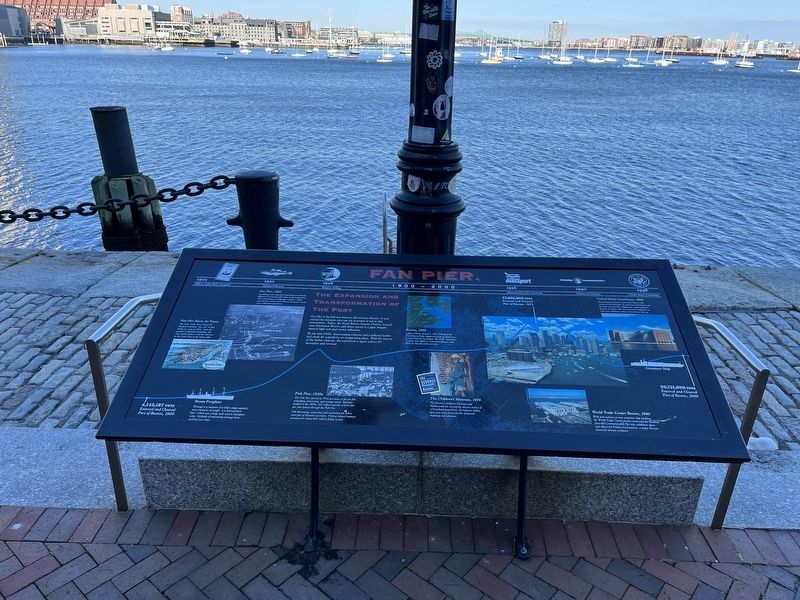
The Expansion and Transformation of the Port
Fan Pier is the fulcrum between old and new Boston. It was created by investors who saw the potential of rail to ship connections. Today, the South Boston Seaport District, located near downtown Boston with direct access to Logan Airport attracts high-tech and service industries.
By the mid-1900s, deteriorating wharves and a polluted harbor had made the waterfront and unappealing place. With the success of the harbor cleanup, the waterfront is again a place for recreation and renewal.
[Captions:]
Fan Pier, 1925
Landfill greatly expanded South Boston with the filling of Commonwealth Flats in the foreground. The combination of shipping, wharves, docks, and rail lines made South Boston the center of the city's industrial waterfront.
Fan Pier Earns Its Name
The New York, New Haven & Hartford rail lines "fan out" in this bird's eye view of 1903. Note the growth of industrial buildigns, the new South Station, and the wharves in the South Bay at the upper right.
Steam Freighter
Tonnage is a measure of a ship's cargo capacity, not a measure of weight. It is derived from "tun", which a large cask used to transport wine. Methods of measuring tonnage have evolved over time.
Fish Pier, 1930s
The Fish Pier opened in 1914 as a state of the art fish unloading, processing, and storage center. Business peaked in the 1930s; 300 million pounds of fresh fish per year passed through the Fish Pier.
Fish harvesting, processing and marketing are still a vital part of Boston's economy. Fishing-related business accounts for about 600 million dollars a year.
Boston, 1950
Logan Airport opened in 1923. Filling of the East Boston Flats, begun as a port development, created land for the airport. By 1950, hundreds of acres were filled in, with more filling to take place by the end of the century.
The Children's Museum, 1979
The Boston Children's Museum and Harborwalk are among the success stories of a revitalized waterfront. As industry faded, new uses were found for the industrial buildigns and wharves.
World Trade Center Boston, 1990
With port activity at new container ship facilities, the World Trade Center project converted the hundred-year-old Commonwealth Pier into exhibition space and offices for Fidelity Investments, a major Boston financial services company.
United States Courthouse, 1998
Massachusetts federal courts have been a rich source of the principles of American Maritime Law. Its huge rotunda like a lighthouse, representing a beacon of justice, the new federal Courthouse on Fan Pier emphasizes that connection to the sea.
4,145,187 tons
this page online
27,056,868 tons entered and cleared Port of Boston, 1973.
20,751,000 tons entered and cleared Port of Boston, 2000.
[Timeline:]
1905: Gillette Safety Razor Company
1930: Fishing industries
1936: Eastern Airlines
1956: Massachusetts Port Authority
1990: Fidelity Investments
1998: United States Courthouse
Topics. This historical marker is listed in these topic lists: Air & Space • Government & Politics • Industry & Commerce • Waterways & Vessels. A significant historical year for this entry is 1925.
Location. 42° 21.307′ N, 71° 2.764′ W. Marker is in Boston, Massachusetts, in Suffolk County. It is in South Boston Waterfront. It is on Harborwalk west of Courthouse Way, on the left when traveling east. Touch for map. Marker is at or near this postal address: 1 Courthouse Way, Boston MA 02210, United States of America. Touch for directions.

Regionally, this marker is in Massachusetts’ Historic Boston. It is also in the American Northeast, in New England, and on the Eastern Seaboard. Globally, it is in the North Atlantic Region, North America, the Western Hemisphere,
Other nearby markers. At least 8 other markers are within walking distance of this marker: The Way to a Cleaner Harbor (a few steps from this marker); a different marker also named Fan Pier. (within shouting distance of this marker); a different marker also named Fan Pier. (about 400 feet away, measured in a direct line); Boston Harbor Islands (about 600 feet away); Transformed Tidal Flats (approx. 0.2 miles away); Captain John Foster Williams (approx. ¼ mile away); Anthony's Pier 4: Boston Icon (approx. ¼ mile away); Four Point Channel (approx. 0.3 miles away). Touch for a list and map of all markers in Boston.
Credits. This page was last revised on February 4, 2023. It was originally submitted on February 4, 2023, by Devry Becker Jones of Washington, District of Columbia. This page has been viewed 463 times since then and 65 times this year. Photos: 1, 2. submitted on February 4, 2023, by Devry Becker Jones of Washington, District of Columbia.
