Government Center in Boston in Suffolk County, Massachusetts — The American Northeast (New England)
The New England Holocaust Memorial
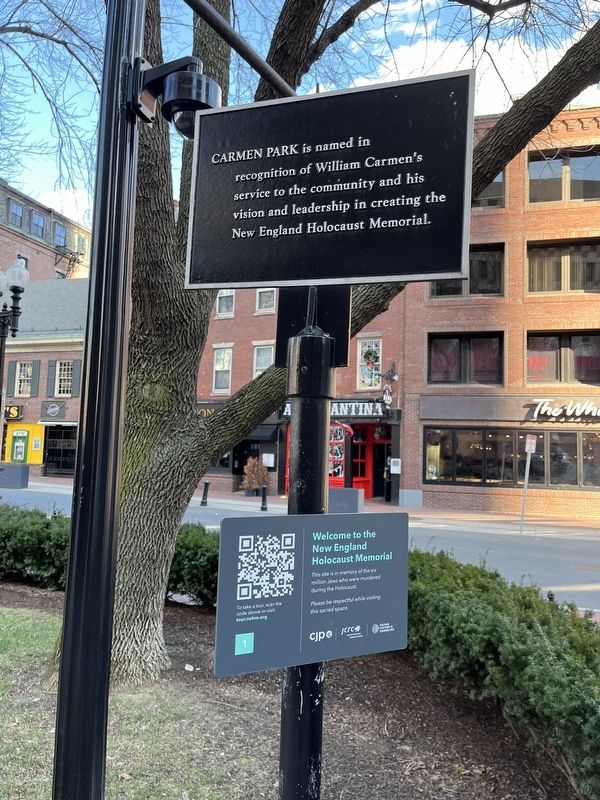
Carmen Park is named in recognition of William Carmen's service to the community and his vision and leadership in creating the New England Holocaust Memorial.
Welcome to the New England Holocaust Memorial
This site is in memory of the six million Jews who were murdered during the Holocaust.
Please be respectful while visiting this sacred space.
April 29, 2003: The Freedom Trail, Boston
We have raised this flag in tribute to all the American and other Allied soldiers who liberated us from the brutal Nazi tyranny and opened the gates to our trail to freedom in America.
Israel Arbeiter, President
American Association of Jewish Holocaust Survivors of Greater Boston
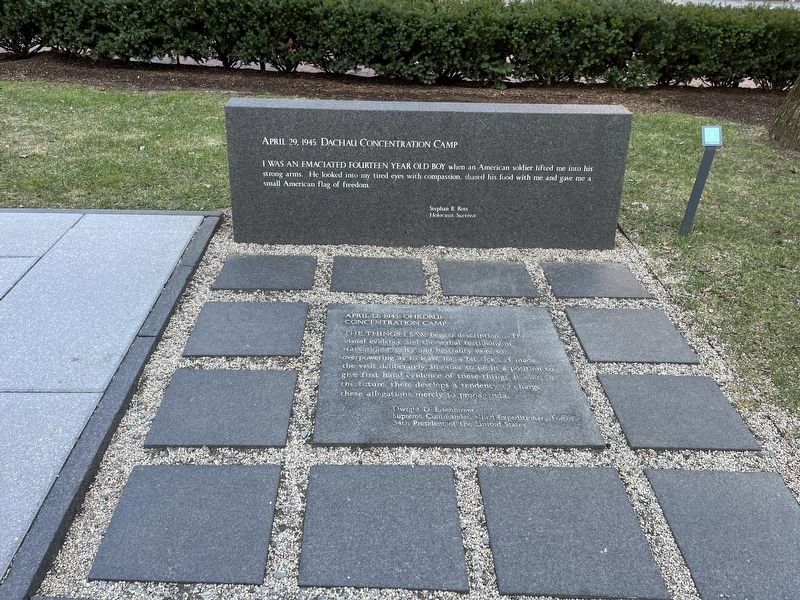
April 29, 1945: Dachau Concentration Camp
I was an emaciated fourteen year old boywhen an American soldier lifted me into his strong arms. He looked into my tired eyes with compassion, shared his food with me and gave me a small American flag of freedom.
Stephen B. Ross
Holocaust Survivor
April 12, 1945: Ohrdruf Conentration Camp
The things I sawbeggar description… The visual evidence and the verbal testimony of starvation, cruelty,
this page online
Dwight D. Eisenhower
Supreme Commander, Allied Expeditionary Forces
34th President of the United States
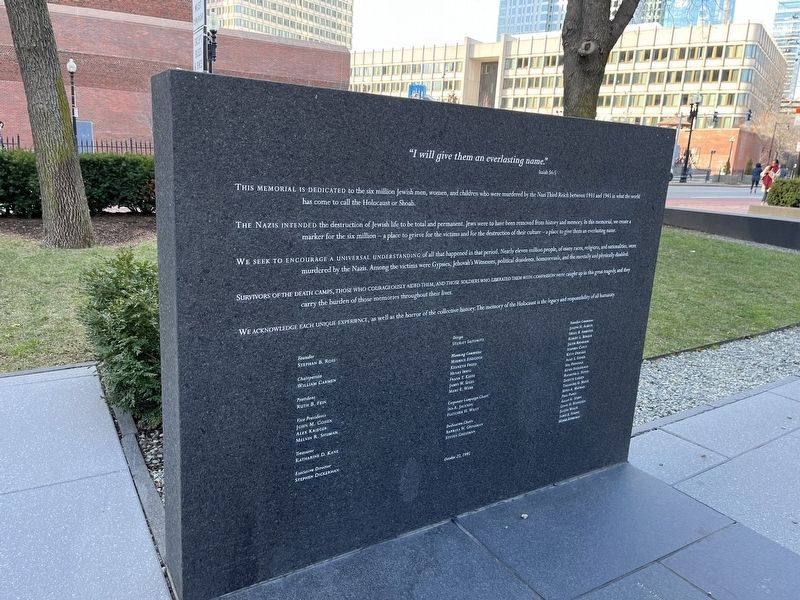
"I will give them an everlasting name."
Isaiah 56:5
This memorial is dedicated to the six million Jewish men, women, and children who were murdered by the Nazi Third Reich between 1933 and 1945 in what the world has come to call the Holocaust or Shoah.
The Nazis intended the destruction of Jewish life to be total and permanent. Jews were to have been removed from history and memory. In this memorial, we create a marker for the six million — a place to grieve for the victims and for the destruction of their culture — a place to give them an everlasting name.
We seek to encourage a universal understanding of all that happened in that period. Nearly eleven million people, of many races, religions, and nationalities, were murdered by the Nazis. Among the victims

Survivors of the death camps, those who courageously aided them, and those soldiers who liberated them with compassion were caught up in this great tragedy, and they carry the burden of those memories throughout their lives.
We acknowledge each unique experience, as well as the horror of the collective history. The memory of the Holocaust is the legacy and responsibility of all humanity.
On April 18, 1993, on Holocaust Remembrance Day, a time capsule buried here by survivors of the Nazi death camps, and their children and the liberators.
The capsule contains names submitted by New Englanders, of family and and loved ones who perished in the Holocaust.
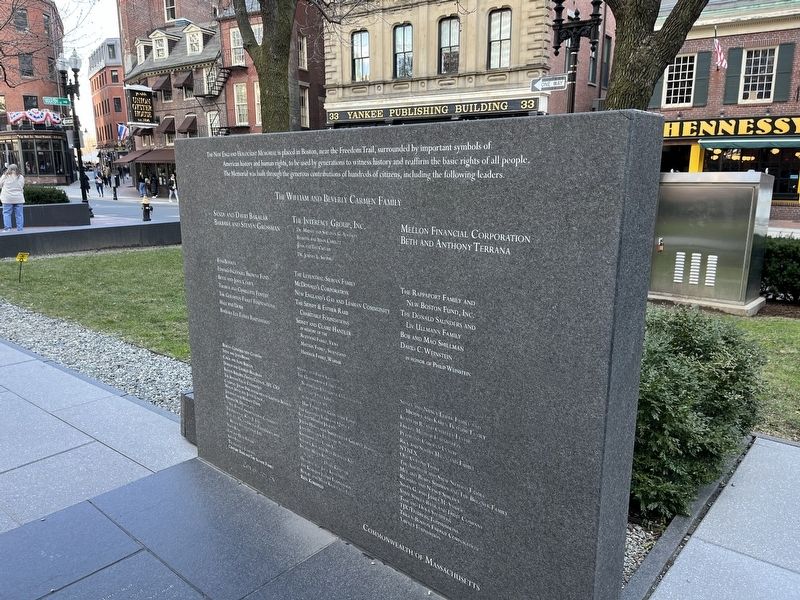
The New England Holocaust Memorial is placed in Boston, near the Freedom Trail, surrounded by important symbols of American history and human rights, to be used by generations to witness history and reaffirm the basic rights of all people. The Memorial was built through the generous contributions of hundreds of citizens, including the following leaders.
[Contributors listed]
The
Between 1933 and 1945, the Nazis created a regime of hate and victimization in Germany that eventually consumed most of Europe. Driven by racist beliefs, they killed as many as eleven million men, women and children in their quest to dominate Europe and to create a "pure and superior" race. The Nazis singled out the Jews for total extermination — their very existence to be raced from history and memory. Before their defeat in 1945, the Nazi regime murdered six million Jews — more than half of Europe's Jewish population.
Those who have perished have been silenced forever. Those who witnessed and survived the horrors carry with them the burden of memory. Through their voices, we seek to comprehend the acts of inhumanity that can stem from the prejudice.
To remember their suffering is to recognize the danger and evil that are possible whenever one group persecutes another. AS you walk this Freedom Trail pause here to reflect on the consequences of a world in which there
1933
January
The Nazi Party takes power in Germany. Hitler becomes Chancellor.
February
Nazis "temporarily restrict" civil liberties for all citizens — never to be restored.
March
The concentration camp at Dachau is established.
May
Trade unions are closed. Books declared contrary to Nazi beliefs are publicly burned.
1935
September
The German government enacts the Nuremberg Laws — codifying the "racial" definitions of Jews and depriving them of citizenship and fundamental rights.
The Nazis intensify persecution of political dissidents and others considered "inferior," including Gypsies, Jehovah's Witnesses, and homosexuals. Many are sent to concentration camps.
1938
November
Kristallnacht: "The Night of Broken Glass." Nazis attack Jews throughout Germany — 30,000 Jews arrested. 91 Jews killed. 7,500 shops and businesses looted. More than 1,000 synagogues set afire.
Jewish children are expelled from public schools.
December
Nazisseize control of Jewish-owned businesses.
1939
September
Germany invades Poland. World War II begins. Nazis order Polish Jews into restricted ghettos and force them into slave labor.
October
Hitler orders the so-called "Euthanasia" program leading to the systemic murder of the mentally and physically disabled in Germany and Austria.
1940
February
Nazis begin deporting German Jews to Poland.
December
Nazis begin the first mass murder of Jews at Treblinka.
1941
June
Germany attacks the Soviet Union. Mobile killing units begin the systematic slaughter of Jews.
September
In two days, mobile killing units shoot 33,771 Ukrainian Jews at Babi Yar — the largest single massacre of the Holocaust.
December
The death camp at Chelmno begins operation.
1942
January
Wannsee Conference: The Nazis coordinate the "Final Solution" — a plan to kill all European Jews through mass exterminations. Six death camps equipped with gas chambers soon begin full-scale operation in Poland: Majdanek, Chelmno, Sobibor, Treblinka, Belzec, and Auschwitz-Birkenau.
During peak operations, thousands of people a day are murdered inthese death factories.
1945
May
U.S. and Allied forces defeat the Nazis and liberate the remaining concentration camp survivors.

Belzec
"Transports arrived every day, mainly from Poland, but also from other European countries — Germany, Austria, Czechoslovakia, and others. In one transport there was a Ukrainian woman. She possessed documents that proved she was a genuine Aryan and yet she went to the gas chamber."
Chaim Hirszman
Metal worker imprisoned at Belzec
"Nothing belongs to us anymore. They have taken away our shoes and even our hair. If we speak, they will not listen to us. And if they listen, they will not understand. They have even taken away our names.
My number is 14317. I will carry the tattoo on my left arm until I die."
Primo Levi
Holocaust Survivor
A chemist captured in Italy while trying to join the partisans.
Became an author after the war.
Most infants and children were killed immediately upon arrival at the camps. The Nazis murdered as many as passed a [unreadable] Jewish children.
"Some Catholics, including Father Amyot, invited me to join them in prayer. Seven or eight of us gathered secretly of course, in the shed used as a lavatory.
In prayer we laid before God our suffering, our rags, our filth, our fatigue, our exposure, our hunger, and our misery."
Aimé Bonifas
Holocaust Survivor
,br> French resistance fighter who later became Pastor of the French Reformed Church.
"When my parents were sent off to the camp, I gave my good shoes to my father because I thought he'd need them if he did physical labor. When I saw my mother for the last time, I hugged her and said I hoped she didn't have to work too hard.
I never dreamed they'd be dead within such a short time of their departure."
Jack Polak
Holocaust Survivor
Captured by Nazis in Amsterdam
After the German army invaded Denmark, the Danish people mobilized to ferry 7,800 Jews to safety in neutral Sweden. At the end of the War, 99% of Denmarker Jews were still alive.
The Nazis also declared the Romani people, commonly called Gypsies, as "racially undesirable." Hundreds of thousands of them were imprisoned or murdered.
"From our barracks we could see the gas chambers. A heart-wrending cry of women and children reached us there. We were overcome by a feeling of helplessness There we were, watching and unable to do anything.
We had already worked out a plan of escape. But at that movement I decided. We must not simply escape. We must destroy the fascists and the camp."
Alexander Pechersky
Holocaust Survivor
Captured Russian soldier who led the prisoner revolt at Sobibor.
"My younger sister went up to a Nazi soldier with one of her friends. Standing naked, embracing each other, she asked to be spared. He looked into her eyes and shot the two of them.
They fell together in their embrace, my sister and her young friend.
Rivka Yosselevscka
Holocaust Survivor
A young mother who witnessed the murder of her entire family.
There were many acts of Jewish resistance against the Nazis. With little or no resources, they rebelled in the ghettos, fought as partisans in the forests, and revolted as prisoners at the camps.
The Nazis considered the Slavic peoples to be "subhuman" — the elite were to be exterminated and the rest were to be used for slave labor. Millions died under German occupation.
"Ilse, a childhood friend of mine, found a raspberry in the camp and carried it in her pocket all day to present to me that night on a leaf.
Imagine a world in which your entire possession is one raspberry and you give it to your friend."
Gerda Weissmen Klein
Holocaust Survivor
Deported from Germany as a teenager. Later married the U.S. Army officer who led the troops that rescued her.
"I was assigned to work outside digging ditches. We dug in the freezing cold and rain, wearing only the thin striped dresses issued to us. The ditches weren't to be used for any particular purpose.
The Nazis were merely trying to work us to death. And many did die of sickness, cold, exhaustion, and starvation."
Sally Sander
Holocaust Survivor
Dressmaker who was forced to make uniforms for Germany flyers.
German homosexuals were early victims of Nazi persecution. Many were imprisoned. Some were castrated or used in medical experiments. Thousands died in concentration camps.
Jews in the Warsaw ghetto revolted against the Nazis on April 19, 1943. A handful of Jews heroically held off the German army for several weeks. Finally, the Nazis destroyed the ghetto.
"In one transport, people refused to be taken to the gas chambers. A tragic struggle developed. They destroyed everything in sight and broke the crates willed with gold taken from the prisoners. They grabbed sticks and anything they could get their hands on to fight."
But the guards' bullets cut them down. When morning came the yard was still full of the dead."
Jacob Wiernik
Holocaust Survivor
Construction worker forced to build the gas chambers at Treblinka.
"I was chosen to work as a barber outside the gas chamber. The Nazis needed the women's hair. They told us 'make these women believe that they are just getting a haircut.'
We already knew it was the last place they went alive."
Abraham Bomba
Holocaust Survivor
Barber who escaped Treblinka and survived in hiding.
By late 1942, the United States and its allies were aware of the death camps, but did nothing to destroy them.
"I remember stooping down picking up a piece of something black near the crematorium. I realized it was a bone. I was going to throw it down again, and I thought, my God this may be all that's left of someone.
So I wrapped it up and carried it with me. A couple of days later, I dug it out of my pocket and buried it.
George Kaiser
American Soldier
Participated in the liberation of the concentration camps in 1945.
"At first the bodies weren't burned, they were buried. In January 1944, we were forced to dig up the bodies so they could be burned.
When the last mass grave was opened I recognized my whole family — my mother, my sisters and their kids. They were all in there."
Motke Zaidl
Holocaust Survivor
Deported from Lithuania and forced to work the death detail at Chelmno.
"They came first for the Communists,
and I didn't speak up because I wasn't a Communist.
Then they came for the Jews,
and I didn't speak up because I wasn't a Jew.
Then they came for the trade unionists,
and I didn't speak up because I wasn't a trade unionist.
Then they came for the Catholics,
and I didn't speak up because I was a Protestant.
Then they came for me,
and by that time no one was left to speak up."
Martin Niemoeller
Lutheran Pastor
This statement, attributed to Pastor Niemoeller, has become a legendary expression of the lesson of the Holocaust. Ironically Niemoeller had delivered anti-Semitic sermons early in the Nazi regime. He later opposed Hitler and was sent to a concentration camp.
Erected 1995 by Stanley Saitowitz, architect; CJP, Jewish Community Relations Council, Facing History & Ourselves.
Topics and series. This memorial is listed in these topic lists: Law Enforcement • War, World II. In addition, it is included in the The Holocaust, and the Time Capsules series lists. A significant historical month for this entry is January 1933.
Location. 42° 21.642′ N, 71° 3.424′ W. Memorial is in Boston, Massachusetts, in Suffolk County. It is in Government Center. It is on Union Street north of North Street, on the left when traveling north. Touch for map. Memorial is at or near this postal address: 19 North St, Boston MA 02108, United States of America. Touch for directions.

Regionally, this memorial is in Historic Boston. It is also in the American Northeast, in New England, and on the Eastern Seaboard. Globally, it is in the North Atlantic Region, North America, the Western Hemisphere, the Western World, and the Anglosphere. Historically, it finds itself in what was once one of the original Thirteen Colonies.
Other nearby markers. At least 8 other markers are within walking distance of this marker: James Michael Curley (a few steps from this marker); Union Oyster House (within shouting distance of this marker); Samuel Adams (about 300 feet away, measured in a direct line); Green Dragon Tavern (about 300 feet away); Proclamation of the "Bells" Journey (about 300 feet away); Ebenezer Hancock House (about 300 feet away); Faneuil Hall (about 300 feet away); The Bell-in-Hand (about 300 feet away). Touch for a list and map of all markers in Boston.
Also see . . . The New England Holocaust Memorial 1-28-2023. Collection of 50 photos from the memorial (Submitted on February 4, 2023, by Devry Becker Jones of Washington, District of Columbia.)
Additional commentary.
1. Language used in the marker
Some of the language used in the memorial is considered dated or offensive, particularly the use of the terms Gypsies (an epithet for the Romani people) and homosexuals (a dated, medicalized term for individuals, especially male-identifying, who are gay). The language used was common in the 1930s and 1940s and is likely used to share mindsets of society at large from the era.
— Submitted February 4, 2023, by Devry Becker Jones of Washington, District of Columbia.
Credits. This page was last revised on February 4, 2023. It was originally submitted on February 4, 2023, by Devry Becker Jones of Washington, District of Columbia. This page has been viewed 631 times since then and 94 times this year. Photos: 1, 2, 3, 4, 5, 6. submitted on February 4, 2023, by Devry Becker Jones of Washington, District of Columbia.
