Crow Agency in Big Horn County, Montana — The American West (Mountains)
Weir Point Fight
(Little Bighorn Battlefield)
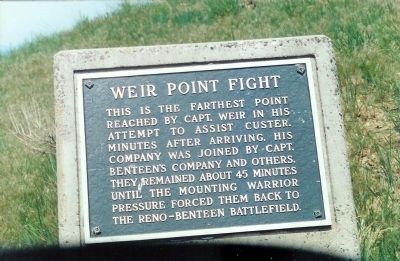
Photographed by Mike Stroud, June 1992
1. Weir Point Fight Marker
Topics. This historical marker is listed in these topic lists: Indigenous Peoples and Communities • Wars, US Indian.
Location. 45° 32.146′ N, 107° 23.651′ W. Marker is in Crow Agency, Montana, in Big Horn County. It is on Little Bighorn Battlefield Road. at Interstate 90 at Mile Marker 510 near U.S. 212. East of I-90. Touch for map. Marker is in this post office area: Crow Agency MT 59022, United States of America. Touch for directions.

Regionally, this marker is in Montana’s and he Crow Nation, in Southeast Montana, in Custer Country. It is also in the American Mountain West, in the Lewis & Clark Corridor, on the prairies, on the Great Plains, and specifically on the Northern Plains. Globally, it is in North America, the Rocky Mountains, the Western Hemisphere, the Western
this page online
Other nearby markers. At least 8 other markers are within walking distance of this marker: Weir Point (about 500 feet away, measured in a direct line); Custer Last Seen (approx. 0.2 miles away); Sharpshooter Ridge (approx. 0.4 miles away); Medicine Tail Coulee (approx. 0.8 miles away); Custer’s Advance (approx. 0.8 miles away); Reno’s Valley Fight (approx. 0.9 miles away); Reno’s Retreat (approx. 0.9 miles away); Reno's Skirmish Line - Warrior Counterattack (approx. 0.9 miles away). Touch for a list and map of all markers in Crow Agency.
Regarding Weir Point Fight. The two-day battle took place between the U.S. Army's Seventh Cavalry, guided by Crow and Arikara scouts and led by Lt. Col. George Armstrong Custer, against bands of Lakota Sioux, Cheyenne, and Arapaho, led by Chief Sitting Bull.
Little Bighorn was the pinnacle of the Indians' power. They had achieved their greatest victory yet, but soon their tenuous union fell apart in the face of the white onslaught. Outraged over the death of a popular
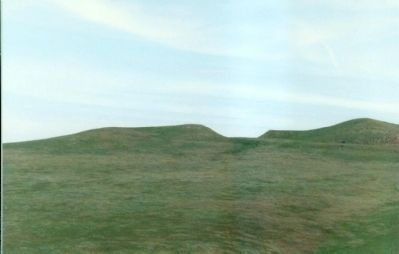
Photographed by Mike Stroud, June 1992
2. The farthest point reached by Capt. Weir
Also see . . .
1. Battle of Little Bighorn. (Submitted on August 14, 2009, by Mike Stroud of Bluffton, South Carolina.)
2. Captain Thomas Benton Weir, Wikipedia entry. ... Weir disobeyed orders to remain on what is now called Reno Hill. Instead, Weir (and eventually other soldiers including Benteen) moved north to attempt to support Custer, who had led a detachment to attack the encampment from that direction. The effort was too late to save Custer and over 200 of his men, all of whom were killed. ... (Submitted on June 24, 2012, by Mike Stroud of Bluffton, South Carolina.)
Credits. This page was last revised on January 5, 2025. It was originally submitted on August 14, 2009, by Mike Stroud of Bluffton, South Carolina. This page has been viewed 5,481 times since then and 261 times this year. Photos: 1, 2. submitted on August 14, 2009, by Mike Stroud of Bluffton, South Carolina. • Craig Swain was the editor who published this page.
