Geuzenveld-Slotermeer in Amsterdam, North Holland, Netherlands — Northwestern Europe
Sam van Houten

Photographed by Andrew Ruppenstein, November 5, 2022
1. Sam van Houten Marker

Deze zoon van een Groningse doopsgezinde houthandelaar en molenaar is al jong een markant politicus, bekend door zijn spectaculaire optredens. Zelf was hij niet christelijk, maar een uiterst kritisch liberaal. Hij studeerde rechten en na zijn promotie vestigde hij zich als advocaat in Groningen. Hij werd op 27-jarige leeftijd raadslid en vervolgens wethouder. In 1869 werd hij lid van de Tweede Kamer en vele jaren later, in 1894. minister van Binnenlandse Zaken. Hij werd vooral bekend door zijn Kinderwetje uit 1874 waarin bepaalde vormen van kinderarbeid werden verboden. Ook bracht hij een nieuwe kieswet tot stand, waarbij de helft van de mannelijke volwassenen kiesrecht kreeg. Een belangrijke stap op weg naar het algemeen kiesrecht.
The son of a Groningen Mennonite wood merchant and miller, he became a striking politician at an early age, known for his spectacular performances. He himself was not a Christian, but an extremely critical liberal. He studied law and after obtaining his doctorate he established himself as a lawyer in Groningen.
this page online
Erected by Geef Straten Een Gezicht.
Topics and series. This historical marker is listed in these topic lists: Civil Rights • Government & Politics. In addition, it is included in the Dutch Politicians (GSEG), and the Give Streets a Face / Geef Straten Een Gezicht series lists.
Location. 52° 22.751′ N, 4° 48.044′ E. Marker is in Amsterdam, Noord-Holland (North Holland). It is in Geuzenveld-Slotermeer. It is at the intersection of Sam van Houtenstraat, on the right when traveling east on Sam van Houtenstraat. Touch for map. Marker is at or near this postal address: Sam van Houtenstraat 197 /F, Amsterdam, Noord-Holland 1067 JG, Netherlands. Touch for directions.

Regionally,
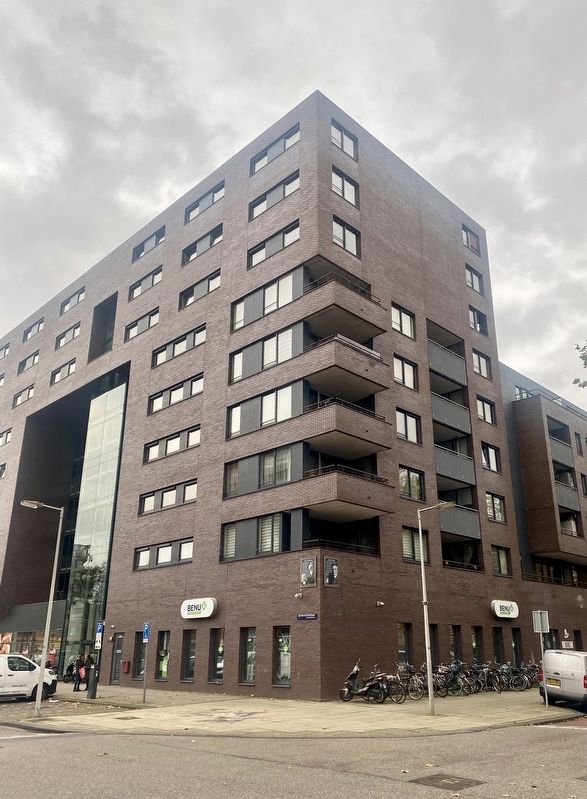
Photographed by Andrew Ruppenstein, November 5, 2022
2. Sam van Houten Marker - wide view
Other nearby markers. At least 8 other markers are within walking distance of this marker: Willem Nolens (here, next to this marker); Arnold Kerdijk (within shouting distance of this marker); Ben Telders (within shouting distance of this marker); Jan van Duivenvoorde (about 150 meters away, measured in a direct line); Piet Aalberse (about 210 meters away); Willem Albarda (about 210 meters away); Henri Marchant (about 210 meters away); Kenau Simonsdochter Hasselaer (approx. 0.2 kilometers away). Touch for a list and map of all markers in Amsterdam.
Also see . . . Samuel van Houten (Wikipedia).
On limiting child labor: Van Houten adhered to the principle of autonomy regarding the individual as well. On the issue of social policy, he believed government intervention was necessary to eliminate barriers to development of the individual so as to create equality of opportunity and thus to promote individual liberty. In this spirit, Van Houten introduced a bill that forbade child labour for children younger than 12 years. This bill, nicknamed the Kinderwetje van Van Houten, became the first social law of the Netherlands in 1874...(Submitted on February 22, 2023.)
Credits. This page was last revised on December 31, 2023. It was originally submitted on February 22, 2023, by Andrew Ruppenstein of Lamorinda, California. This page has been viewed 163 times since then and 31 times this year. Photos: 1, 2. submitted on February 22, 2023, by Andrew Ruppenstein of Lamorinda, California.
