Sorbonne in Paris in Département de Paris, Île-de-France, France — Western Europe
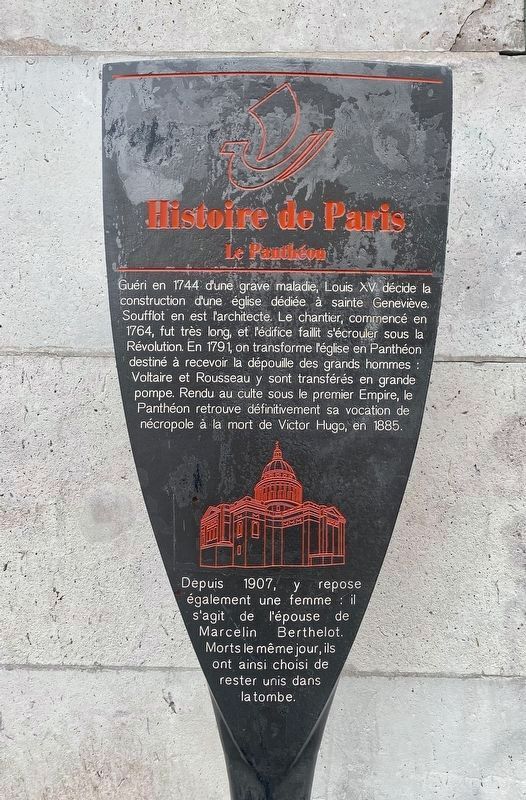
Le Panthéon
| — | Histoire de Paris | — |
Photographed by Andrew Ruppenstein, July 27, 2022
1. Le Panthéon Marker

Cured in 1744 of a serious illness, Louis XV decided to build a church dedicated to Saint Geneviève. Jacques-Germain Soufflot was the architect. Construction at the site, started in 1764, was of long duration, and the building almost collapsed during the Revolution. In 1791, the church was transformed into a Pantheon intended to receive the remains of great men: Voltaire and Rousseau were transferred there with great pomp. Returned to use as a site of worship under the First Empire, the Pantheon definitively regained its vocation as a necropolis on the death of Victor Hugo in 1885. Since 1907, a woman has also rested there, the wife of Marcelin Berthelot. Dying the same day as her husband, they thus chose to remain united in the grave.
Erected by Ville de Paris.
Topics and series. This historical marker is listed in these topic lists: Cemeteries & Burial Sites • Religion & Religious Structures. In addition, it is included in the Histoire de Paris series list. A significant historical year for this entry is 1744.
Location. 48° 50.767′ N, 2° 20.7′ E. Marker is in Paris, Île-de-France, in Département
this page online

Regionally, it is in the North Atlantic Region, Europe, the European Union, Atlantic Europe, the Schengen Area, Western Europe, a coastal Mediterranean country, and the Western World. Historically, it finds itself in what was once a French colony and also the Roman Empire.
Other nearby markers. At least 8 other markers are within walking distance of this marker: Les Champs magnétiques / The Magnetic Fields (1919 - 1989) (within shouting distance of this marker); La Mairie du Ve Arrondissement / Fifth Arrondissement City Hall (within shouting distance of this marker); Ancienne Eglise Ste Genevieve (within shouting distance of this marker); Alexandre Massiani (within shouting distance of this marker); Charles Péguy (within shouting distance of this marker); La Faculté de Droit / School of Law (about 90 meters away, measured in a direct line); Ferdinand Buisson (about 90 meters away); Marius Constant (1925-2004) (about 90 meters
Photographed by Andrew Ruppenstein, July 27, 2022
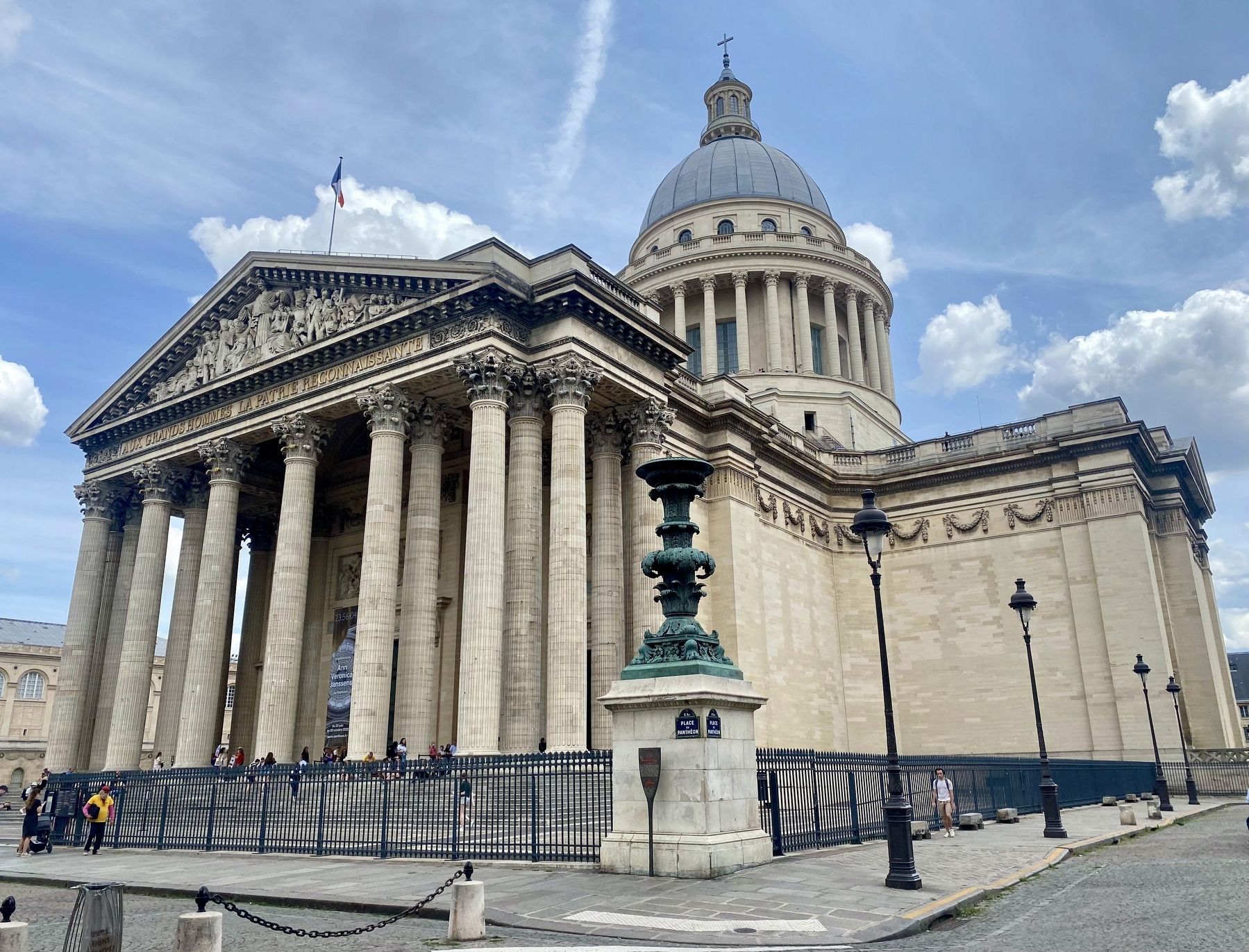
2. Panthéon and Marker
Regarding Le Panthéon. The information on the marker is a bit dated with respect to women, as the remains of a number of women have now been interred therein, including Marie Curie in 1995 and Josephine Baker in 2021.
Also see . . . Panthéon (Wikipedia).
Overview: The Panthéon (from the Classical Greek word πάνθειον, pántheion, '[temple] to all the gods') is a monument in the 5th arrondissement of Paris, France. It stands in the Latin Quarter, atop the Montagne Sainte-Geneviève, in the centre of the Place du Panthéon, which was named after it. The edifice was built between 1758 and 1790, from designs by Jacques-Germain Soufflot, at the behest of King Louis XV of France; the king intended it as a church dedicated to Saint Genevieve, Paris's patron saint, whose relics were to be housed in the church. Neither Soufflot nor Louis XV lived to see the church completed.(Submitted on February 25, 2023.)
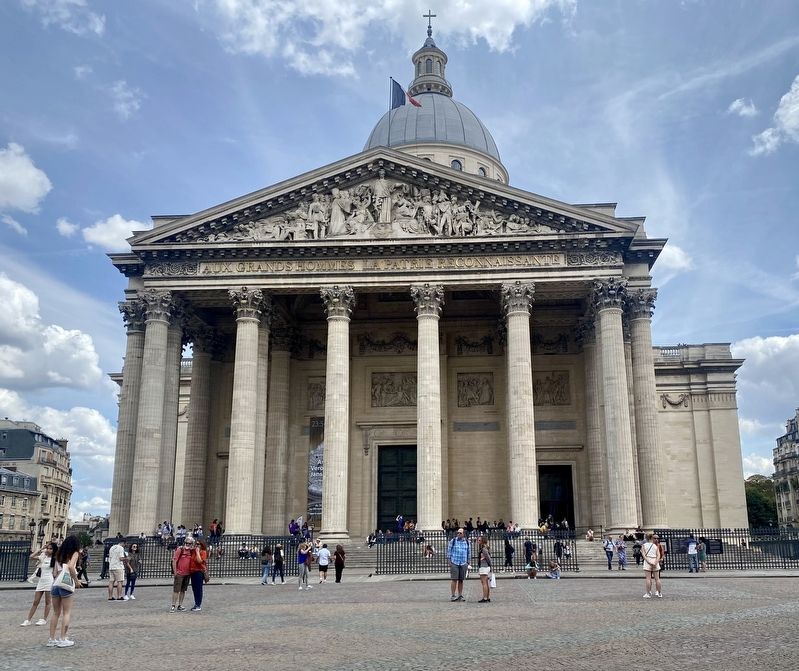
By the time the construction was finished, the French Revolution had started; the National Constituent Assembly voted in 1791 to transform the Church of SaintGenevieve into a mausoleum for the remains of distinguished French citizens, modelled on the Pantheon in Rome which had been used in this way since the 17th century. The first panthéonisé was Honoré Gabriel Riqueti, comte de Mirabeau, although his remains were removed from the building a few years later. The Panthéon was twice restored to church usage in the course of the 19th century—although Soufflot's remains were transferred inside it in 1829—until the French Third Republic finally decreed the building's exclusive use as a mausoleum in 1881. The placement of Victor Hugo's remains in the crypt in 1885 was its first entombment in over 50 years.Photographed by Andrew Ruppenstein, July 27, 20223. Panthéon
In 1851, Léon Foucault conducted a demonstration of diurnal motion at the Panthéon by suspending a pendulum from the ceiling, a copy of which is still visible today. As of December 2021 the remains of 81 people (75 men and six women) had been transferred to the Panthéon. More than half of all the panthéonisations were made under Napoleon's rule during the First Empire.
Additional keywords. panneau
Son of Groucho from Scotland (via Flickr and Wikimedia Commons, under CC 2.0 license), October 11, 2012
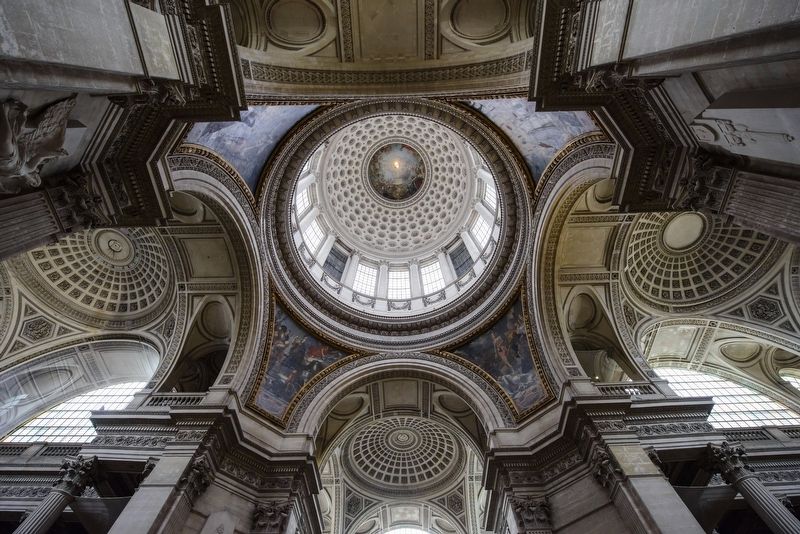
4. Looking upward at the first and second domes of the Panthéon in Paris (unmodified)
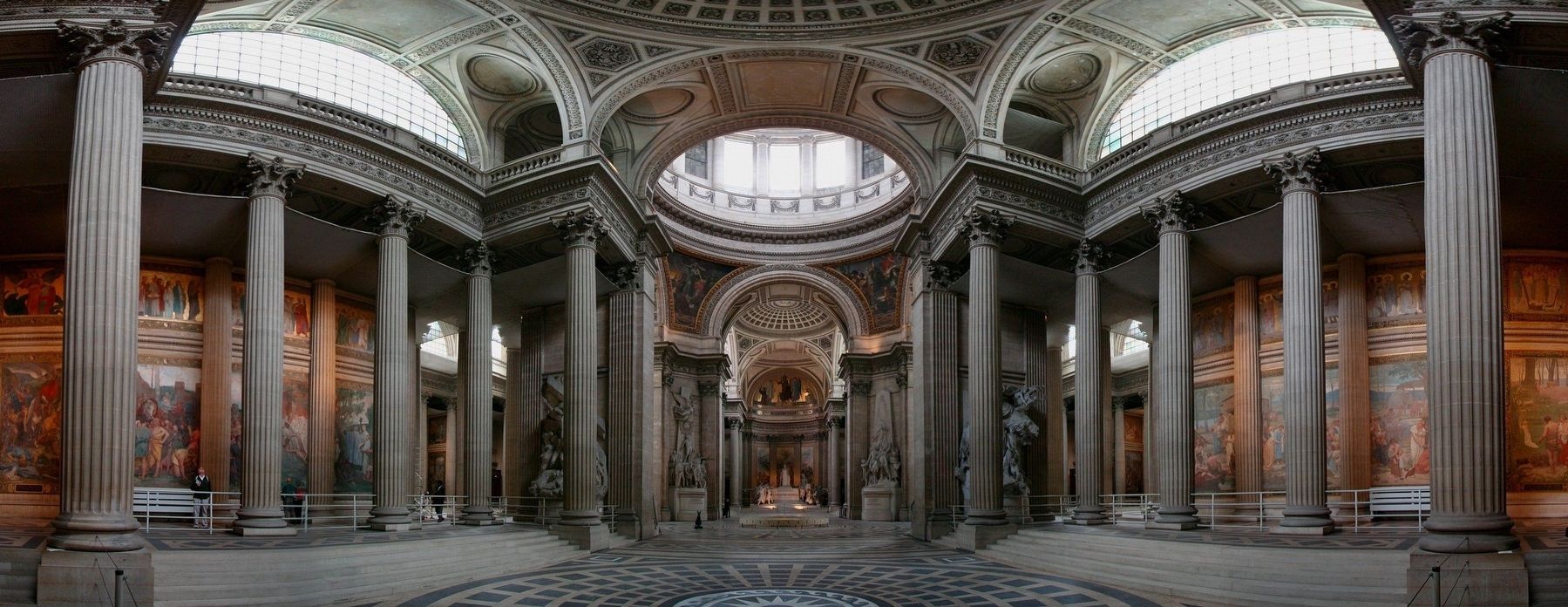
Photographed by Jean-Pierre Lavoie (Jplavoie) (via Wikimedia Commons under CC 3.0, unmodified), 2005
5. Le Panthéon - Panoramic view of interior
It’s worth noting that this is a featured picture on the English language Wikipedia. (A big merci beaucoup to Mr. Jean-Pierre Lavoie!)
Credits. This page was last revised on May 1, 2025. It was originally submitted on February 25, 2023, by Andrew Ruppenstein of Lamorinda, California. This page has been viewed 342 times since then and 56 times this year. Photos: 1, 2, 3, 4, 5. submitted on February 25, 2023, by Andrew Ruppenstein of Lamorinda, California.
