Downtown Yonge East in Toronto, Ontario — Central Canada (North America)
St. Lawrence Hall
1850

Photographed by Cosmos Mariner, May 29, 2022
1. St. Lawrence Hall Marker
Parks Canada website entry:
Click for more information.
Click for more information.
St. Lawrence Hall, one of the oldest public buildings in Toronto, was constructed following the Great Fire of 1849 that destroyed a large part of the city's core. Architect William Thomas designed the building in the Renaissance Revival style with Corinthian columns and a domed cupola.
The entrance originally led to a shopping arcade connected to the St. Lawrence Market. The building had shops on the main floor and, on the upper floors, offices and a grand meeting hall used for social events and by prominent speakers, performers, and musicians. Abolitionist Frederick Douglass, Swedish soprano Jenny Lind, and showman P. T. Barnum all appeared in the hall, as did William Lyon Mackenzie, Toronto's first mayor and Upper Canada Rebellion leader.
In the 20th century, St. Lawrence Hall lost prominence and fell into disrepair. By 1965, it was partially derelict and threatened with demolition. A campaign led by architect Eric Arthur resulted in the restoration of the building and its recognition as a National Historic Site in 1967.
Erected 2017 by Heritage Toronto.
Topics and series. This historical marker is listed
this page online
Location. 43° 39.017′ N, 79° 22.33′ W. Marker is in Toronto, Ontario. It is in Downtown Yonge East. It is on King Street East 0.1 kilometers west of Jarvis Street, on the left when traveling west. Marker is mounted just to the left of the front/north entrance on King Street East. Touch for map. Marker is at or near this postal address: 157 King Street East, Toronto ON M5C 1G9, Canada. Touch for directions.

Regionally, this marker is in Greater Toronto and on the Golden Horseshoe. It is also in Central Canada. Globally, it is in North America, on the Great Lakes, in the Western Hemisphere, in the Western World, and in the Anglosphere. Historically, it finds itself in what was once a British colony, the Viceroyalty of New France, the Haudenosaunee (Iroquois) Confederacy, and Rupert’s Land.
Other nearby markers. At least 8 other markers are within walking distance of this marker: Cholera Epidemics of 1832 & 1834
Toronto Public Library
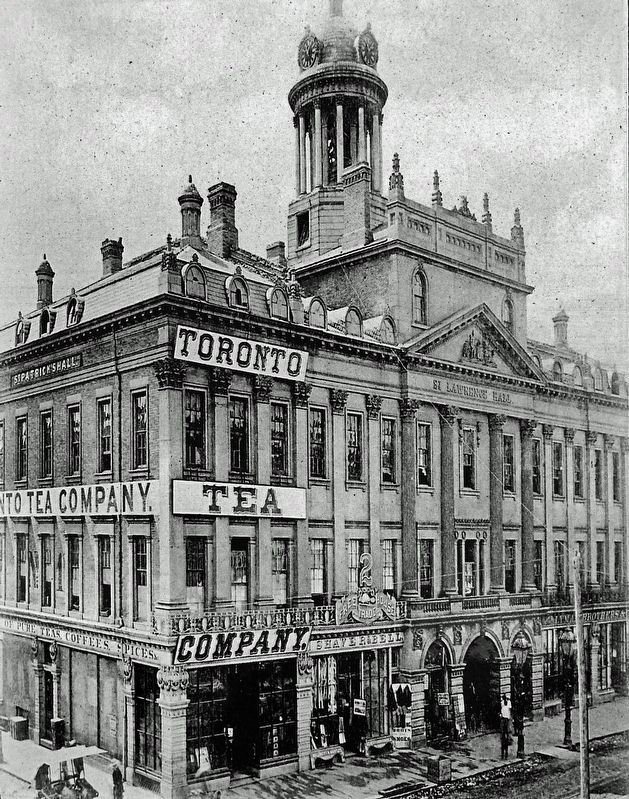
2. Marker detail: St. Lawrence Hall, 1873
In the 19th century, the Irish Catholic Benevolent Union leased space in the east wing, known as St. Patrick's Hall, where they also set up one of the earliest basketball courts in Canada. During the 1967 renovation, the east wing collapsed and was rebuilt.
Regarding St. Lawrence Hall.
From the Canadian Register Statement of Significance:
St. Lawrence Hall was designated a national historic site in 1967 because:
• it was designed in the renaissance tradition, this hall was for many years Toronto's chief social and cultural centre;
• it ranks amongst the finest of 19th-century Canadian public buildings;
• and it was a place of gatherings of the Abolitionist movement.It provided an elegant meeting place for Toronto's 19th-century elite. The ground floor was designed as commercial space, the second as offices, and the third to house a 1000-seat assembly
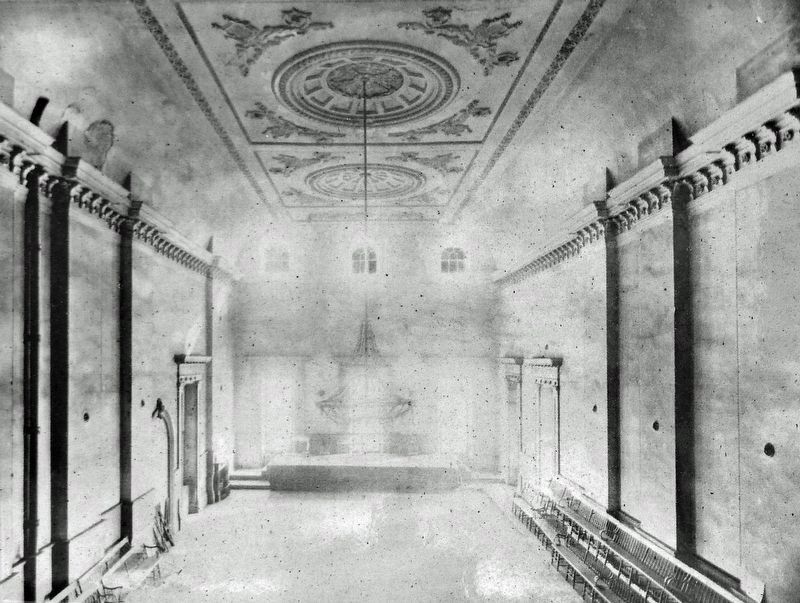
room. The building was a major cultural venue for lectures, concerts, balls and receptions attended by the city's most notable citizens. These events included several important Abolition meetings in the years when Canada was receiving thousands of Underground Railroad refugees from American slavery.Toronto Public Library3. Marker detail: Grand Third-floor Hall, 1898Interior of the grand third-floor hall, looking south, 1898. The hall was lit by a gasolier (a gas-powered chandelier), a feature that was retained in 1967 along with the ornate plaster ceiling. The streetlamps on King Street are still gas-powered.
Also see . . . St. Lawrence Hall.
It was here that prominent politicians such as John A. Macdonald and George Brown, Fathers of Confederation, addressed the people of Toronto. It was the main venue for musicians and other performers who came to the city. The lower levels were integrated into the market and were home to stores and businesses. The City of Toronto government fully restored the hall in 1967 to mark the Centennial of Confederation (and rebuilt the east wing which had completely collapsed). That same year it was designated as a National Historic Site.(Submitted on March 1, 2023, by Cosmos Mariner of Cape Canaveral, Florida.)

Courtesy McCord Museum, N-0000.193.254.1
4. Marker detail: View South to the Harbor
From the cupola of St. Lawrence Hall, circa 1860, by William Notman.
Photographed by Cosmos Mariner, May 29, 2022
5. St. Lawrence Hall Marker

Photographed by Cosmos Mariner, May 29, 2022
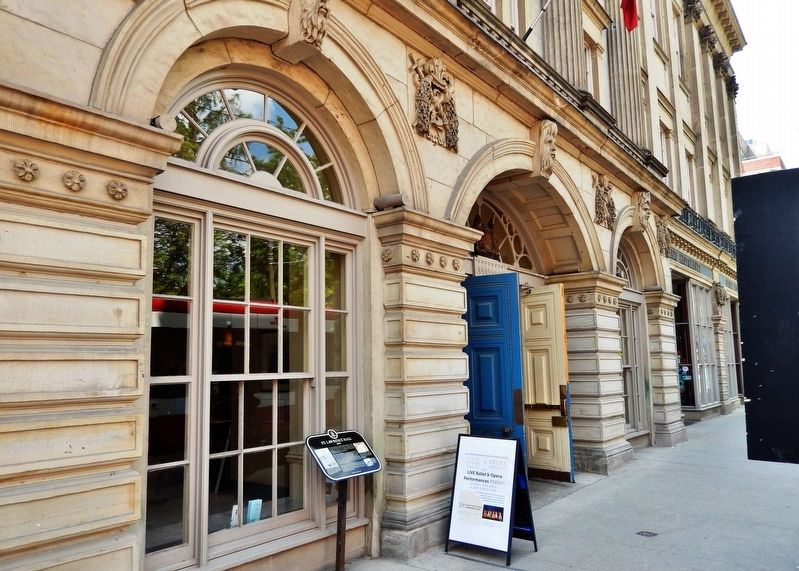
6. St. Lawrence Hall (north/front elevation)

Photographed by Cosmos Mariner, May 29, 2022
7. St. Lawrence Hall (northeast elevation)
Canada's Historic Places website entry:
Click for more information.
Click for more information.
Credits. This page was last revised on May 7, 2023. It was originally submitted on February 26, 2023, by Cosmos Mariner of Cape Canaveral, Florida. This page has been viewed 807 times since then and 75 times this year. Photos: 1, 2, 3, 4, 5, 6, 7. submitted on March 1, 2023, by Cosmos Mariner of Cape Canaveral, Florida.
