Centro Histórico in Ciudad de México, Mexico — The Valley of Mexico (The Central Highlands)
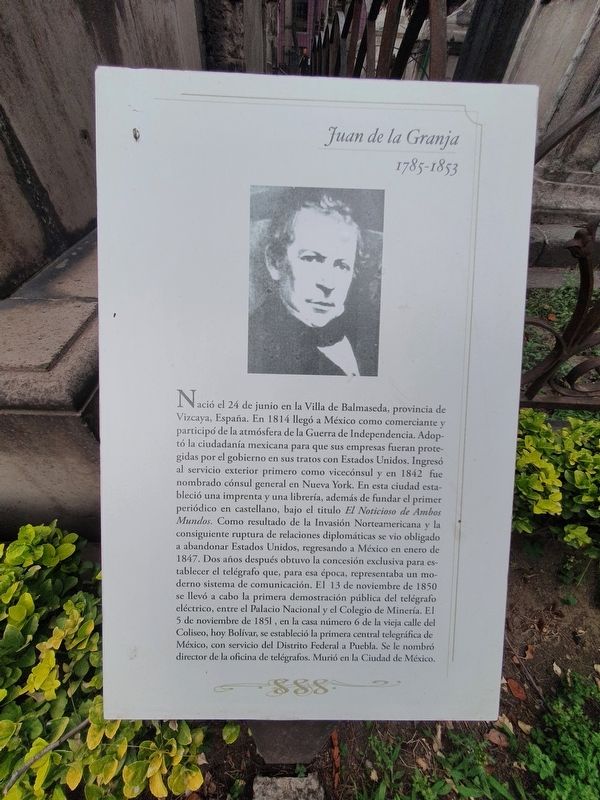
Juan de la Granja
Photographed by J. Makali Bruton, May 24, 2022
1. Juan de la Granja Marker

1785-1853
Nació el 24 de junio en la Villa de Balmaseda, provincia de Vizcaya, España. En 1814 llegó a México como comerciante y participó de la atmósfera de la Guerra de Independencia. Adoptó la ciudadanía mexicana para que sus empresas fueran protegidas por el gobierno en sus tratos con Estados Unidos. Ingresó al servicio exterior primero como vicecónsul y en 1842 fue nombrado cónsul general en Nueva York. En esta ciudad estableció una imprenta y una librería, además de fundar el primer periódico en castellano, bajo el titulo El Noticioso de Ambos Mundos. Como resultado de la Invasión Norteamericana y la consiguiente ruptura de relaciones diplomáticas se vio obligado a abandonar Estados Unidos, regresando a México en enero de 1847. Dos años después obtuvo la concesión exclusiva para establecer el telégrafo que, para esa época, representaba un moderno sistema de comunicación. El 13 de noviembre de 1850 se llevó a cabo la primera demostración pública del telégrafo eléctrico, entre el Palacio Nacional y el Colegio de Minería. El 5 de noviembre de 1851, en la casa número 6 de la vieja calle del
this page online
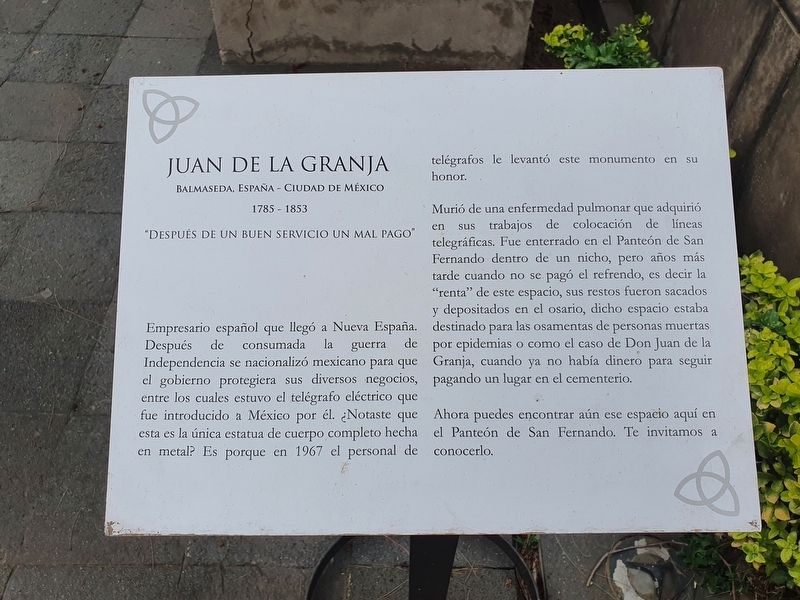
Juan de la Granja
Balmaseda, España - Ciudad de México
1785-1853
"Después de un buen servicio un mal pago"
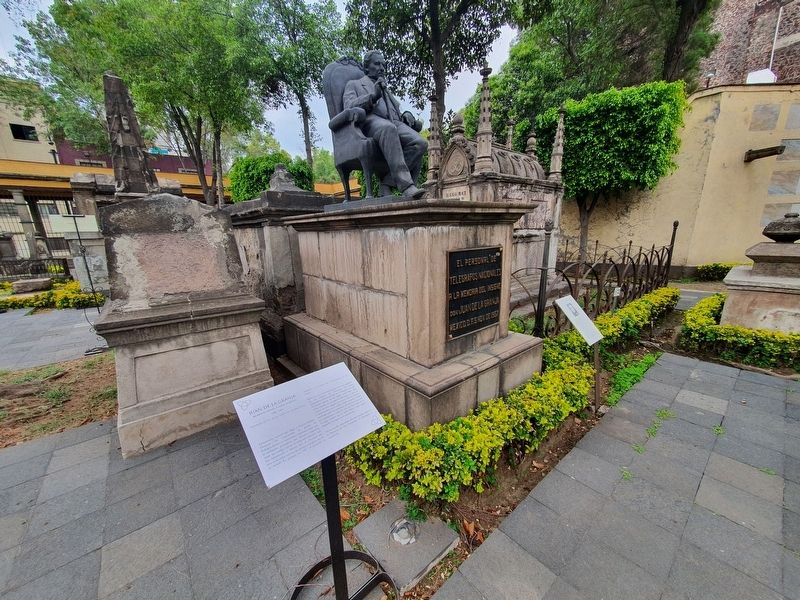
Empresario español que llegó a Nueva España. Después de consumada la guerra de Independencia se nacionalizó mexicano para que el gobierno protegiera sus diversos negocios, entre los cuales estuvo el telégrafo eléctrico que fue introducido a México por él. ¿Notaste que esta es la única estatua de cuerpo completo hecha en metal? Es porque en 1967 el personal de telégrafos le levantó este monumento en su honor.
Murió de una enfermedad pulmonar que adquirió en sus trabajos de colocación de líneas telegráficas. Fue enterrado en el Panteón de San Fernando dentro de un nicho, pero años más tarde cuando no se pagó el refrendo, es decir la "renta" de este espacio, sus restos fueron sacados y depositados en el osario, dicho espacio estaba destinado para las osamentas de personas muertas por epidemias o como el caso de Don Juan de la Granja,
Photographed by J. Makali Bruton, May 24, 2022
2. Juan de la Granja Marker
Ahora puedes encontrar aun ese espacio aqui en el Panteon de San Fernando. Te invitamos a conocerlo.
Juan de la Granja
1785-1853
Born on June 24 in the Villa de Balmaseda, province of Biscay, Spain. In 1814 he arrived in Mexico as a merchant and participated in the War of Independence. He adopted Mexican citizenship so that his companies would be protected by the government in their dealings with the United States. He entered the foreign service first as vice-consul and in 1842 was appointed consul general in New York. In this city he established a printing press and a bookstore, in addition to founding the first newspaper in Spanish, under the title “El Noticioso de Ambos Mundos”. As a result of the American invasion and the consequent rupture of diplomatic relations he was forced to leave the United States, returning to Mexico in January 1847. Two years later he obtained the exclusive concession to establish the telegraph which, at that time, represented a modern system of communication. On November 13, 1850, the first public demonstration
Photographed by J. Makali Bruton, May 24, 2022
3. Juan de la Granja Marker
Juan de la Granja
Balmaseda, Spain - Mexico City
1785-1853
"After a good service a bad payment"
Spanish businessman who arrived in New Spain. After the War of Independence was over, he became a Mexican citizen so that the government could protect his various businesses, among which was the electric telegraph that was introduced to Mexico by him. Did you notice that this is the only full-length statue in the cemetery made of metal? It is because in 1967 the telegraph staff placed this monument in his honor.
He died of a lung disease that he acquired in his work of laying telegraph lines. He was buried in the Pantheon of San Fernando inside a niche, but years later when the space was not paid, that is, the "rent" of the space, his remains were removed and deposited in the ossuary, which was a space destined for the bones of people killed by epidemics or as in the case of Juan de la Granja, when there was no money to continue paying for a place in the cemetery.
Now you can still find that space here in the Pantheon of San Fernando. We invite you to meet him.
Topics. This historical marker is listed in these topic lists: Communications • War, Mexican-American • Wars, Non-US. A significant historical month for this entry is January 1847.
Location. 19° 26.35′ N, 99° 8.882′ W. Marker is in Ciudad de México. It is in Centro Histórico. It can be reached from Calle San Fernando, on the right when traveling west. The marker is on the grounds of the Panteón de San Fernando. Touch for map. Marker is at or near this postal address: C San Fernando 17, Ciudad de México 06300, Mexico. Touch for directions.

Regionally, this marker is in Central Mexico and specifically in Mexico City Metropolitan Area. Globally, it is in North America, specifically in Mesoamerica, on the Ring of Fire, and in the Western Hemisphere. Historically, it finds itself in what was once New Spain, a Spanish colony, and the Aztec Empire.
Other nearby markers. At least 8 other markers are within walking distance of this marker: Mariano Riva Palacio (a few steps from this marker); Vicente Guerrero (a few steps from this marker); Francisco Zarco (a few steps from this marker); Benito Juárez (a few steps from this marker); Juan C. Doria (a few steps from this marker); Ignacio Comonfort (a few steps from this marker); Tomás Mejía (a few steps from this marker); Ignacio Zaragoza (a few steps from this marker). Touch for a list and map of all markers in Ciudad de México.
Credits. This page was last revised on February 27, 2023. It was originally submitted on February 27, 2023, by J. Makali Bruton of Washington, District of Columbia. This page has been viewed 410 times since then and 27 times this year. Photos: 1, 2, 3. submitted on February 27, 2023, by J. Makali Bruton of Washington, District of Columbia.
