Columbus in Muscogee County, Georgia — The American South (South Atlantic)
Griffin
Photographed by J. Makali Bruton, November 7, 2022
1. Griffin Marker
Inscription.
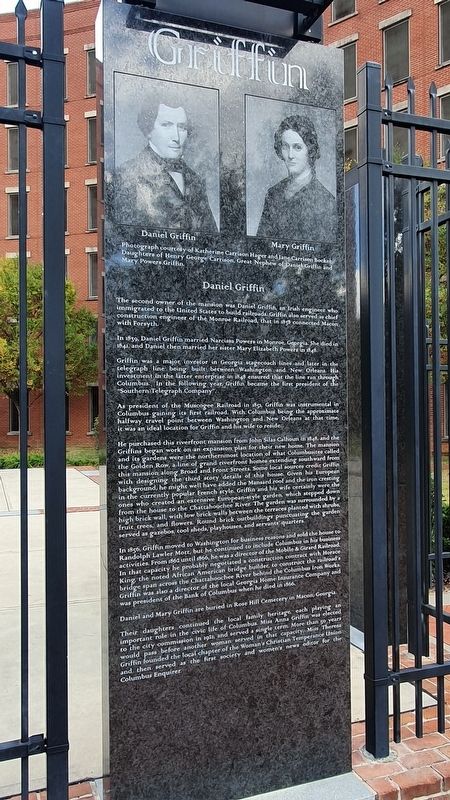
Griffin. . , Daniel Griffin , The second owner of the mansion was Daniel Griffin, an Irish engineer who immigrated to the United States to build railroads. Griffin also served as chief construction engineer of the Monroe Railroad, that in 1848 connected Macon with Forsyth., In 1839, Daniel Griffin married Narcissa Powers in Monroe, Georgia. She died in 1844, and Daniel then married her sister Mary Elizabeth Powers in 1848., Griffin was a major investor in Georgia stagecoach lines and later in the telegraph line being built between Washington and New Orleans. His investment in the latter enterprise in 1848 ensured that the line ran through Columbus. In the following year, Griffin became the first president of the "Southern Telegraph Company"., As president of the Muscogee Railroad in 1851, Griffin was instrumental in Columbus gaining its first railroad. With Columbus being the approximate halfway travel point between Washington and New Orleans at that time, it was an ideal location for Griffin and his wife to reside., He purchased this riverfront mansion from John Silas Calhoun in 1848, and the Griffins began work on an expansion plan for their new home. The mansion and its gardens were the northernmost location of what Columbusites called the Golden Row, a line of grand riverfront homes extending southward from this mansion along Broad and Front Streets. Some local sources credit Griffin with designing the third story details of this house. Given his European background, he might well have added the Mansard roof and the iron cresting in the currently popular French style. Griffin and his wife certainly were the ones who created an extensive European-style garden, which stepped down from the house to the Chattahoochee River. The garden was surrounded by a high brick wall, with low brick walls between the terraces planted with shrubs, fruit trees, and flowers. Round brick outbuildings punctuating the garden served as gazebos, tool sheds, playhouses, and servants quarters., In 1856, Griffin moved to Washington for business reasons and sold the house to Randolph Lawler Mott, but he continued to include Columbus in his business activities. From 1864 until 1866, he was a director of the Mobile and Girard Railroad. In that capacity he probably negotiated a construction contract with Horace King, the noted African American bridge builder, to construct the railroad's bridge span across the Chattahoochee River behind the Columbus Iron Works. Griffin was also a director of the local Georgia Home Insurance Company and was president of the Bank of Columbus when he died in 1866., Daniel and Mary Griffin are buried in Rose Hill Cemetery in Macon, Georgia., Their daughters continued the local family heritage each playing an important role in the civic life of Columbus. Miss Anna Griffin was elected to the city commission in 1921, and served a single term. More than 50 years would pass before another woman served in that capacity. Miss Theresa Griffin founded the local chapter of the Woman's Christian Temperance Union and then served as the first society and women's news editor for the Columbus Enquirer., Caption , Daniel Griffin · Mary Griffin , Photograph courtesy of Katherine Carrison Hager and Jane Carrison Bockel daughters of Henry George Carrison, great nephew of Daniel Griffin and Mary Powers Griffin
Daniel Griffin
The second owner of the mansion was Daniel Griffin, an Irish engineer who
immigrated to the United States to build railroads. Griffin also served as chief
construction engineer of the Monroe Railroad, that in 1848 connected Macon
with Forsyth.
In 1839, Daniel Griffin married Narcissa Powers in Monroe, Georgia. She died in
1844, and Daniel then married her sister Mary Elizabeth Powers in 1848.
Griffin was a major investor in Georgia stagecoach lines and later in the
telegraph line being built between Washington and New Orleans. His
investment in the latter enterprise in 1848 ensured that the line ran through
Columbus. In the following year, Griffin became the first president of the
"Southern Telegraph Company".
As president of the Muscogee Railroad in 1851, Griffin was instrumental in Columbus gaining its first railroad. With Columbus being the approximate
halfway travel point between Washington and New Orleans at that time,
it was an ideal location for Griffin and his wife to reside.
He purchased this riverfront mansion from John Silas Calhoun in 1848, and the
Griffins began work on an expansion plan for their new home. The mansion
and its gardens were the northernmost location of what Columbusites called the Golden Row, a line of grand riverfront homes extending
Click or scan to see this page online
southward from
this mansion along Broad and Front Streets. Some local sources credit Griffin
with designing the third story details of this house. Given his European
background, he might well have added the Mansard roof and the iron cresting
in the currently popular French style. Griffin and his wife certainly were the
ones who created an extensive European-style garden, which stepped down
from the house to the Chattahoochee River. The garden was surrounded by a
high brick wall, with low brick walls between the terraces planted with shrubs, fruit trees, and flowers. Round brick outbuildings punctuating the garden
served as gazebos, tool sheds, playhouses, and servants quarters.
In 1856, Griffin moved to Washington for business reasons and sold the house to
Randolph Lawler Mott, but he continued to include Columbus in his business
activities. From 1864 until 1866, he was a director of the Mobile & Girard Railroad.
In that capacity he probably negotiated a construction contract with Horace
King, the noted African American bridge builder, to construct the railroad's
bridge span across the Chattahoochee River behind the Columbus Iron Works. Griffin was also a director of the local Georgia Home Insurance Company and
was president of the Bank of Columbus when he died in 1866.
Daniel and Mary Griffin are buried in Rose Hill Cemetery in Macon, Georgia.
Their
Photographed by J. Makali Bruton, November 7, 2022
2. Griffin Marker
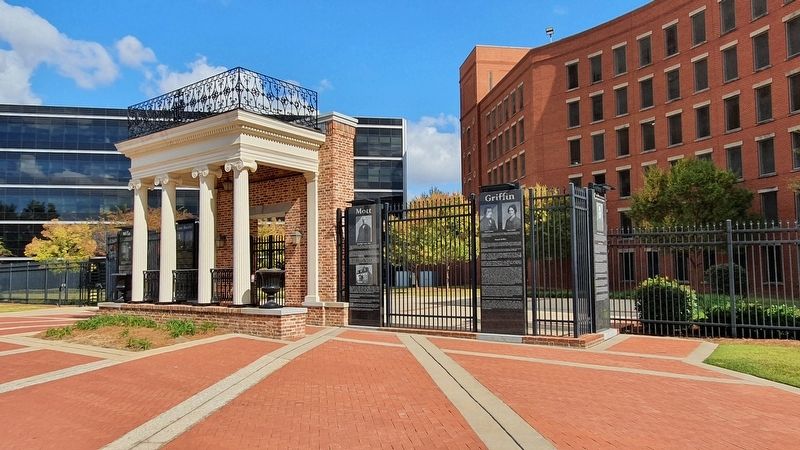
The marker is to the right of the reconstructed facade of the Calhoun-Griffin-Mott House.
daughters continued the local family heritage each playing an
important role in the civic life of Columbus. Miss Anna Griffin was elected
to the city commission in 1921, and served a single term. More than 50 years
would pass before another woman served in that capacity. Miss Theresa
Griffin founded the local chapter of the Woman's Christian Temperance Union
and then served as the first society and women's news editor for the
Columbus Enquirer.
Caption Daniel Griffin · Mary Griffin
Photograph courtesy of Katherine Carrison Hager and Jane Carrison Bockel
daughters of Henry George Carrison, great nephew of Daniel Griffin and
Mary Powers Griffin
Location. 32° 28.39′ N, 84° 59.666′ W. Marker is in Columbus, Georgia, in Muscogee County. It can be reached from 14th Street north of Front Avenue, on the right when traveling west. Touch for map. Marker is at or near this postal address: 1 14th St, Columbus GA 31901, United States of America. Touch for directions.
Regionally, this marker is in Georgia’s Piedmont. It is also in the American South and specifically in the Deep South. Globally, it is in the North Atlantic Region, North America, the Western Hemisphere, the Western World, and the Anglosphere. Historically, it finds itself in what was once the territory of the Mississippian Culture, one of the original Thirteen Colonies, one of the Confederate States of America, and the Antebellum South.
Other nearby markers. At least 8 other markers are within walking distance of this marker: Mott (here, next to this marker); Calhoun (here, next to this marker); Last Battle (here, next to this
marker); Mills (a few steps from this marker); TSYS (a few steps from this marker); Freedom Day (within shouting distance of this marker); J.S. Pemberton & the Confederacy / The Formula (within shouting distance of this marker); George Parker Swift I (about 400 feet away, measured in a direct line). Touch for a list and map of all markers in Columbus.
Credits. This page was last revised on February 22, 2026. It was originally submitted on March 7, 2023, by J. Makali Bruton of Washington, District of Columbia. This page has been viewed 419 times since then and 59 times this year. Last updated on January 29, 2026, by Katherine Carrison Hager of Jacksonville, Florida. Photos:1, 2. submitted on March 7, 2023, by J. Makali Bruton of Washington, District of Columbia. • Devry Becker Jones was the editor who published this page.