
Delft, South Holland, Netherlands — Northwestern Europe
Antoni van Leeuwenhoek
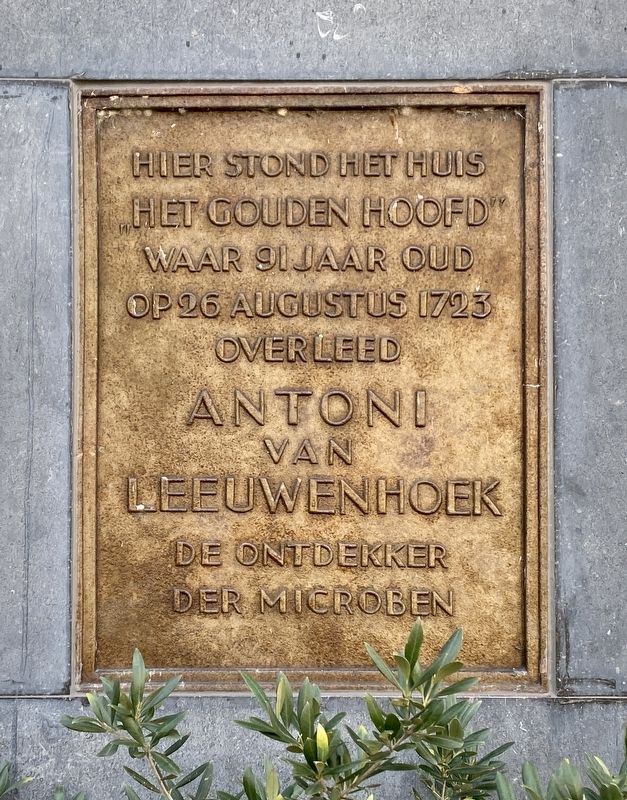
Photographed by Andrew Ruppenstein, March 11, 2023
1. Antoni van Leeuwenhoek Marker

Hier stond het huis
“Het Gouden Hoofd”
waar 91 jaar oud
op 26 augustus 1723
overleed
Antoni
van
Leeuwenhoek
de ontdekker
der microben
Here stood “The Golden Head”, where on August 26, 1723, Anthony van Leeuwenhoek, the discoverer of microbes, died at 91 years of age.
Topics. This historical marker is listed in this topic list: Science & Medicine. A significant historical date for this entry is August 26, 1723.
Location. 52° 0.707′ N, 4° 21.439′ E. Marker is in Delft, Zuid-Holland (South Holland). It is on Hippolytusbuurt, on the left when traveling north. Touch for map. Marker is at or near this postal address: Hippolytusbuurt 3, Delft, Zuid-Holland 2611 EX, Netherlands. Touch for directions.

Regionally, it is in Europe, the European Union, Atlantic Europe, the Benelux Low Countries, the Schengen Area, Western Europe, and the Western World. Historically, it finds itself in what was once the Roman Empire and specifically also the Holy Roman Empire.
Other nearby markers. At least 8 other markers are within walking distance of this marker: Vleeshal / Meathall (within shouting
this page online
Also see . . .
1. Antonie van Leeuwenhoek (Wikipedia).
Overview: Antonie Philips van Leeuwenhoek(24 October 1632 – 26 August 1723) was a Dutch microbiologist and microscopist in the Golden Age of Dutch science and technology. A largely self-taught man in science, he is commonly known as "the Father of Microbiology", and one of the first microscopists and microbiologists. Van Leeuwenhoek is best known for his pioneering work in microscopy and for his contributions toward the establishment of microbiology as a scientific discipline…(Submitted on March 12, 2023.)
Using single-lensed microscopes of his own design and make,van Leeuwenhoek was the first to observe and to experiment with microbes, which he originally referred to as dierkens, diertgensor diertjes(Dutch for "small animals" [translated into English as animalcules, from Latin animalculum = "tiny animal"]). He was the first to relatively determine their size. Most of the "animalcules" are now referred to as unicellular organisms, although he observed multicellular organisms in pond water. He was also the first to document microscopic observations of muscle fibers, bacteria, spermatozoa, red blood cells, crystals in gouty tophi, and among the first to see blood flow in capillaries. Although van Leeuwenhoek did not write any books, he described his discoveries in letters to the Royal Society, which published many of his letters, and to persons in several European countries.Photographed by Andrew Ruppenstein, March 11, 20232. Antoni van Leeuwenhoek Marker - wide view

2. Hippolytusbuurt 3, Leeuwenhoek's Home and Laboratory (Lens on Leeuwenhoek). From a website providing an in depth look at Leeuwenhoek…
About Het Gulden Hoofd: Leeuwenhoek lived in the same house for his whole adult life. It was also his laboratory. He made his lenses and microscopes there and did almost all of his observing and letter-writing there, as well as entertaining visitors. Named the Gulden Hoofd (golden head), the house had been built of brick after the fire of 1536 destroyed most of Delft's wooden houses.(Submitted on March 12, 2023.)
About the subject marker: In fact, Leeuwenhoek was still 90 when he died and the Gulden Hoofd has disappeared so completely that the plaque is on the wrong house.
Credits. This page was last revised on December 31, 2023. It was originally submitted on March 11, 2023, by Andrew Ruppenstein of Lamorinda, California. This page has been viewed 358 times since then and 65 times this year. Photos: 1, 2. submitted on March 11, 2023, by Andrew Ruppenstein of Lamorinda, California.
