
Fredericksburg, Virginia — The American South (Mid-Atlantic)
Walker-Grant High School Class of 1950 Stages Graduation Protest at Fredericksburg Community Center
Trail to Freedom
Photographed by Devry Becker Jones (CC0), March 4, 2023
1. Walker-Grant High School Class of 1950 Stages Graduation Protest at Fredericksburg Community Center Marker
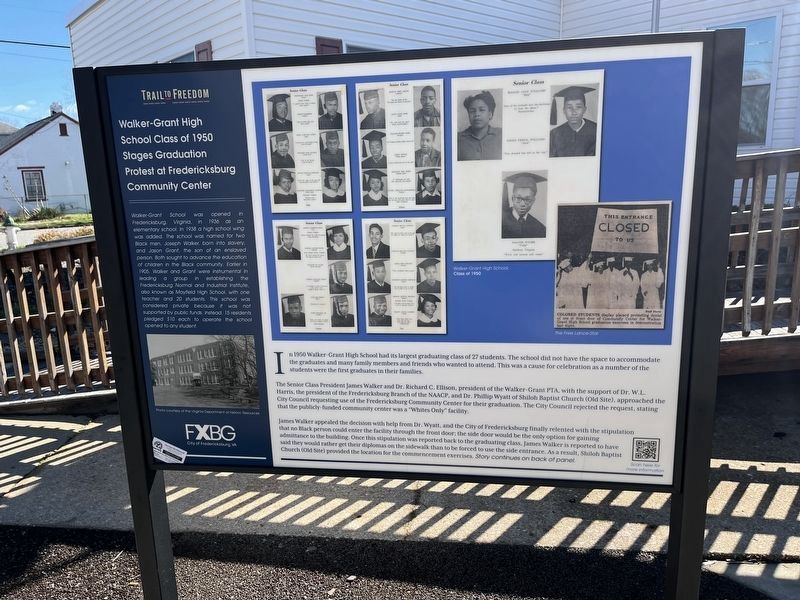
Walker-Grant School was opened in Fredericksburg, Virginia, in 1936 as an elementary school. In 1938 a high school wing was added. The school was named for two Black men, Joseph Walker, born into slavery, and Jason Grant, the son of an enslaved person. Both sought to advance the education of children in the Black community. Earlier in 1905, Walker and Grant were instrumental in leading a group in establishing the Fredericksburg Normal and Industrial Institute also known as Mayfield High School, with one teacher and 20 students. This school was considered private because it was not supported by public funds. Instead, 15 residents pledged $10 each to operate the school opened to any student.
In 1950 Walker-Grant High School had its largest graduating class of 27 students. The school did not have the space to accommodate the graduates and many family members and friends who wanted to attend. This was a cause for celebration as a number of the students were the first graduates in their families.
The Senior Class President James Walker and Dr. Richard C. Ellison, president of the Walker-Grant PTA, with the support of
this page online
James Walker appealed the decision with help from Dr. Wyatt, and the City of Fredericksburg finally relented with the stipulation that no Black person could enter the facility through the front door; the side door would be the only option for gaining admittance to the building. Once this stipulation was reported back to the graduating class, James Walker is reported to have said they would rather get their diplomas on the sidewalk than be forced to use the side entrance. As a result, Shiloh Baptist Church (Old Site) provided the location for the commencement exercises.
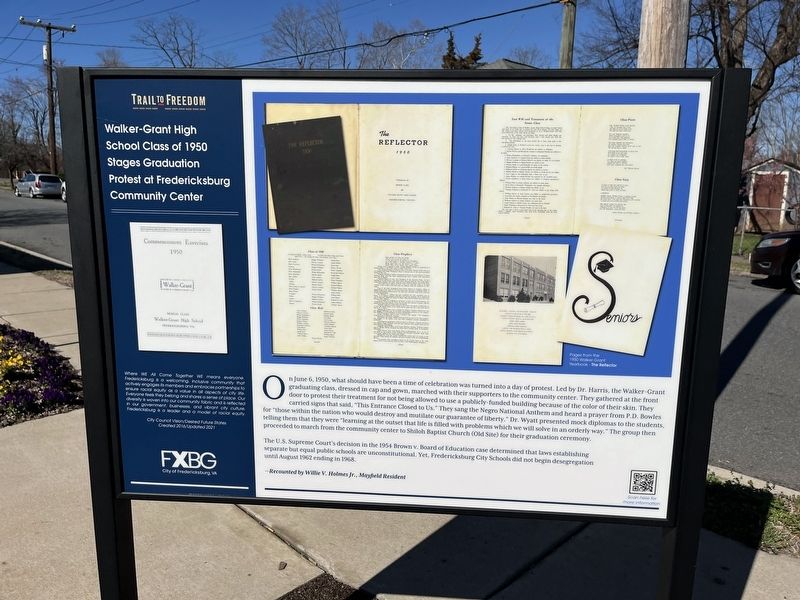
On June 6, 1950, what should have been a time of celebration was turned into a day of protest. Led by Dr. Harris, the Walker-Grant graduating class, dressed in cap and gown, marched with their supporters to the
By Devry Becker Jones (CC0), March 4, 2023
2. Walker-Grant High School Class of 1950 Stages Graduation Protest at Fredericksburg Community Center
The U.S. Supreme Court's decision in the 1954 Brown v. Board of Education case determined that laws establishing separate but equal public schools are unconstitutional. Yet, Fredericksburg City Schools did not begin desegregation until August 1962 ending in 1968.
Recounted by Willie V. Holmes Jr., Mayfield Resident
Where We All Come Together We means everyone. Fredericksburg is a welcoming, inclusive community that actively encourages its members and embraces partnerships to ensure racial equity as a value in all aspects of city life. Everyone feels they belong and shares a sense of place. Our diversity is woven into our community fabric and is reflected in our government, businesses, and vibrant city culture. Fredericksburg is a leader and a model of racial equity.
Created 2016/Updated 2021
Erected 2023

Topics. This historical marker is listed in these topic lists: African Americans • Charity & Public Work • Civil Rights • Education. A significant historical date for this entry is June 6, 1950.
Location. 38° 18.504′ N, 77° 27.929′ W. Marker is in Fredericksburg, Virginia. It is on Canal Street just west of Charles Street, on the left when traveling west. Touch for map. Marker is at or near this postal address: 403 Canal St, Fredericksburg VA 22401, United States of America. Touch for directions.

Regionally, this marker is in the Washington Metropolitan Area and in Northern Virginia. It is also in the American South and specifically in the Upper South. Globally, it is in North America, the Western Hemisphere, the Western World, and the Anglosphere. Historically, it finds itself in what was once the territory of the Mississippian Culture, one of the original Thirteen Colonies, one of the Confederate States of America, and the Antebellum South.
Other nearby markers. At least 8 other markers are within walking distance of this marker: A Canal Defines Its Neighborhood (about 300 feet away, measured in a direct line); French John's Wharf (about 800 feet away); Water Powered Industries (approx. 0.2 miles away); Rappahannock River Heritage Trail (approx. 0.2 miles away); 1868 (approx. 0.2 miles away); 1883 (approx. 0.2 miles away); Fredericksburg Granite (approx. ¼ mile away); 1856 (approx. ¼ mile away). Touch for a list and map of all markers in Fredericksburg.
Another marker is no longer nearby. A Canal Defines its Neighborhood (was about 400 feet away but has been replaced with another marker now near it).
Credits. This page was last revised on March 12, 2023. It was originally submitted on March 4, 2023, by Devry Becker Jones of Washington, District of Columbia. This page has been viewed 603 times since then and 37 times this year. Last updated on March 12, 2023, by Carl Gordon Moore Jr. of North East, Maryland. Photos: 1, 2, 3. submitted on March 4, 2023, by Devry Becker Jones of Washington, District of Columbia. • J. Makali Bruton was the editor who published this page.
