Delft, South Holland, Netherlands — Northwestern Europe
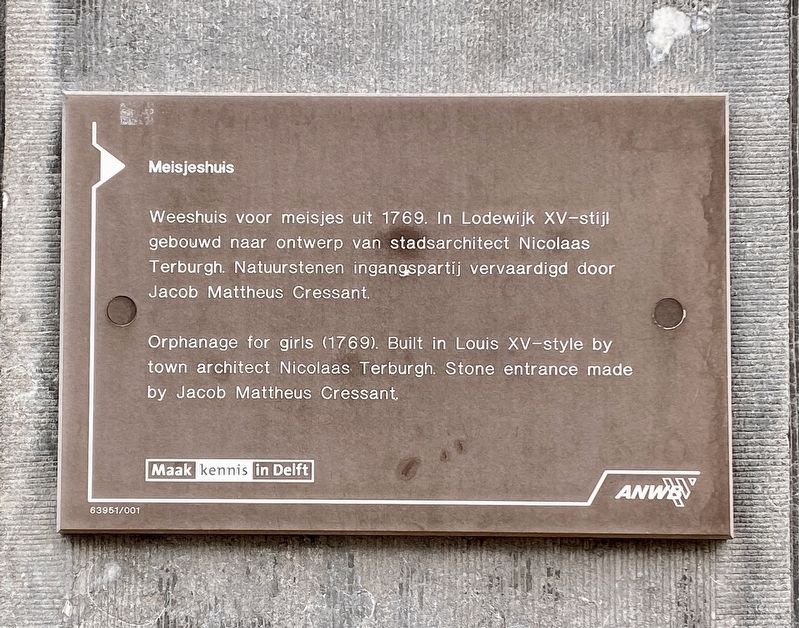
Meisjeshuis
⎯⎯⎯
Orphanage for Girls
Photographed by Andrew Ruppenstein, March 11, 2023
1. Meisjeshuis / Orphanage for Girls Marker

Weeshuis voor meisjes uit 1769. In Lodewijk XV-stijl gebouwd naar ontwerp van stadsarchitect Nicolaas Terburgh. Natuurstenen ingangspartij vervaardigd door Jacob Mattheus Cressant.
Erected by The ANWB, VVV.
Topics. This historical marker is listed in these topic lists: Charity & Public Work • Women. A significant historical year for this entry is 1769.
Location. 52° 0.665′ N, 4° 21.4′ E. Marker is in Delft, Zuid-Holland (South Holland). It is on Oude Delft, on the right when traveling north. Touch for map. Marker is at or near this postal address: Oude Delft 116, Delft, Zuid-Holland 2611 BL, Netherlands. Touch for directions.

Regionally, it is in Europe, the European Union, Atlantic Europe, the Benelux Low Countries, the Schengen Area, Western Europe, and the Western World. Historically, it finds itself in what was once the Roman Empire and specifically also the Holy Roman Empire.
Other nearby markers. At least 8 other markers are within walking
this page online
Also see . . .
1. De geschiedenis van het Meisjeshuis in Delft (Geschiednis van Zuid-Holland, in Dutch). Extensive article covering the use of the location, both as a “sister house” and as an orphanage for girls.
On its earlier use as a sister house (in translation): There is quite a bit of confusion in the historical literature about the character of the Holy Ghost Sisters' House. That is not surprising, because it is also referred to variously in contemporary sources as 'gasthuis', 'convent' or 'sister's house'. The first term suggests that(Submitted on March 14, 2023.)it was a kind of hospital where nursing took place, the last two seem to indicate a monastic status. But in fact it was none of them: no patients lived in the house, and the sisters were not monastics. The sisters formed a community together and religion formed a large part of their daily activities, but they did not take the vows of poverty, chastity and obedience as monastics did.Photographed by Andrew Ruppenstein, March 11, 20232. Meisjeshuis / Orphanage for Girls Marker - wide viewThe marker is visible here just to the left of the doorway.
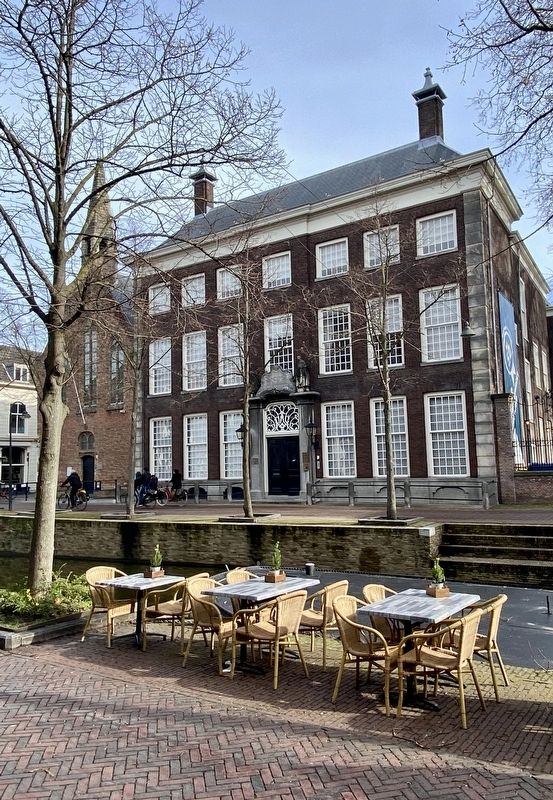
2. Meisjeshuis (Delft) (Wikipedia, in Dutch).
On the orphanage (in translation): Between 1578 and 1954, the Girls' House was an orphanage for half-orphaned girls from Reformed families. The girls had to have at least one living parent… Initially there were 18 half orphans, but the new building had room for 32 girls. The orphaned girls had to be between 6 and 10 years old when they entered the orphanage and be of legal birth. Entry was not free; everyone had to bring in a bed with accessories or a Flemish pound, and also bring in a decent set of clothes. When a pupil left the Girls' House (usually at the age of 18), she took back her inheritance. After the age of eighteen, the girls usually went into employment: they were well trained for this during their stay in the orphanage with education in language, arithmetic, religion, handicrafts and cooking. Every Sunday, the girls attended morning and afternoon services in the nearby Oude Kerk, to which they walked two by two. After church they were allowed to go home for a few hours, to the left-behind parent and possibly to brothers and/or sisters who still lived at home...(Submitted on March 14, 2023.)
Credits. This page was last revised on December 30, 2023. It was originally submitted on March 14, 2023, by Andrew Ruppenstein of Lamorinda, California. This page has been viewed 203 times since then and 13 times this year. Photos: 1, 2. submitted on March 14, 2023, by Andrew Ruppenstein of Lamorinda, California.
