Wawa in Algoma District, Ontario — Central Canada (North America)
Wawa's Logging Heritage

Photographed by Cosmos Mariner, June 7, 2022
1. Wawa's Logging Heritage Marker
Wawa's economy is based on our abundance of natural resources. Fur, fish, iron, gold, water and trees.
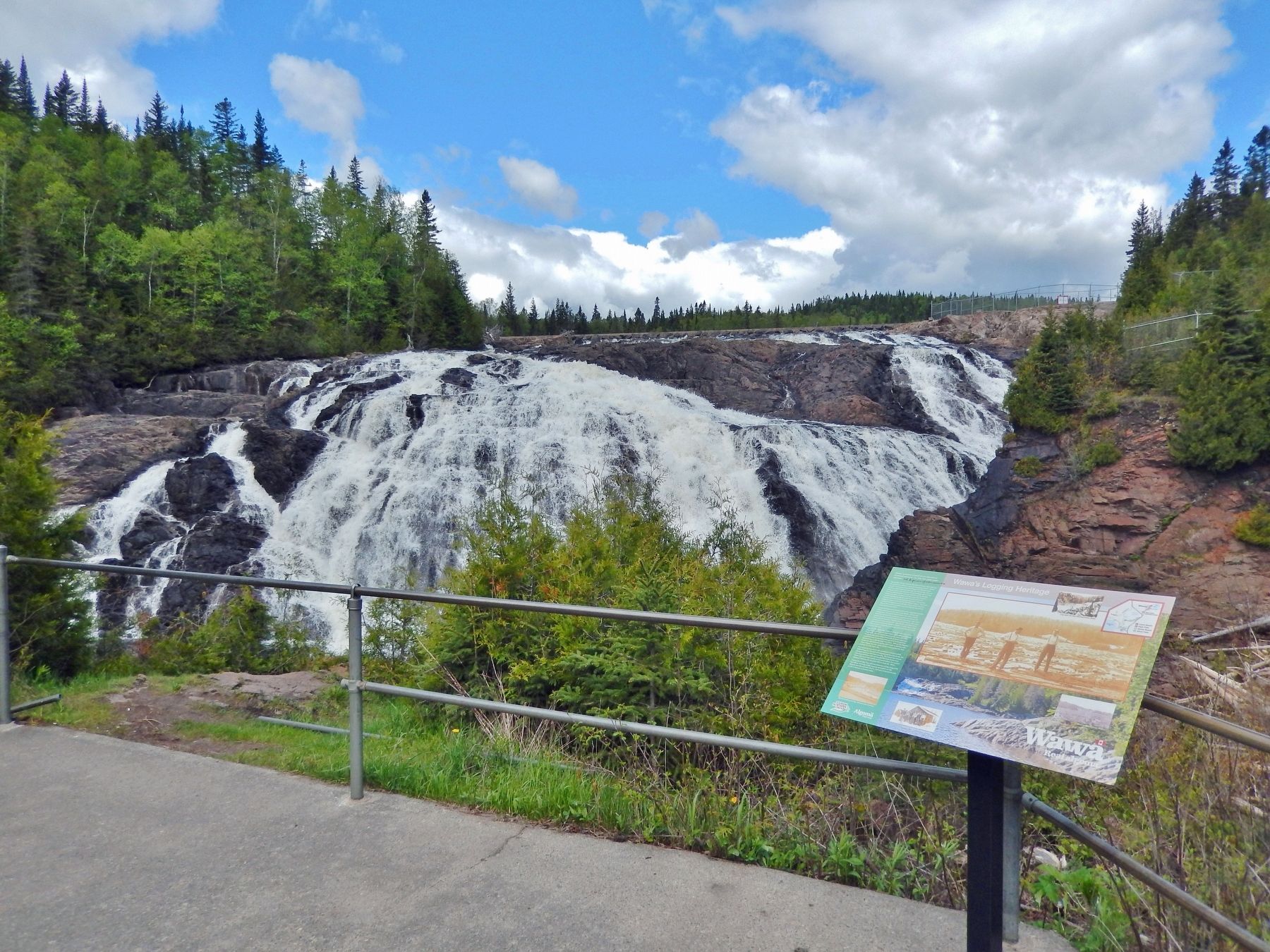
The jumble of logs found at the base of Scenic High Falls are the remnants of Wawa's important logging history. Wood was first harvested along the Magpie and Michipicoten Rivers in 1900. Pulpwood and logs for railway ties were cut along the brand new Algoma Central Railway right of way between Michipicoten Harbour and the newly opened Helen Iron Mine. Farmers and labourers from Eastern Canada looking for winter work would travel to the Michipicoten area to take up axe and saw in the remote logging camps scattered throughout the region. The main method of logging was to fell the trees by hand, haul the logs by horse on icy winter roads and pile the harvested wood onto frozen lakes.
A series of dams was constructed on the outgoing streams of these lakes to ensure high water levels. During the spring thaw, the wood would drift to the dams, which would be opened in a particular sequence to ensure the swiftest flush of wooden debris down the rocky, river bed to its next destination. Despite their best efforts, the rivers sometimes
this page online
Imagine the sight and sound of thousands of 8 and 4 foot pulp logs crashing over the 70 foot chasm here at Magpie High Falls. The 90 degree sweep of the river was often blocked with wood which had to be pushed, pried and prodded loose to continue the rest of its swift descent downstream to the Michipicoten River. Where the Magpie meets the Michipicoten below Silver Falls at Michipicoten River Village, the logs were rafted and prepared for their journey on Lake Superior.
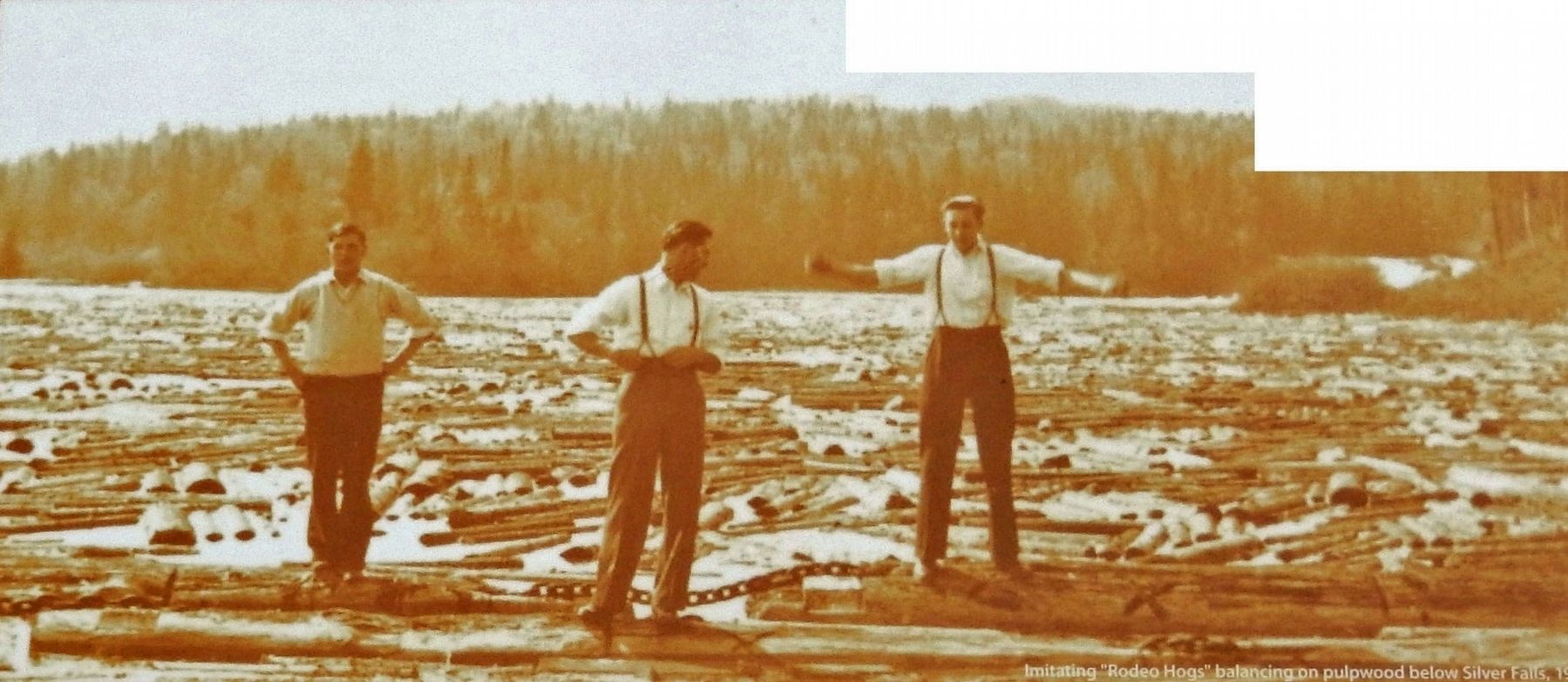
During spring log drives, the surefooted workers called Rodeo Hogs had the job of hopping and dancing across the floating logs near the river mouths. The wood was bound into huge wooden rafts surrounded by large boom logs. These rafts were then ready to be towed down the eastern Superior shoreline to the pulp mills in Sault Ste. Marie.
During World War Two, German Prisoners of War helped fill the labour shortage in the logging operations on the Magpie and Michipicoten Rivers. Forestry continues to
June 7, 2022
2. Marker detail: Imitating “Rodeo Hogs” balancing on pulpwood below Silver Falls, 1930
[other photo captions]
• Michipicoten River, 1930’s
• Log Jam on the Michipicoten River
Topics. This historical marker is listed in these topic lists: Horticulture & Forestry • Industry & Commerce • Settlements & Settlers • Waterways & Vessels. A significant historical year for this entry is 1900.
Location. 47° 57.56′ N, 84° 49.701′ W. Marker is in Wawa, Ontario, in Algoma District. It can be reached from Scenic High Falls Road (Pinewood Drive) 3.6 kilometers west of Trans-Canada Highway (Provincial Highway 17). Marker is located at the Magpie Falls Scenic Overlook. Touch for map. Marker is in this post office area: Wawa ON P0S 1K0, Canada. Touch for directions.

Regionally, this marker is in the Sault Ste. Marie and Algoma Area and in Northern Ontario. It is also in Central Canada. Globally, it is in North America, in the Great North Woods, on the Great Lakes, on Lake Superior’s North Shore, in the Western Hemisphere, in the Western World, and in the Anglosphere. Historically, it finds itself in what was once a British colony, the Viceroyalty of New France, the Haudenosaunee

3. Marker detail: Minnie M taking on logs, Michipicoten Harbour
Other nearby markers. At least 8 other markers are within 3 kilometers of this marker, measured as the crow flies: Glenn Gould (a few steps from this marker); Scenic High Falls Park Dedication (a few steps from this marker); Jack Legarde (within shouting distance of this marker); Reverend Father Dominique Chardon du Ranquet (within shouting distance of this marker); Michipicoten Ojibway (within shouting distance of this marker); Professor Lewis Agassiz (1807-1873) (approx. 2 kilometers away); Alexander Young Jackson (1882-1974) (approx. 2 kilometers away); Michipicoten Scenic Lookout (approx. 2.1 kilometers away). Touch for a list and map of all markers in Wawa.
Also see . . .
1. Wawa Heritage: Mining and Logging. Municipality website entry:
Gold, Iron Ore, and logging all helped build the foundation of what Wawa once was and continues to be today. European immigrants made their way to Wawa after the war and established themselves working in the newly formed gold mines. These gold mines led to other mining and logging in the area.(Submitted on March 22, 2023, by Cosmos Mariner of Cape Canaveral, Florida.)
2. Wawa, Ontario History.
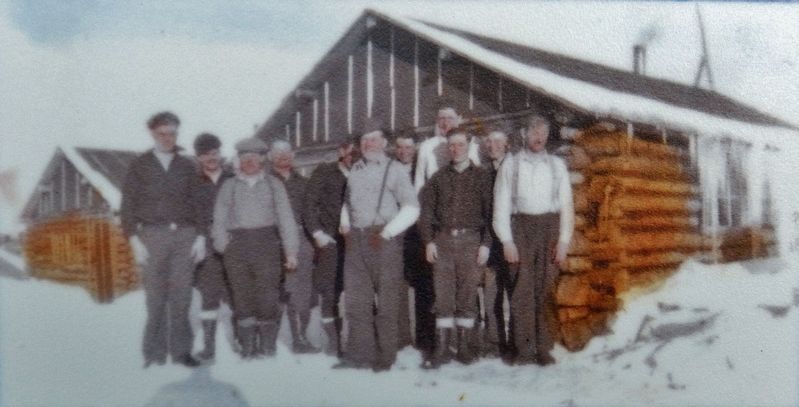
4. Marker detail: Logging Crew on the Firesand River
In October 2007 Weyerhauser, which operated an oriented strandboard mill 30 kilometres east of the town, announced an indefinite shutdown of its mill. The final production shift ran at the end of December 2007. Given low demand for wood products, the likelihood of the mill reopening was marginal at best. Since the shutdown, Wawa's economy has suffered a near complete collapse, as the closure resulted in over 135 lost jobs, and more residents left the area. This has had a spinoff effect on other businesses and on the town's population.(Submitted on March 22, 2023, by Cosmos Mariner of Cape Canaveral, Florida.)
3. The Life of a Lumberjack in Five Objects. Ontario Parks website entry:
In the early days of the country, much of Canada’s population was employed in the logging industry. For Ontario, logging was (and still is in the north) a major component of the economy and defined the settlement patterns of many of its communities, especially in northern Ontario.(Submitted on March 22, 2023, by Cosmos Mariner of Cape Canaveral, Florida.)
Photographed by Cosmos Mariner, June 7, 2022
5. Wawa's Logging Heritage Marker
Credits. This page was last revised on August 22, 2025. It was originally submitted on March 21, 2023, by Cosmos Mariner of Cape Canaveral, Florida. This page has been viewed 564 times since then and 98 times this year. Photos: 1, 2, 3, 4, 5. submitted on March 22, 2023, by Cosmos Mariner of Cape Canaveral, Florida.
