
Scala in Milano in Città Metropolitana di Milano, Lombardy, Italy — Southern and Western Europe (Mediterranean)
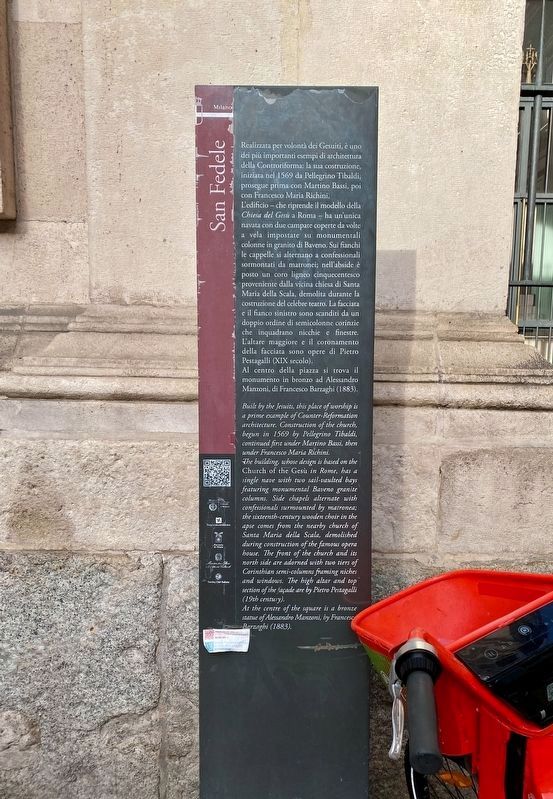
San Fedele
Photographed by Andrew Ruppenstein, March 15, 2023
1. San Fedele Marker

L'edificio - che riprende il modello della Chiesa del Gesù a Roma - ha un'unica navata con due campate coperte da volte a vela impostate su monumentali colonne in granito di Baveno. Sui fianchi le cappelle si alternano a confessionali sormontati da matronei; nell'abside è posto un coro ligneo cinquecentesco proveniente dalla vicina chiesa di Santa Maria della Scala, demolita durante la costruzione del celebre teatro. La facciata e il fianco sinistro sono scanditi da un doppio ordine di semicolonne corinzie che inquadrano nicchie e finestre. L'altare maggiore e il coronamento della facciata sono opere di Pietro Pestagalli (XIX secolo).
Al centro della piazza si trova il monumento in bronzo ad Alessandro Manzoni, di Francesco Barzaghi (1883).
this page online
The building, whose design is based on the Church of the Gesù in Rome, has a single nave with two sail-vaulted bays featuring monumental Baveno granite columns. Side chapels alternate with confessionals surmounted by matronea; the sixteenth-century wooden choir in the apse comes from the nearby church of Santa Maria della Scala, demolished during construction of the famous opera house. The front of the church and its north side are adorned with two tiers of Corinthian semi-columns framing niches and windows. The high altar and top section of the façade are by Pietro Pestagalli (19th century).
At the centre of the square is a bronze statue of Alessandro Manzoni, by Francesco Barzaghi (1883).
Topics and series. This historical marker is listed in these topic lists: Architecture • Religion & Religious Structures. In addition, it is included in the Milan Red-Gray Stelae series list. A significant historical year for this entry is 1569.
Location. 45° 27.992′ N, 9° 11.486′ E. Marker is in Milano,
Photographed by Andrew Ruppenstein, March 15, 2023
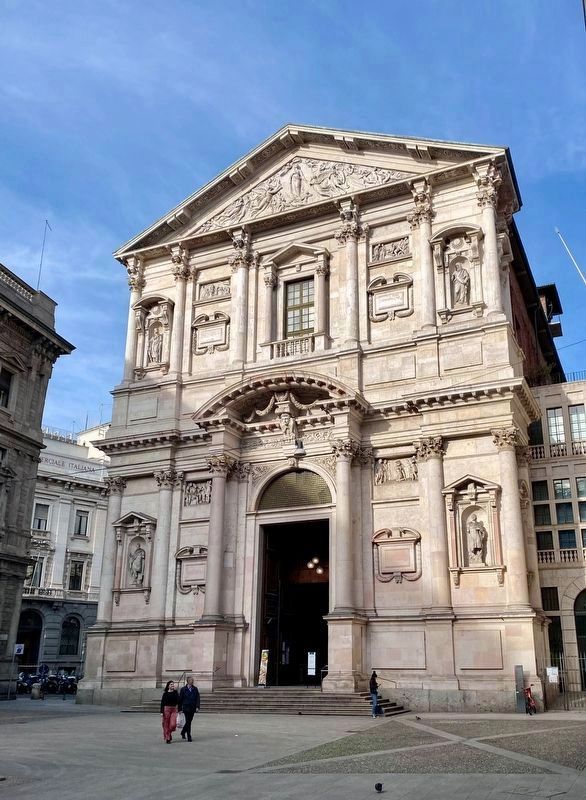
2. San Fedele Marker - wide view
The marker is visible here at the lower right corner of the church.

Regionally, it is in Europe, the European Union, the Schengen Area, a coastal Mediterranean country, and the Western World. Historically, it finds itself in what was once the Roman Empire and specifically also the Holy Roman Empire.
Other nearby markers. At least 8 other markers are within walking distance of this marker: Galleria Vittorio Emanuele II (about 120 meters away, measured in a direct line); Associazione Nazionale Alpini (about 120 meters away); San Raffaele (about 120 meters away); ‘Hotel Gestapo’ - L’Albergo Regina (about 180 meters away); Carlo Emilio Gadda (about 180 meters away); Palazzo Anguissola (about 180 meters away); Filippo Turati and Anna Kuliscioff (about 210 meters away); Museo Poldi Pezzoli (approx. 0.2 kilometers away). Touch for a list and map of all markers in Milano.
Also see . . . San Fedele, Milan (Wikipedia).
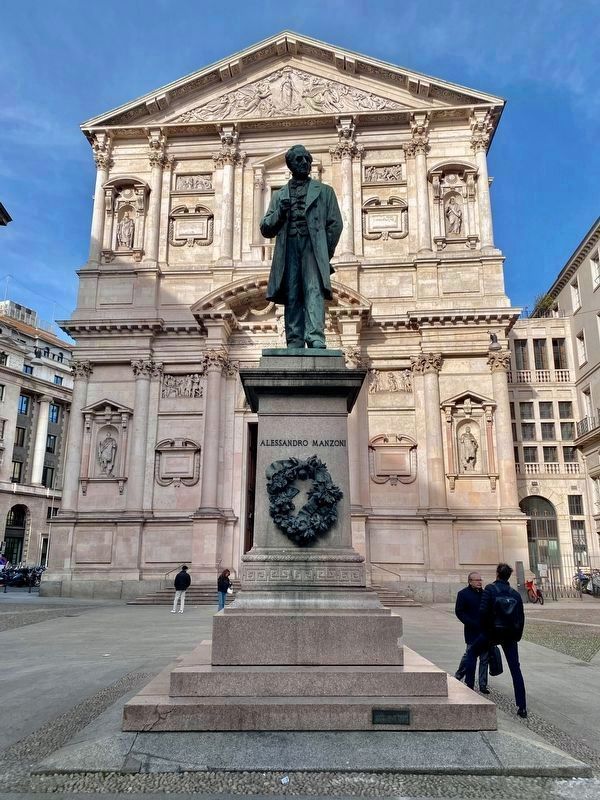
Overview(Submitted on April 2, 2023.)and history: San Fedele is a Jesuit church in Milan, northern Italy. It is dedicated to St. Fidelis of Como, patron of the Catholic diocese of Como. Presently it remains a parish church, owned by the Jesuit order, though focusing on religious works.Photographed by Andrew Ruppenstein, March 15, 20233. Statue of Alessandro Manzoni in Piazza San FedeleAlessandro Francesco Tommaso Antonio Manzoni (7 March 1785 – 22 May 1873) was an Italian poet, novelist and philosopher. He is famous for the novel The Betrothed (orig. Italian: I promessi sposi) (1827), generally ranked among the masterpieces of world literature. The novel is also a symbol of the Italian Risorgimento, both for its patriotic message and because it was a fundamental milestone in the development of the modern, unified Italian language. - Wikipedia
Located in Saint Fedele Square in the centre of the city, near the Palazzo Marino, the Teatro alla Scala and the Galleria Vittorio Emanuele II, the church was commissioned by Charles Borromeo from Pellegrino Tibaldi (1559). Outside of the church, in Piazza San Fedele, is a bronze statue (1883) in memory of the writer Alessandro Manzoni, who lived nearby, and who died from a head injury he received after a fall while exiting mass at San Fedele on 6 January 1873.
Credits. This page was last revised on April 2, 2023. It was originally submitted on April 1, 2023, by Andrew Ruppenstein of Lamorinda, California. This page has been viewed 321 times since then and 51 times this year. Photos: 1, 2. submitted on April 1, 2023, by Andrew Ruppenstein of Lamorinda, California. 3. submitted on April 2, 2023, by Andrew Ruppenstein of Lamorinda, California.
