
Missouri Botanical Garden in St. Louis, Missouri — The American Midwest (Upper Plains)
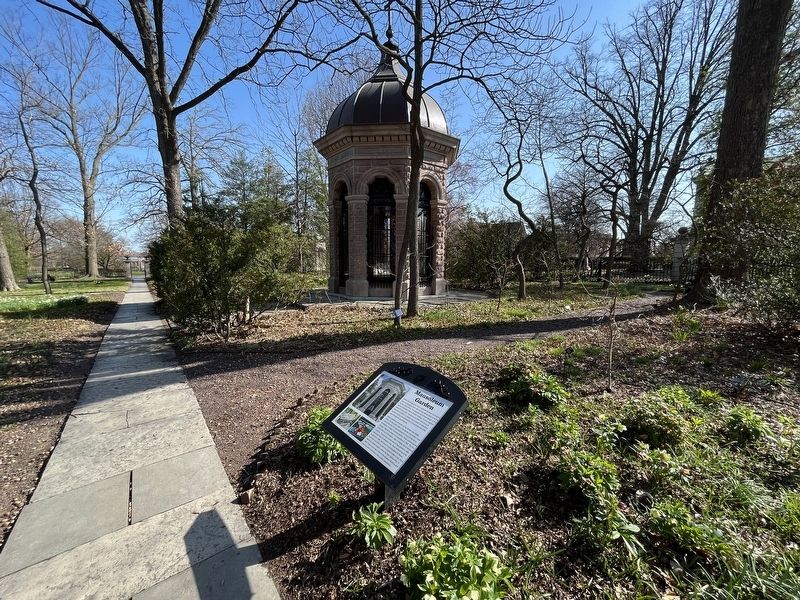
Mausoleum Garden
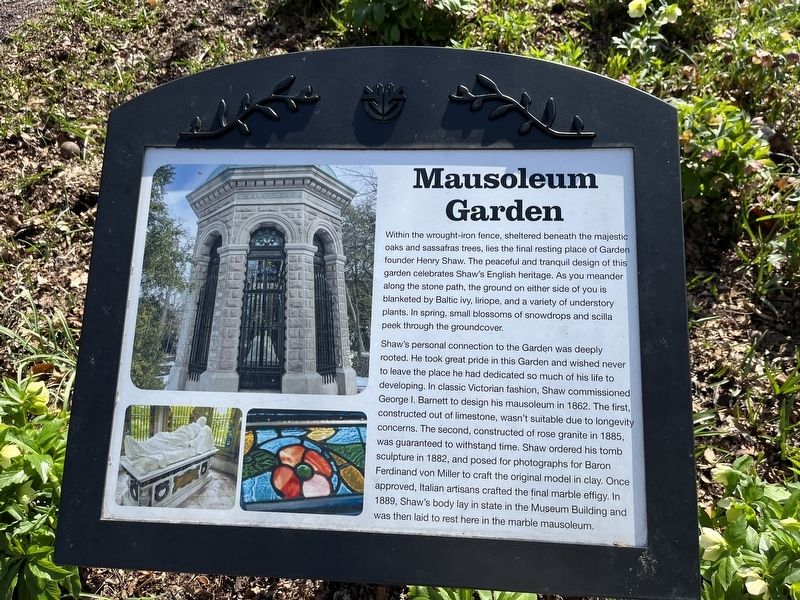
Shaw's personal connection to the Garden was deeply rooted. He took great pride in his Garden and wished never to leave the place he had dedicated so much of his life to developing. In classic Victorian fashion, Shaw commissioned George I. Barnett to design his mausoleum in 1862. The first, constructed out of limestone, wasn't suitable due to longevity concerns. The second, constructed of rose granite in 1885, was guaranteed to withstand time. Shaw ordered his tomb sculpture in 1882, and posed for photographs for Baron Ferdinand von Miller to craft the original model in clay. once approved, Italian artisans crafted the final marble effigy. In 1889, Shaw's body lay in state
this page online
Erected by Missouri Botanical Garden.
Topics. This historical marker is listed in these topic lists: Architecture • Arts, Letters, Music • Cemeteries & Burial Sites • Horticulture & Forestry. A significant historical year for this entry is 1862.
Location. 38° 36.72′ N, 90° 15.494′ W. Marker is in St. Louis, Missouri. It is in Missouri Botanical Garden. It can be reached from Shaw Boulevard west of Tower Grove Avenue, on the left when traveling west. Touch for map. Marker is at or near this postal address: 4344 Shaw Boulevard, Saint Louis MO 63110, United States of America. Touch for directions.

Regionally, this marker is in the American Midwest, in the Lewis & Clark Corridor, in the Corn Belt, and in the Great River Road Region. Globally, it is in North America, the Western Hemisphere, the Western World, and the Anglosphere. Historically, it finds itself in what was once the territory of the Mississippian Culture, the Louisiana Purchase, and the Antebellum South.
Other nearby markers. At least 8 other markers are within walking
Credits. This page was last revised on July 18, 2023. It was originally submitted on April 2, 2023, by Devry Becker Jones of Washington, District of Columbia. This page has been viewed 251 times since then and 56 times this year. Photos: 1, 2. submitted on April 2, 2023, by Devry Becker Jones of Washington, District of Columbia.
