Inner Harbor in Baltimore, Maryland — The American Northeast (Mid-Atlantic)
Spar Deck Guns
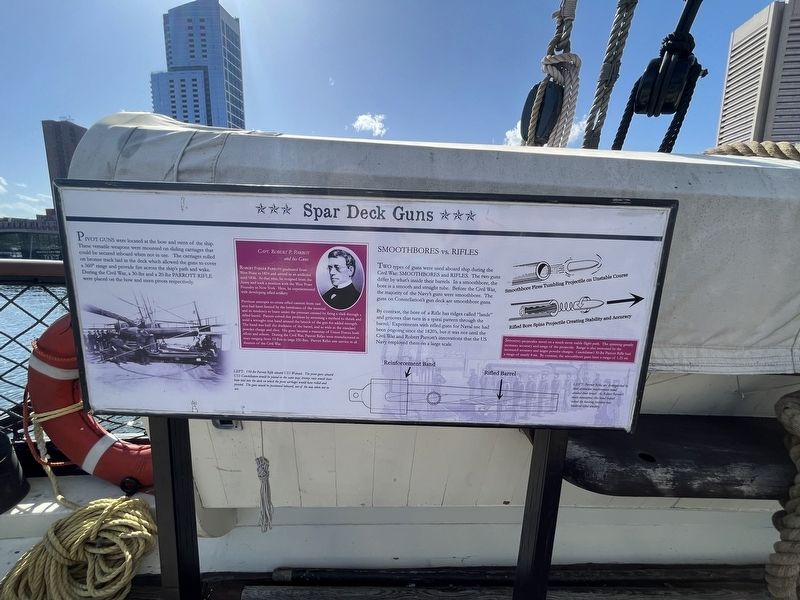
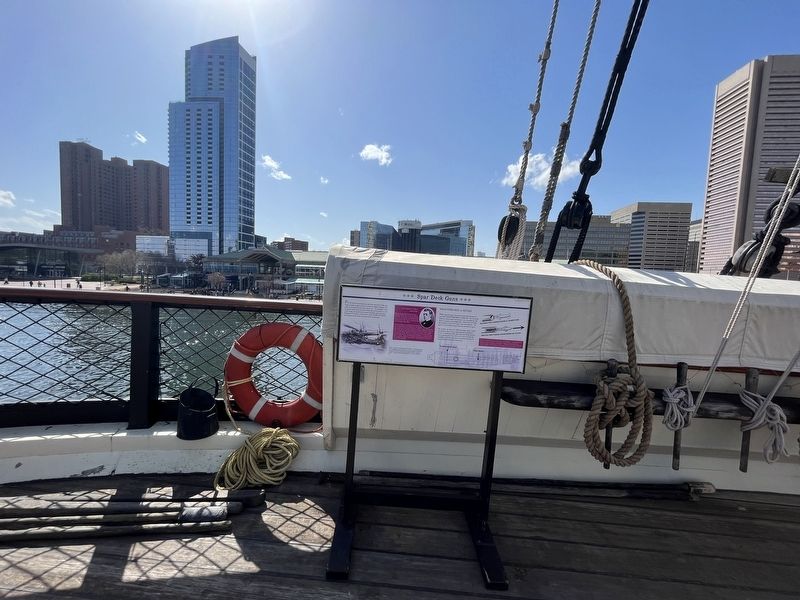
Pivot guns were located at the bow and stern of the ship. These versatile weapons were mounted on sliding carriages rolled on bronze track laid in the deck which allowed the guns to cover a 360° range and provide a fire across the ship's path and wake. During the Civil War, a 30-lbr and a 20-lbr Parrot Rifle were placed on the bow and stern pivots respectively.
Capt. Robert P. Parrot and his Guns
Robert Parker Parrot graduated from West Point in 1824 and served as an artillerist until 1836. At that time, he resigned from the Army and took a position with the West Point Foundry in New York. Here, he experimented with developing rifled artillery.
Previous attempts to create rifled cannon from cast iron had been limited by the brittleness of the material and its tendency to burst under the pressure created by firing a shell through a rifled barrel. Parrot solved this problem by inventing a method to shrink and weld a wrought-iron band around the breech of the gun for added strength. The band was half the thickness of the barrel, and as wide as the standard powder charge and shot. His guns became a mainstay of Union
this page online
Smoothbores vs. Rifles
Two types of guns were used aboard ship during the Civil War: smoothbores and rifles. The two guns differ by what's inside their barrels. In a smoothbore, the bore is a smooth and straight tube. Before the Civil War, the majority of the Navy's guns were smoothbore. The guns on Constellation's gun deck are smoothbore guns.
By contrast, the bore of a Rifle has ridges called "lands" and grooves that turn in a spiral pattern through the barrel. Experiments with rifled guns for Naval use had been ongoing since the 1820's, but it was not until the Civil War and Robert Parrott's innovations that the US Navy employed them on a large scale.
Spinning projectiles travel on a much more stable flight path. The spinning greatly increases accuracy and range of the projectile. Range is also increased by the increased accuracy and larger powder charges. Constellation's 30-lbr Parrot Rifle had a range of nearly 4 mi. By contrast,
[Captions:]
Left: 150-lbr Parrott Rifle aboard USS Wabash. The pivot guns aboard USS Constellation would be placed in the same way; bronze rails would have been laid into the deck on which the pivot carriages would have rolled and pivoted. The guns would be positioned inboard, out of the way when not in use.
Left: Parrott Rifles are distinguished by their distinctive reinforcement band around their breech. As Robert Parrott's main innovation, this band helped solved the bursting problem that hindered rifled artillery.
Erected by Historic Ships in Baltimore.
Topics. This historical marker is listed in these topic lists: War, US Civil • Waterways & Vessels. A significant historical year for this entry is 1824.
Location. 39° 17.121′ N, 76° 36.674′ W. Marker is in Baltimore, Maryland. It is in the Inner Harbor. It can be reached from East Pratt Street just east of Light Street (Maryland Route 2), on the right when traveling east. Touch for map. Marker is at or near this postal address: 301 E Pratt St, Baltimore MD 21230, United States of America. Touch for directions.

Regionally, this marker is in Central Maryland. It is also in the American Mid-Atlantic, in the Chesapeake Bay Region, and on the Eastern Seaboard. Globally, it is in the North Atlantic Region, North America, the Western Hemisphere, the Western World, and the Anglosphere. Historically, it finds itself in what was once one of the original Thirteen Colonies and also the Antebellum South.
Other nearby markers. At least 8 other markers are within walking distance of this marker: The Ship's Helm (here, next to this marker); Hammock Rails (a few steps from this marker); USS Constellation (within shouting distance of this marker); The Ship's Head (within shouting distance of this marker); Living Classrooms (about 400 feet away); a different marker also named The Port of Baltimore (about 400 feet away); An Active Port for 300 Years (about 400 feet away); Exodus 1947: "The ship That Launched a Nation" (about 400 feet away). Touch for a list and map of all markers in Baltimore.
Other markers no longer nearby. The Port of Baltimore (was within shouting distance of this marker but has been permanently removed); Baltimore’s Maritime Heritage (was about 300 feet away, measured in a direct line but has been permanently removed); Top of the World Observation Level World Trade Center (was about 400 feet away but has been permanently removed).
Credits. This page was last revised on April 3, 2023. It was originally submitted on April 3, 2023, by Devry Becker Jones of Washington, District of Columbia. This page has been viewed 261 times since then and 19 times this year. Photos: 1, 2. submitted on April 3, 2023, by Devry Becker Jones of Washington, District of Columbia.
