Winona in Montgomery County, Mississippi — The American South (East South Central)
Winona Jail Site
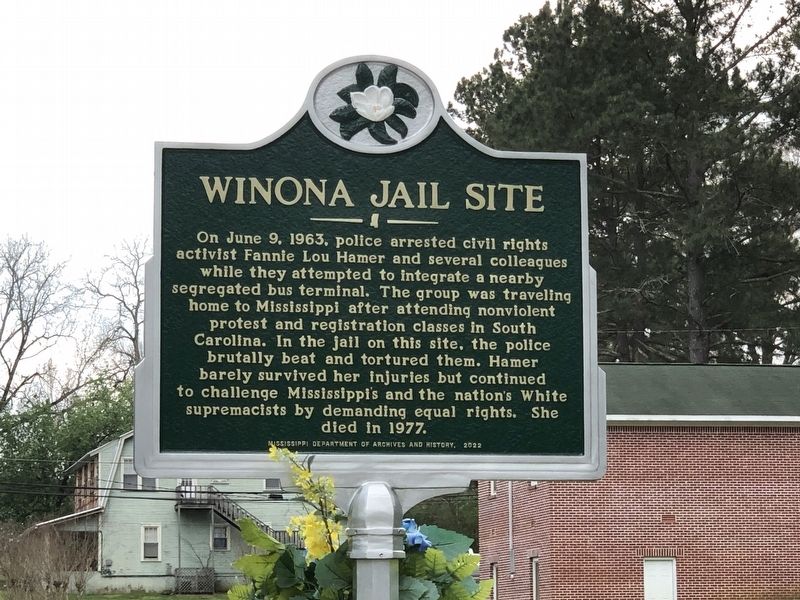
Photographed by Duane and Tracy Marsteller, March 31, 2023
1. Winona Jail Site Marker
Erected 2022 by Mississippi Department of Archives and History.
Topics and series. This historical marker is listed in these topic lists: African Americans • Civil Rights • Law Enforcement. In addition, it is included in the Mississippi State Historical Marker Program series list. A significant historical date for this entry is June 9, 1963.
Location. 33° 29.121′ N, 89° 43.768′ W. Marker is in Winona, Mississippi, in Montgomery County. It is at the intersection of Sterling Avenue and Oak Drive, on the right when traveling south on Sterling Avenue. Touch for map. Marker is at or near this postal address:
this page online

Regionally, this marker is in Central Mississippi. It is also in the American South, specifically in the Deep South, and in the Mississippi Delta. Globally, it is in North America, a Gulf of Mexico state, the Western Hemisphere, the Western World, and the Anglosphere. Historically, it finds itself in what was once the territory of the Mississippian Culture, one of the Confederate States of America, and the Antebellum South.
Other nearby markers. At least 8 other markers are within walking distance of this marker: Montgomery County Confederate Monument (approx. 0.2 miles away); George A. McLean (approx. 0.2 miles away); The "Final Spike" (approx. ¼ mile away); Immanuel Episcopal Church (approx. 0.3 miles away); Brutality in Winona (approx. 0.4 miles away); Jefferson Davis Memorial Highway (approx. 0.4 miles away); Roebuck "Pops" Staples (approx. half a mile away); Winona Confederate Monument (approx. ¾ mile away). Touch for a list and map of all markers in Winona.
Also see . . .
1. Beatings in Winona jail. This multimedia report
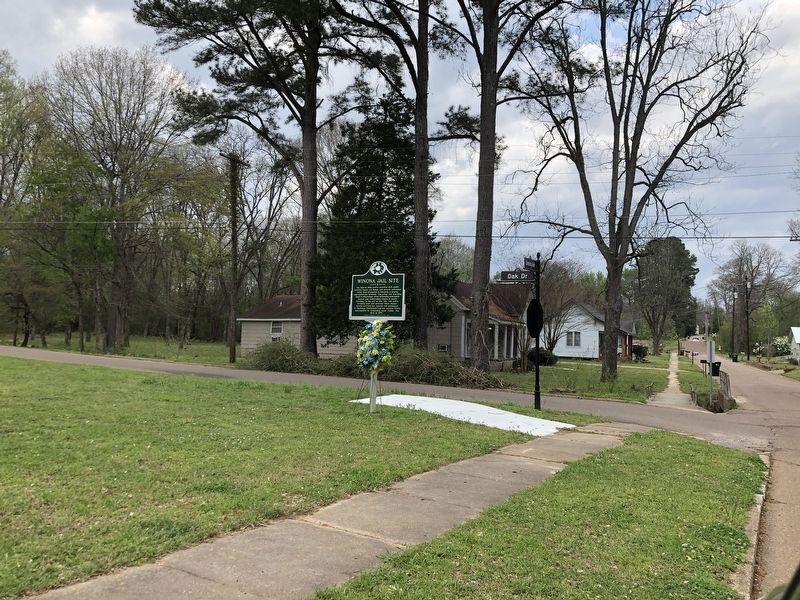
Photographed by Duane and Tracy Marsteller, March 31, 2023
2. Winona Jail Site Marker
2. Fannie Lou Hamer. A forced sterilization was one of the moments that set Hamer on the path to the forefront of the Mississippi Civil Rights movement, but the incident that brought her into a leadership role came a year later. (PBS, American Experience) (Submitted on April 5, 2023, by Duane and Tracy Marsteller of Murfreesboro, Tennessee.)
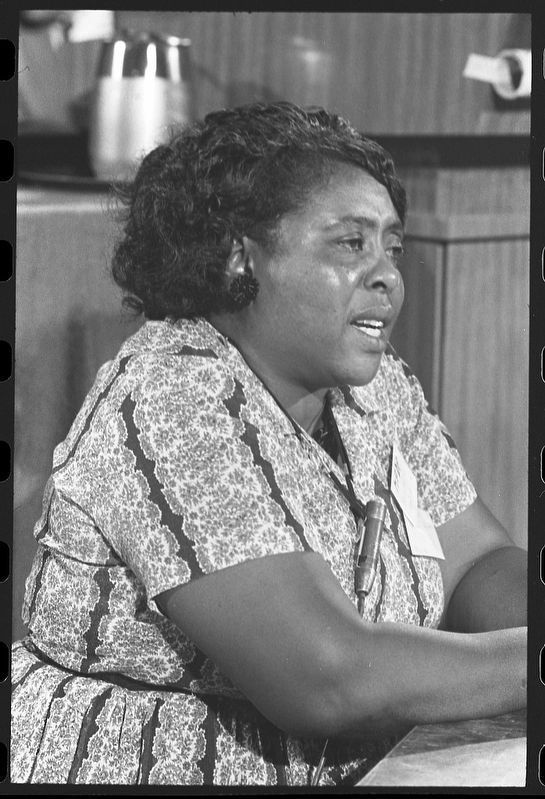
Warren K. Leffler via Library of Congress Prints and Photographs Division (Public Domain), August 22, 1964
3. Fannie Lou Hamer
Scarred from the jail beating, Hamer addresses the Credentials Committee at the Democratic Party's 1964 convention in Atlantic City. She and other Mississippi Freedom Democratic Party delegates were challenging the seating of the all-white Mississippi delegation. “Is this America, the land of the free and the home of the brave, where we … [are] threatened daily, because we want to live as decent human beings, in America?” she asked the committee while recounting Winona. President Lyndon B. Johnson, alarmed that Hamer's story could cost him the support of Southern Democrats, called an impromptu press conference to divert media attention from her.
Credits. This page was last revised on April 5, 2023. It was originally submitted on April 5, 2023, by Duane and Tracy Marsteller of Murfreesboro, Tennessee. This page has been viewed 339 times since then and 45 times this year. Photos: 1, 2, 3. submitted on April 5, 2023, by Duane and Tracy Marsteller of Murfreesboro, Tennessee.
