Waterloo in Monroe County, Illinois — The American Midwest (Great Lakes)
The Moore Family

Photographed by Thomas Smith, March 31, 2023
1. The Moore Family Marker
The Moore family left a distinguished mark on Waterloo's history.
Some time after settlement at Bellefontaine had been made, Captain James Moore, having established to some degree amicable relations with the Indians, took steps toward founding a business of barter with them. Moore formed a partnership with a wealthy French merchant, Gabriel Cerre, of St. Louis. Just as their efforts were met with success, Capt. James Moore died in 1788, aged 38.
Upon the settlement of his affairs, Cerre was said to have withheld the partnership assets from Moore's wife, who was left with six children, the eldest being fourteen and the youngest an infant. All neighbors and friends came to her help and put in her crop, so her children could stay at Bellefontaine.
Upon the settlement of his affairs, Cerre was said to have withheld the partnership assets from Moore's wife, who was left with six children, the eldest being fourteen and the youngest an infant. All neighbors and friends came to her help and put in her crop, so the her children could stay at Bellefontaine.
The oldest son of Captain James Moore was John Moore, born
this page online
William and Benjamin, the two next sons of the pioneer, died early in life.
The fourth son, James Biggs Moore, was born in Virginia in 1780. For some years, he traded on the Ohio and Mississippi rivers between New Orleans and Pittsburg. Realizing financial success, he settled three miles northeast of the present site of Waterloo on what was known as the tanyard farm. Here he invested in the tanning business, which was said to be the largest west of the Alleghenies. He organized a company of rangers in the War of 1812 under Gov. Ninian Edwards. On his return, Capt. Moore was appointed the first sheriff of Monroe County. Later he represented the county in the State Legislature. After his term, he established a mill on Prairie du Long Creek and a carding factory near his own homestead. He died at the tanyard farm in 1840.
The convention that framed
Photographed by Thomas Smith, March 31, 2023
2. The Moore Family Marker
Enoch Moore, the fifth son, was born at Bellefontaine in 1783 and is said to have been first Caucasian American child born in the State of Illinois. Enoch became a surveyor, and much of government surveying in this part of Illinois was done under his direction. About 1803 he married Miss Mary Whiteside. During the War of 1812 he was a private in the company of rangers commanded by his brother. He was a delegate to the convention that framed the first constitution of Illinois. In 1818, he platted the town of Waterloo. He died in 1848
Mary Moore, the sixth child, and only daughter, was born at Bellefontaine in 1784. She was married to Col. David Robinson on December 4, 1806.
J. Milton Moore, the youngest son, was born in 1786 at Bellefontaine. While a young boy, he accompanied an uncle, Zaccheus Biggs, to his Virginia home, where he was educated. Soon after he was 16, he was made surveyor of St. Clair County. He served in the rangers in the War of 1812, married Miss Mary Clarke in 1814 and they lived on the original site at Bellefontaine. The grant of 400 acres, claim 220, survey 394, covering the spring, remained in the possession of the J. Milton Moore heirs to and including the fifth generation.
Topics. This historical marker is listed in these topic lists: Immigration • Industry & Commerce • Patriots & Patriotism • Settlements & Settlers. A significant historical year for this entry is 1778.
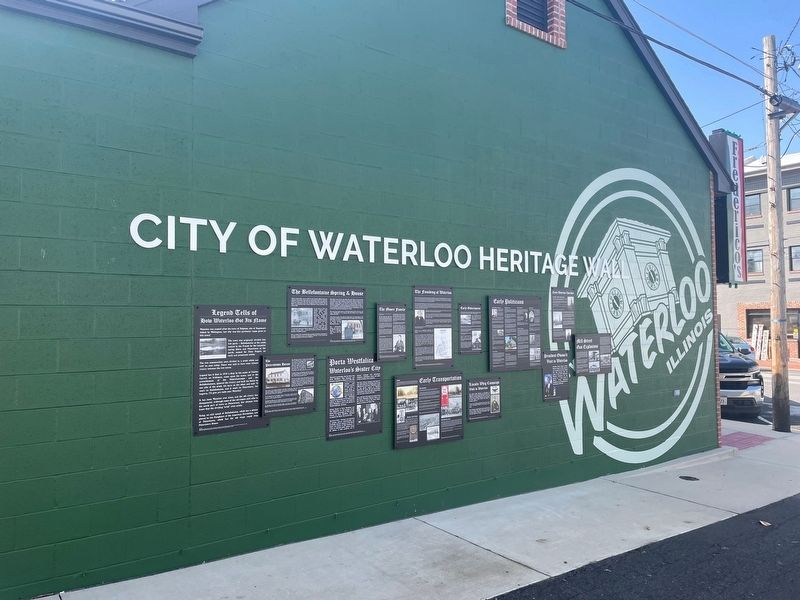
Location. 38° 20.203′ N, 90° 9.02′ W. Marker is in Waterloo, Illinois, in Monroe County. It is on North Main Street south of First Street, on the left when traveling south. The marker hangs on the north side of Frederico's Restaurant. Touch for map. Marker is at or near this postal address: 114 N Main St, Waterloo IL 62298, United States of America. Touch for directions.

Regionally, this marker is in Greater St. Louis. It is also in the American Midwest, in the Lewis & Clark Corridor, in the Corn Belt, and in the Great River Road Region. Globally, it is in North America, the Western Hemisphere, the Western World, and the Anglosphere. Historically, it finds itself in what was once the territory of the Mississippian Culture and also the Northwest Territory.
Other nearby markers. At least 8 other markers are within walking distance of this marker: President Obama's Visit to Waterloo (here, next to this marker); Lincoln Whig Campaign (here, next to this marker); Porta Westfalica (here, next to this marker); The Bellefontaine Spring & House (here, next to this marker); Legend Tells How Waterloo Got Its Name (here, next to this marker); The Peterstown House (here, next to this marker); Early Politicians (here, next to this marker); Mill Street Gas Explosions (here, next to this marker). Touch for a list and map of all markers in Waterloo.
Credits. This page was last revised on April 8, 2023. It was originally submitted on April 7, 2023, by Thomas Smith of Waterloo, Ill. This page has been viewed 1,045 times since then and 90 times this year. Photos: 1, 2. submitted on April 7, 2023, by Thomas Smith of Waterloo, Ill. • Devry Becker Jones was the editor who published this page.
