
Cerchia dei Navigli in Milano in Città Metropolitana di Milano, Lombardy, Italy — Southern and Western Europe (Mediterranean)
Piazza dei Mercanti
⎯⎯⎯
Merchants Square
Photographed by Andrew Ruppenstein, March 15, 2023
1. Piazza dei Mercanti / Merchants Square Marker

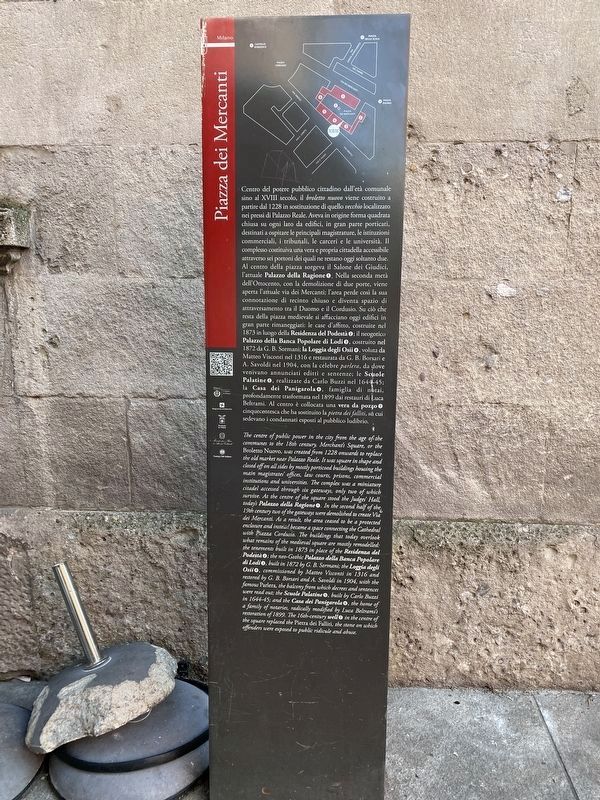
Centro del potere pubblico cittadino dall'età comunale sino al XVIII secolo, il broletto nuovo viene costruito a partire dal 1228 in sostituzione di quello vecchio localizzato nei pressi di Palazzo Reale. Aveva in origine forma quadrata chiusa su ogni lato da edifici, in gran parte porticati, destinati a ospitare le principali magistrature, le istituzioni commerciali, i tribunali, le carceri e le università. Il complesso costituiva una vera e propria cittadella accessibile attraverso sei portoni dei quali ne restano oggi soltanto due. Al centro della piazza sorgeva il Salone dei Giudici, l'attuale Palazzo della Ragione (1). Nella seconda metà dell'Ottocento, con la demolizione di due porte, viene aperta l'attuale via dei Mercanti; l'area perde così la sua connotazione di recinto chiuso e diventa spazio di attraversamento tra il Duomo e il Cordusio. Su ciò che resta della piazza medievale si affacciano oggi edifici in gran parte rimaneggiati: le case d'affitto, costruite nel 1873 in luogo della Residenza del Podestà (2); il neogotico Palazzo della Banca Popolare di Lodi (3), costruito nel 1872
this page online
Photographed by Andrew Ruppenstein, March 15, 2023
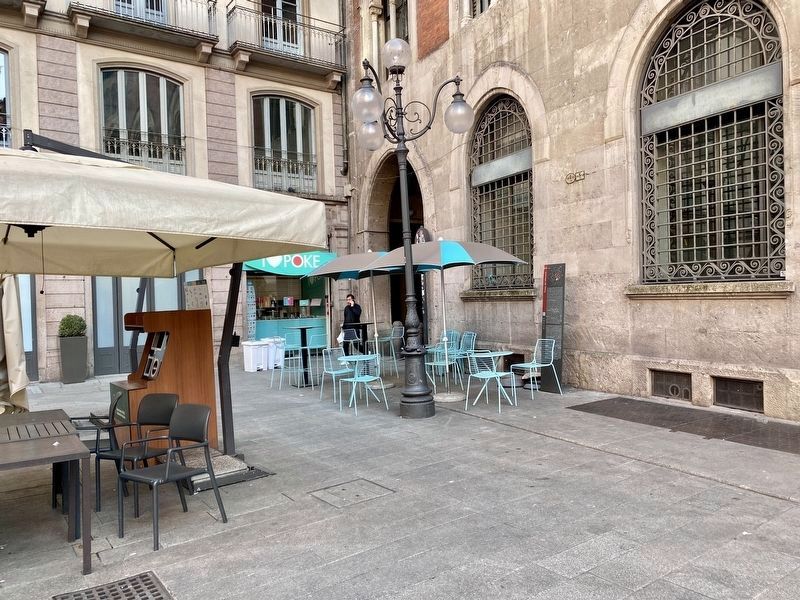
2. Piazza dei Mercanti / Merchants Square Marker - wide view
Topics and series. This historical marker is listed in this topic list: Notable Places. In addition, it is included

Photographed by Andrew Ruppenstein, March 15, 2023
3. Piazza dei Mercanti / Merchants Square, looking south from the marker
Location. 45° 27.866′ N, 9° 11.272′ E. Marker is in Milano, Lombardia (Lombardy), in Città Metropolitana di Milano. It is in Cerchia dei Navigli. It is on Piazza dei Mercanti, on the right when traveling south. Touch for map. Marker is at or near this postal address: Piazza dei Mercanti 7, Milano, Lombardia 20123, Italy. Touch for directions.

Regionally, it is in Europe, the European Union, the Schengen Area, a coastal Mediterranean country, and the Western World. Historically, it finds itself in what was once the Roman Empire and specifically also the Holy Roman Empire.
Other nearby markers. At least 8 other markers are within walking distance of this marker: Palazzo della Ragione (within shouting distance of this marker); Piazza Duomo (within shouting distance of this marker); Ernest Hemingway (about 120 meters away, measured in a direct line); Amatore Sciesa (about 150 meters away); Palazzo dell’Ambrosiana (about 180 meters away); Santa Maria presso San Satiro (about 180 meters away); Filippo Turati and Anna Kuliscioff (about 180 meters
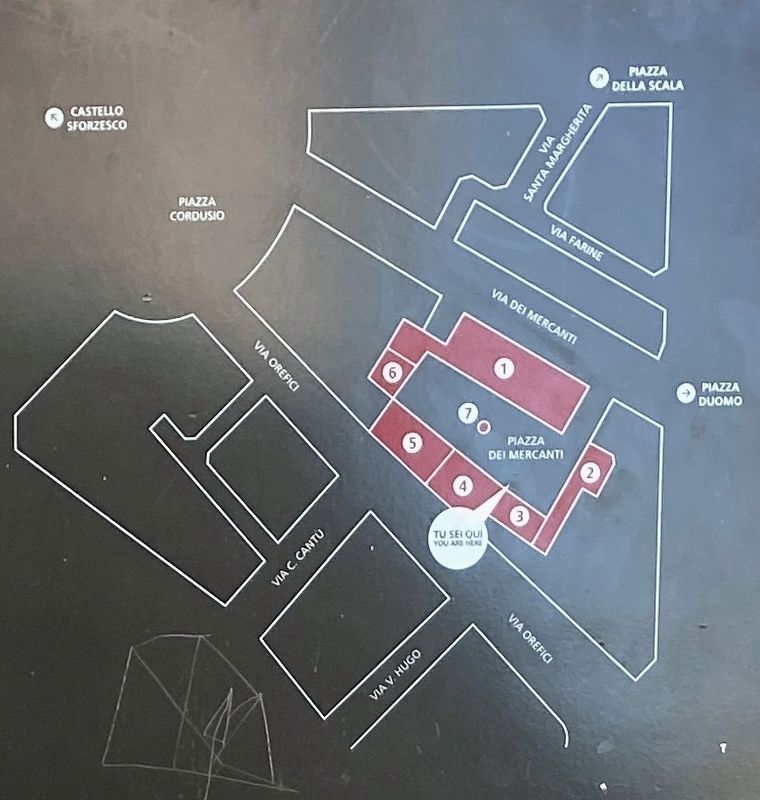
4. Marker inset map
Also see . . . Piazza Mercanti (Wikipedia).
Overview: Piazza Mercanti ("Merchants Square") is a central city square of Milan, Italy. It is located between Piazza del Duomo, which marks the centre of the modern city of Milan, and Piazza Cordusio, and it used to be the heart of the city in the Middle Ages...(Submitted on April 8, 2023.)
Credits. This page was last revised on April 8, 2023. It was originally submitted on April 8, 2023, by Andrew Ruppenstein of Lamorinda, California. This page has been viewed 132 times since then and 22 times this year. Photos: 1, 2, 3, 4. submitted on April 8, 2023, by Andrew Ruppenstein of Lamorinda, California.
