Salem in Essex County, Massachusetts — The American Northeast (New England)
The Pedrick Store House
Photographed by J. Makali Bruton, July 1, 2015
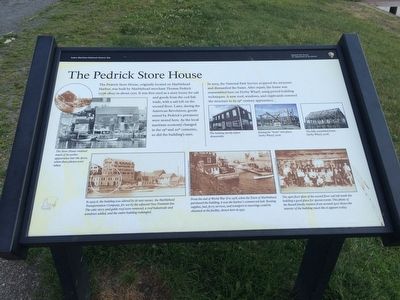
1. The Pedrick Store House Marker
In 2003, the National Park Service acquired the structure and dismantled the frame. After repair, the frame was reassembled here on Derby Wharf, using period building techniques. A new roof, windows, and clapboards restored the structure to its 19th century appearance.
Captions:
The Store House retained much of its earlier appearance into the 1900s, when these photos were taken.
The building shortly before disassembly.
Raising the “bents” into place, Derby Wharf, 2008.
The fully assembled frame, Derby Wharf, 2008.
In 1905-6, the building was altered by its new owner, the Marblehead Transportation Company, for use by the adjacent New Fountain Inn. The attic story and gable
this page online
From the end of World War II to 1978, when the Town of Marblehead purchased the building, it was the harbor’s commercial hub. Boating supplies, fuel, ferry services, and transport to moorings could be obtained at the facility, shown here in 1950.
The open floor plan of the second floor sail loft made the building a good place for special events. This photo of the Russell family reunion from around 1900 shows the interior of the building much like it appears today.
Erected by National Park Service.
Topics. This historical marker is listed in these topic lists: Colonial Era • Industry & Commerce. A significant historical year for this entry is 1770.
Location. Marker has been reported permanently removed. It was located near 42° 31.245′ N, 70° 53.201′ W. Marker was in Salem, Massachusetts, in Essex County. It could be reached from Derby Street. Touch for map. Marker was at or near this postal address: 177 Derby Street, Salem MA 01970, United States of America.
We have been informed that this marker is no longer there and will not
Photographed by J. Makali Bruton, July 1, 2015
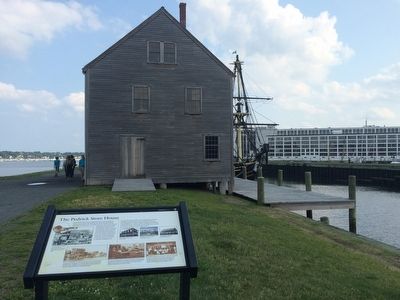
2. The Pedrick Store House Marker
The Pedrick Store House is in the background.
Regionally, this marker was on the North Shore, in Greater Boston, and in the Merrimack Valley. It was also in the American Northeast, in New England, and on the Eastern Seaboard. Globally, it was in the North Atlantic Region, North America, the Western Hemisphere, the Western World, and the Anglosphere. Historically, it found itself in what was once one of the original Thirteen Colonies.

Other nearby markers. At least 8 other markers are within walking distance of this location: Wharves in the Early 1800s (here, next to this marker); Pedrick Store House, 1770 (a few steps from this marker); Friendship of Salem (within shouting distance of this marker); a different marker also named Friendship of Salem (within shouting distance of this marker); a different marker also named Derby Wharf (within shouting distance of this marker); Wharves in the late 1800's (within shouting distance of this marker); a different marker also named The Custom House (within shouting distance of this marker); a different marker also named Central Wharf (about 300 feet away, measured in a direct line). Touch for a list and map of all markers in Salem.
Other markers no longer nearby. Wharves in the Late 1800s (was within shouting distance of this marker but has been replaced with another marker now near it); Central Wharf (was within shouting distance of this marker but has been confirmed missing); Salem Maritime National Historic Site (was within shouting distance of this marker but has been confirmed missing); Derby Wharf (was within shouting distance of this marker but has been confirmed missing); The Custom House (was within shouting distance of this marker but has been replaced with another marker now near it).
More about this marker. The marker was replaced by the nearby Wharves in the Early 1800s Marker.
Credits. This page was last revised on April 21, 2023. It was originally submitted on July 30, 2015, by J. Makali Bruton of Washington, District of Columbia. This page has been viewed 667 times since then and 26 times this year. Last updated on April 18, 2023, by Craig Doda of Napoleon, Ohio. Photos: 1, 2. submitted on July 30, 2015, by J. Makali Bruton of Washington, District of Columbia.
