Dundas in Hamilton, Ontario — Central Canada (North America)
Dundas Street
⎯⎯⎯
La Rue Dundas
Photographed by Tim Boyd
1. Dundas Street / La Rue Dundas Marker

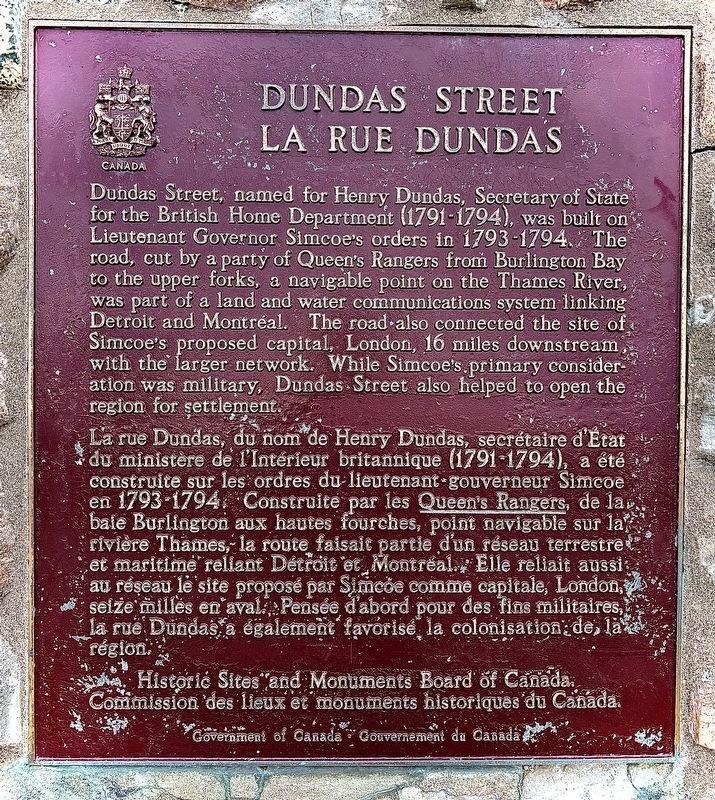
Dundas Street, named for Henry Dundas, Secretary of State for the British Home Department (1791-1794), was built on Lieutenant Governor Simcoe's orders in 1793-1794. The road, cut by a party of Queen's Rangers from Burlington Bay to the upper forks, a navigable point on the Thames River, was part of a land and water communications system linking Detroit and Montréal. The road also connected the site of Simcoe's proposed capital, London, 16 miles downstream, with the larger network. While Simcoe's primary consideration was military, Dundas Street also helped to open the region for settlement.
La rue Dundas, du nom de Henry Dundas, secrétaire d'État du ministère de l'Intérieur britannique (1791-1794), a été construite sur les ordres du lieutenant-gouverneur Simcoe en 1793-1794. Construite par les Queen's Rangers, de la bale Burlington aux hautes fourches, point navigable sur la rivière Thames, la route faisait partie d'un réseau terrestre et maritime reliant Détroit et Montréal. Elle reliait aussi au réseau le site proposé par Simcoe comme capitale, London, seize milles en aval.
this page online
Erected by Historic Sites and Monuments Board of Canada.
Topics and series. This historical marker is listed in this topic list: Roads & Vehicles. In addition, it is included in the Canada, Historic Sites and Monuments Board series list. A significant historical year for this entry is 1793.
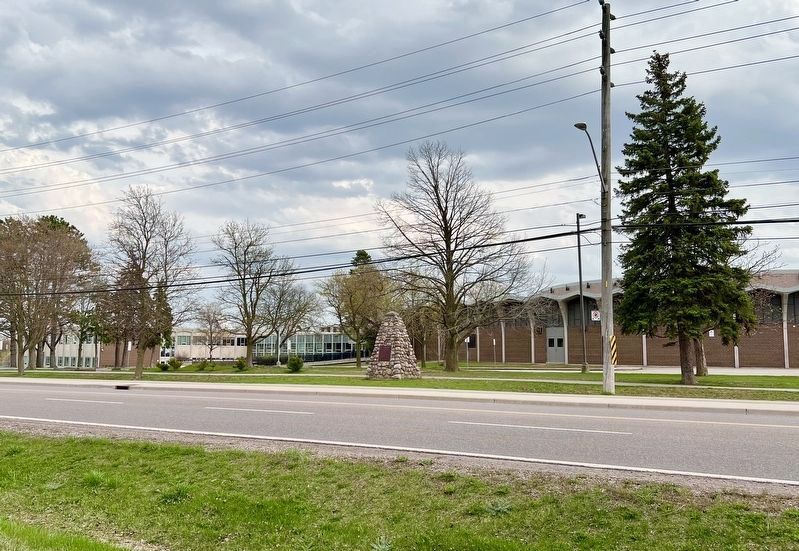
Location. 43° 15.51′ N, 79° 58.631′ W. Marker is in Hamilton, Ontario. It is in Dundas. It is on The Governor’s Road 0.1 kilometers east of Bridelwood Drive, on the left when traveling west. The marker is in the historic town of Dundas, now part of the City of Hamilton. Touch for map. Marker is in this post office area: Hamilton ON L9H L9H, Canada. Touch for directions.

Regionally, this marker is on Ontario’s Golden Horseshoe, in the Hamilton-Halton-Brant Area, and specifically in the Toronto Metropolitan Area. It is also in Central Canada. Globally, it is in North America, on the Great Lakes, in the Western Hemisphere, in the Western World, and in the Anglosphere. Historically, it finds itself in what was once a British
Photographed by Tim Boyd, April 21, 2023
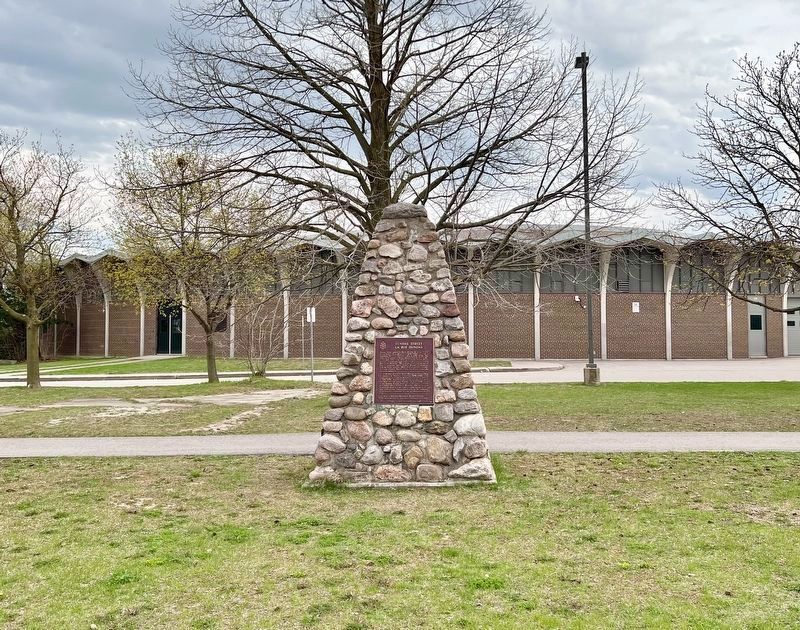
2. Dundas Street / La Rue Dundas Marker
Other nearby markers. At least 8 other markers are within 3 kilometers of this marker, measured as the crow flies: The 25-Pounder Gun/Howitzer (approx. 1.5 kilometers away); 102nd Wentworth Field Battery, Royal Canadian Artillery (approx. 1.5 kilometers away); Dundas Cenotaph (approx. 1.5 kilometers away); Gwyn Memorial Sundial 1927 (approx. 1.8 kilometers away); Bertram Steam Hammer c. 1939 (approx. 1.8 kilometers away); Stone Carriage Step c. 1860 (approx. 1.8 kilometers away); Punching and Shearing Machine c.1904 (approx. 1.8 kilometers away); Boundary Stone of Richard Hatt c.1804 (approx. 1.8 kilometers away). Touch for a list and map of all markers in Hamilton.
Also see . . . The Complicated History of Dundas Street. Article by geographer Sean Marshall
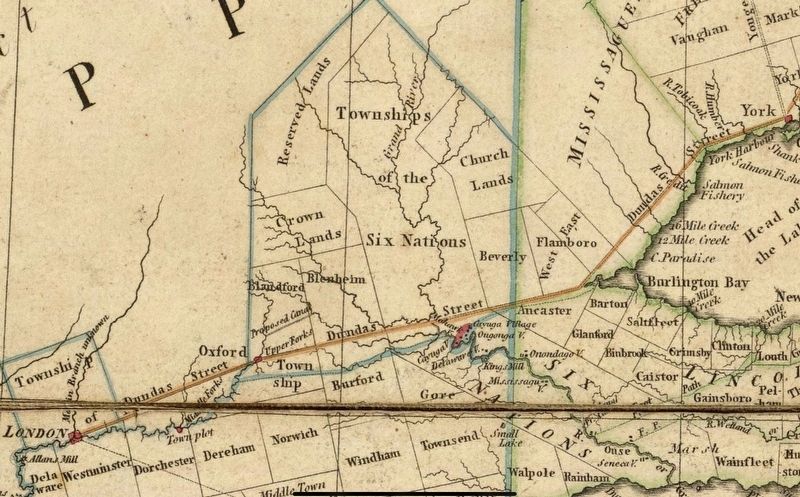
Dundas Street was established as a military supply route by order of John Graves Simcoe, the first British governor of Upper Canada. At first, it was surveyed and cleared in 1794 and 1795 between Cootes Paradise (at the very end of Lake Ontario, beyond Burlington Bay)(Submitted on April 22, 2023, by Tim Boyd of Hamilton, Ontario.)and the Upper Forks of the Thames River, at what is now Woodstock. From there, small boats could be used to travel downriver to London and to Lake St. Clair.Photographed by Tim Boyd, April 21, 20233. Dundas Street / La Rue Dundas Marker
Photographed by Tim Boyd, April 22, 2023
4. Dundas Street as depicted on a map of Upper Canada of 1800.
Credits. This page was last revised on April 22, 2023. It was originally submitted on April 22, 2023, by Tim Boyd of Hamilton, Ontario. This page has been viewed 198 times since then and 20 times this year. Photos: 1, 2, 3, 4. submitted on April 22, 2023, by Tim Boyd of Hamilton, Ontario. • Andrew Ruppenstein was the editor who published this page.
