Downtown in Camden in Camden County, New Jersey — The American Northeast (Mid-Atlantic)
Newton Friends Meetinghouse
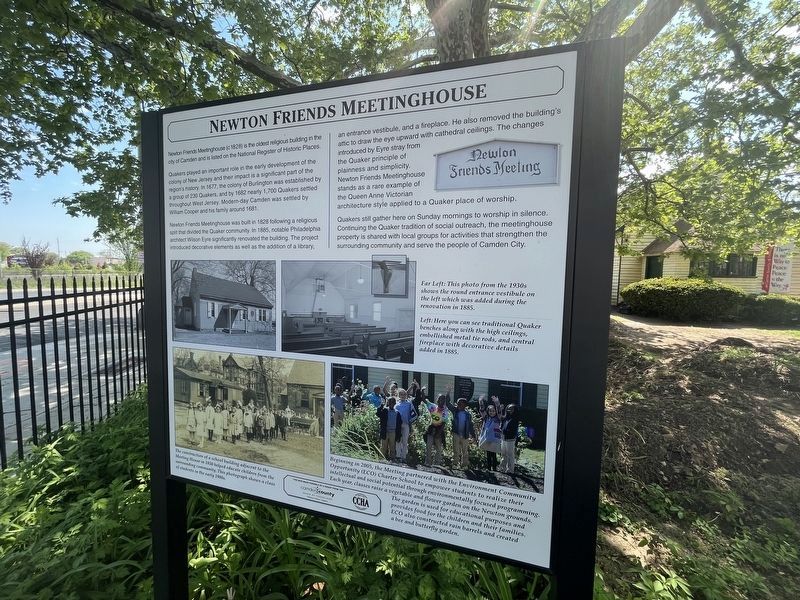
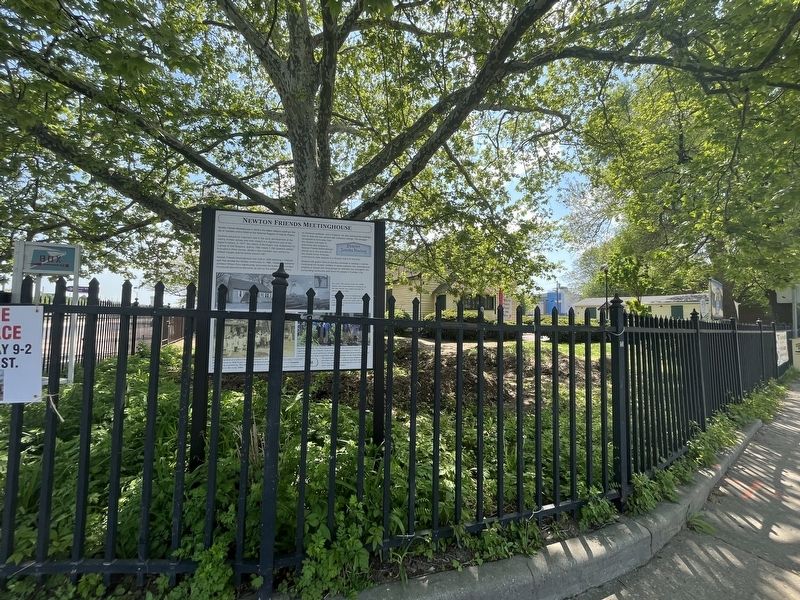
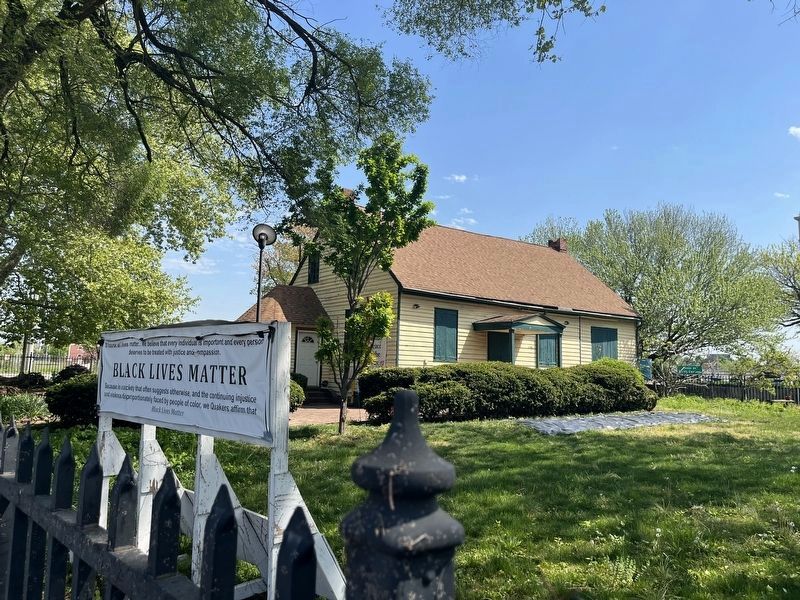
Newton Friends Meetinghouse (c 1828) is the oldest religious building in the city of Camden and is listed on the National Register of Historic Places.
Quakers played an important role in the early development of the colony of New Jersey and their impact is a significant part of the region's history. In 1677, the colony of Burlington was established by a group of 230 Quakers, and by 1682 nearly 1,700 Quakers settled throughout West Jersey. Modern-day Camden was settled by William Cooper and his family around 1681.
Newton Friends Meetinghouse was built in 1828 following a religious split that divided the Quaker community. In 1885, notable Philadelphia architect Wilson Eyre significantly renovated the building. The project introduced decorative elements as well as the addition of a library, an entrance vestibule, and a fireplace. He also removed the building's attic to draw the eye upward with cathedral ceilings. The changes introduced by Eyre stray from the Quaker principle of plainness and simplicity. Newton Friends Meetinghouse stands as a rare example of the Queen Anne Victorian architecture style applied to a
this page online
Quakers still gather here on Sunday mornings to worship in silence. Continuing the Quaker tradition of social outreach, the meetinghouse property is shared with local groups for activities that strengthen the surrounding community and serve the people of Camden City.
[Captions:]
Far Left: This photo from the 1930s shows the round entrance vestibule on the left which was added during the renovation in 1885.
Left: Here you can see traditional Quaker benches along with the high ceilings, embellished metal tie rods, and central fireplace with decorative details added in 1885.
The construction of a school building adjacent to the Meeting House in 1850 helped educate children from the surrounding community. This photograph shows a class of students in the early 1900s.
Beginning in 2005, the Meeting partnered with the Environment Community Opportunity (ECO) Charter School to empower students to realize their intellectual and social potential through environmentally focused programming. Each year, classes raise a vegetable and flower garden on the Newton grounds. The garden is used for educational purposes and provides food for the children and their families. ECO also constructed rain barrels and created a bee and butterfly garden.
Erected by Camden
Topics and series. This historical marker is listed in these topic lists: Architecture • Colonial Era • Religion & Religious Structures • Settlements & Settlers. In addition, it is included in the Quakerism series list. A significant historical year for this entry is 1677.
Location. 39° 56.756′ N, 75° 6.994′ W. Marker is in Camden, New Jersey, in Camden County. It is in Downtown. It is at the intersection of Cooper Street and Haddon Avenue (County Road 561), on the right when traveling east on Cooper Street. Touch for map. Marker is at or near this postal address: 808 Cooper St, Camden NJ 08102, United States of America. Touch for directions.

Regionally, this marker is in South Jersey and in Greater Philadelphia. It is also in the American Northeast, in the Mid-Atlantic, and on the Eastern Seaboard. Globally, it is in the North Atlantic Region, North America, the Western Hemisphere, the Western World, and the Anglosphere. Historically, it finds itself in what was once New Netherland and also one of the original Thirteen Colonies.
Other nearby markers. At
Also see . . . Newton Friends' Meetinghouse. Wikipedia entry:
Links to National Register of Historic Places Nomination Form (Submitted on March 7, 2026, by Larry Gertner of New York, New York.)
Credits. This page was last revised on March 7, 2026. It was originally submitted on April 23, 2023, by Devry Becker Jones of Washington, District of Columbia. This page has been viewed 228 times since then and 31 times this year. Photos: 1, 2, 3. submitted on April 23, 2023, by Devry Becker Jones of Washington, District of Columbia.
Editor’s want-list for this marker. A link to the National Register of Historic Place, citing the Meetinghouse's historical significance. • Can you help?
