Capernaum in Kinneret, Northern District, Israel — West Asia (the Levant in the Middle East)
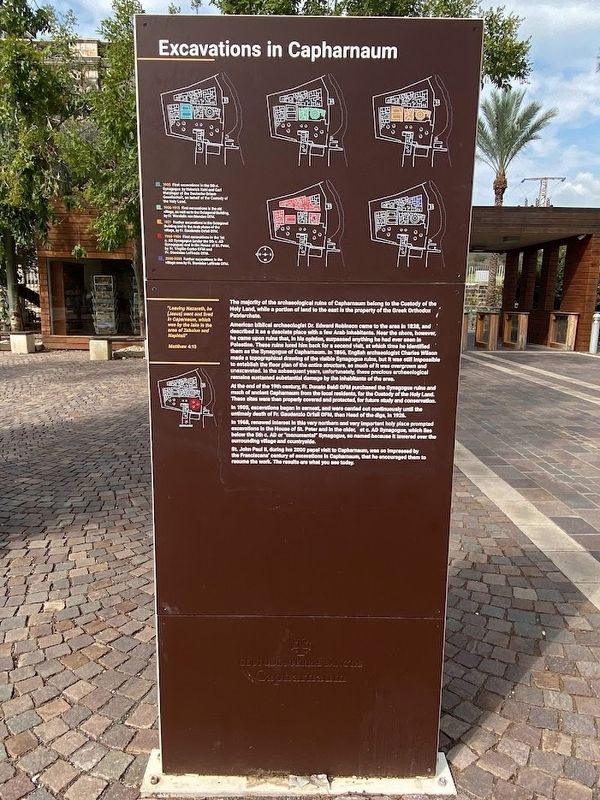
Excavations in Capharnaum
Photographed by Darren Jefferson Clay, March 8, 2023
1. Excavations in Capharnaum Marker
• (Blue icon)-1905 First excavations in the 5th c. Synagogue by Heinrich Kohl and Carl Watzinger of the Deutsche Orient- Gesellschaft, on behalf of the Custody of the Holy Land.
• (Green icon)-1915 First excavations in the old village, as well as in the Octagonal Building, by Fr. Wendelin von Menden OFM.
• (Orange icon)-1921 Further excavations in the Octagonal Building and in the Arab phase of the village, by Fr. Gaudenzio Orfall OFM.
• (Red icon)-1968-1984 First excavations in the 1st c. AD Synagogue (under the 5th c. AD Synagogue) and in the House of St. Peter, by Fr. Virgilio Corbo OFM and Fr. Stanislao Loffreda OFM.
2000-2003 Further excavations in the village area by Fr. Stanislao Loffreda OFM.
The majority of the archaeological ruins of Capharnaum belong to the Custody of the Holy Land, while a portion of land to the east is the property of the Greek Orthodox Patriarchate.
American biblical archaeologist Dr. Edward Robinson came to the area in 1838, and described it as a desolate place with a few Arab inhabitants. Near the shore, however, he came upon ruins that, in his opinion, surpassed anything
this page online
At the end of the 19th century, Fr. Donato Baldi OFM purchased the Synagogue ruins and much of ancient Capharnaum from the local residents, for the Custody of the Holy Land. These sites were then properly covered and protected, for future study and conservation.
In 1905, excavations began in earnest, and were carried out continuously until the untimely death of Fr. Gaudenzio Orfall OFM, then Head of the digs, in 1926.
In 1968, renewed interest in this very northern and very important holy place prompted excavations in the House of St. Peter and in the older, 1st c. AD Synagogue, which lies below the 5th c. AD or "monumental"
Photographed by Darren Jefferson Clay, March 8, 2023
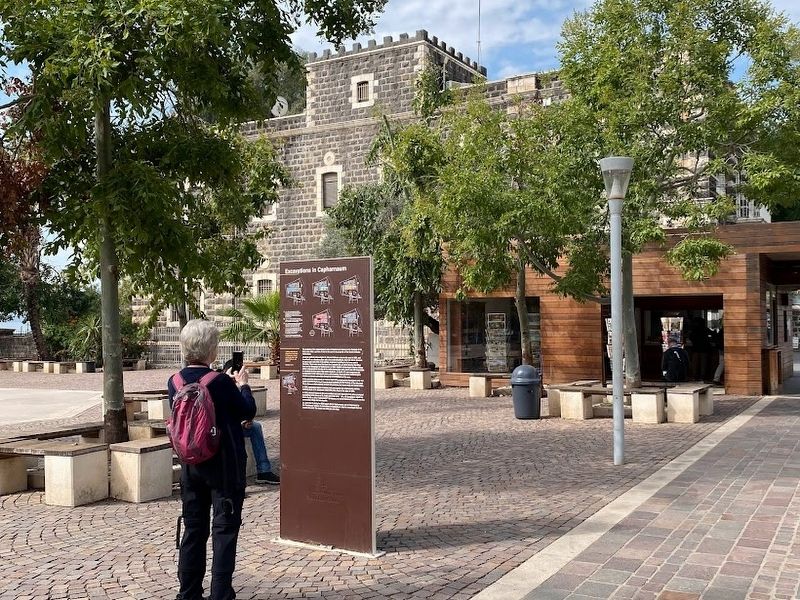
2. Excavations in Capharnaum Marker
St. John Paul II, during his 2000 papal visit to Capharnaum, was so impressed by the Franciscans' century of excavations In Capharnaum, that he encouraged them to resume the work. The results are what you see today.
"Leaving Nazareth, he (Jesus) went and lived In Capernaum, which was by the lake in the area of Zebulun and Naphtali" Matthew 4:13
Topics and series. This historical marker is listed in these topic lists: Anthropology & Archaeology • Religion & Religious Structures. In addition, it is included in the Synagogues series list.
Location. 32° 52.833′ N, 35° 34.492′ E. Marker is in Capernaum, Northern District, in Kinneret. It can be reached from no nearby street. Touch for map. Touch for directions.

Regionally, it is in Asia, specifically in West Asia, in the Middle East, in The Levant, on the Red Sea, in a coastal Mediterranean country, and in the Western World. Historically, it finds itself in what was once the Byzantine Empire, the Ottoman Empire, a British Mandate, and the Roman Empire.
Other nearby markers. At least 8 other markers are within walking distance of this marker: The House of Peter (within shouting distance of this marker); Capharnaum (within shouting distance of this marker); The Synagogue of Capharnaum (within shouting distance of this marker); a different marker also named Capharnaum (within shouting distance of this marker); The Memorial Church of St. Peter (within shouting distance of this marker); Sea of Galilee (within shouting distance of this marker); a different marker also named Capharnaum (within shouting distance of this marker); The Synagogue of Jesus (within shouting distance of this marker). Touch for a list and map of all markers in Capernaum.
Credits. This page was last revised on May 24, 2026. It was originally submitted on April 26, 2023, by Darren Jefferson Clay of Duluth, Georgia. This page has been viewed 194 times since then and 31 times this year. Photos: 1, 2. submitted on April 26, 2023, by Darren Jefferson Clay of Duluth, Georgia. • Andrew Ruppenstein was the editor who published this page.
