French Quarter in New Orleans in Orleans Parish, Louisiana — The American South (West South Central)
Homesite of Oliver Pollock
1768 - 1781

Photographed by James Hulse, January 12, 2023
1. Homesite of Oliver Pollock Marker
Erected 1976 by Vieux Carre Chapter DAR.
Topics and series. This historical marker is listed in these topic lists: Colonial Era • War, US Revolutionary. In addition, it is included in the Daughters of the American Revolution (DAR) series list. A significant historical year for this entry is 1768.
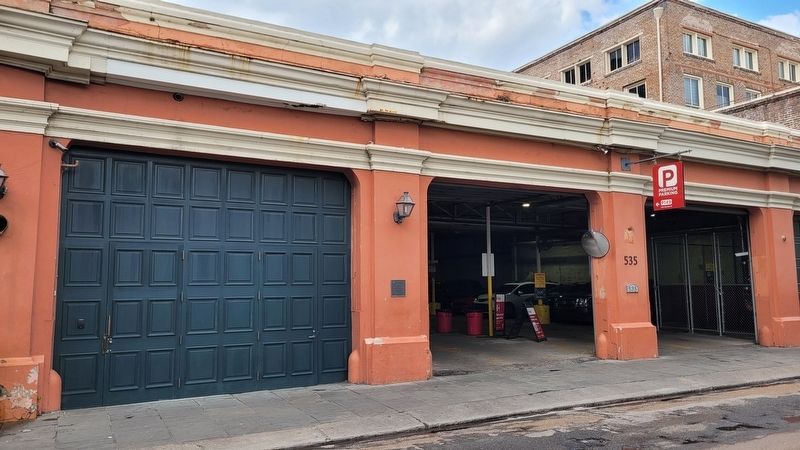
Location. 29° 57.383′ N, 90° 3.892′ W. Marker is in New Orleans, Louisiana, in Orleans Parish. It is in the French Quarter. It is on Chartres Street 0.1 miles north of St. Louis Street, on the left when traveling north. The marker is located on the wall of the building. Touch for map. Marker is at or near this postal address: 535 Chartres Street, New Orleans LA 70130, United States of America. Touch for directions.

Regionally, this marker is in one of Louisiana’s River Parishes. It is also in the American South, specifically in the Deep South, on the Gulf Coast, and in the Great River Road Region. Globally, it is in North America, a Gulf of Mexico state, the Western Hemisphere, the Western World, and the Anglosphere. Historically, it finds
this page online
Other nearby markers. At least 8 other markers are within walking distance of this marker: Calle de Chartres (a few steps from this marker); Louis J. Dufilho (within shouting distance of this marker); Calle de Tolosa (within shouting distance of this marker); Nicholas Bertoli Building (within shouting distance of this marker); St. Louis Hotel (within shouting distance of this marker); Girod House (within shouting distance of this marker); Pierre Maspero’s Exchange (within shouting distance of this marker); Original Pierre Maspero’s Slave Exchange (about 300 feet away, measured in a direct line). Touch for a list and map of all markers in New Orleans.
Also see . . . Oliver Pollock. Wikipedia
Pollock began working as a merchant in New Orleans and, through his relationship with O'Reilly, was favorably received by Spanish Louisiana's officials, who granted him free trade within the city. He became the most successful businessman(Submitted on April 30, 2023, by James Hulse of Medina, Texas.)in the city as a result of the scarcity of provisions at the time, bringing in a desperately needed shipment of flour. However instead of taking advantage of the colonists, Pollock sold the flour for half the going price. In 1770 he married Margaret O'Brien of New Orleans, with whom he had eight children before her death in 1799.Photographed by James Hulse, January 12, 20232. The view of the Homesite of Oliver Pollock Marker from across the street
Credits. This page was last revised on April 30, 2023. It was originally submitted on April 29, 2023, by James Hulse of Medina, Texas. This page has been viewed 681 times since then and 71 times this year. Photos: 1, 2. submitted on April 30, 2023, by James Hulse of Medina, Texas.
