Near Snow Hill in Greene County, North Carolina — The American South (South Atlantic)
James Glasgow
ca. 1735-1819
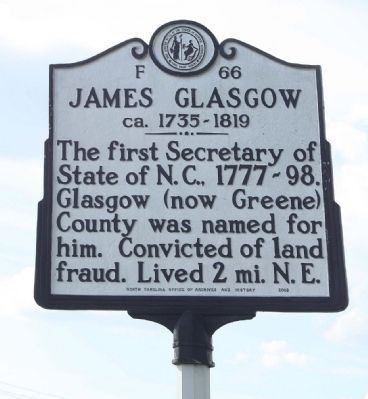
Photographed by Mike Stroud, April 18, 2013
1. James Glasgow Marker
Erected 2003 by North Carolina Office of Archives and History. (Marker Number F-66.)
Topics and series. This historical marker is listed in these topic lists: Law Enforcement • Settlements & Settlers. In addition, it is included in the North Carolina Division of Archives and History series list.
Location. 35° 30.121′ N, 77° 44.359′ W. Marker is near Snow Hill, North Carolina, in Greene County. It is at the intersection of North Carolina Route 58 and Sheppard Ferry Road (County Highway 1222), on the right when traveling north on North Carolina Route 58. Touch for map. Marker is at or near this postal address: 22 Sheppard Ferry Rd, Snow Hill NC 28580, United States of America. Touch for directions.

Regionally, this marker is in North Carolina’s Coastal Plain. It is also in the American South and specifically in the Upper South. Globally, it is in North America, the Western Hemisphere, the Western World, and the Anglosphere.
this page online
Other nearby markers. At least 8 other markers are within 6 miles of this marker, measured as the crow flies: Nooherooka (approx. 1.9 miles away); Snow Hill (approx. 5 miles away); Greene County Confederate Memorial (approx. 5 miles away); Greene County Veterans Memorial (approx. 5 miles away); Ray E. Eubanks (approx. 5 miles away); Tuscarora War (approx. 5 miles away); Grimsley Baptist Church (approx. 5.8 miles away); Hull Road (approx. 5.8 miles away). Touch for a list and map of all markers in Snow Hill.
Regarding James Glasgow. The naming of a county can provide a lesson in North Carolina history. What is now Greene County was once part of Johnston but in 1758 it became Dobbs County for royal governor Arthur Dobbs. In 1791 that name was “expunged from our map,” as historian Kemp Battle phrased it, and a new county was named for the Secretary of State, James Glasgow. When Glasgow met an ignominious end, in 1799 the name was
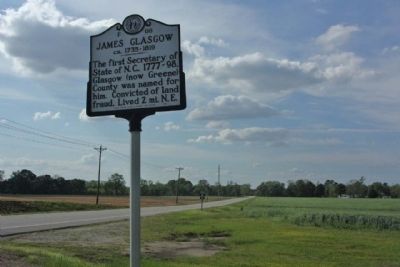
Photographed by Mike Stroud, April 18, 2013
2. James Glasgow Marker along NC Highway 58
James Glasgow (ca. 1735-1819), born in Maryland, in 1765 acquired a plantation on Contentnea Creek known as “Fairfield” as a gift from his father-in-law. Glasgow, active in the colonial militia, took part in the Battle of Moores Creek Bridge but soon forsook the military for politics. As assistant secretary of the Provincial Congresses, 1775-1776, and clerk of the Council of State, 1776-1779, Glasgow earned the respect of the state’s Revolutionary patriots. His reward was election by the legislature in 1777 as North Carolina’s first Secretary of State. A principal duty of that position was the oversight of the military land grant program, the issuance of property in what became Tennessee to veterans of the Revolution.
In 1797, on receipt of a letter from Andrew Jackson setting forth charges of impropriety in the issuance of the grants, Gov. Samuel Ashe and the legislature set in motion events leading to Glasgow’s resignation and eventual conviction on land fraud charges. Notwithstanding the fact that others were involved in the scandal, Glasgow suffered
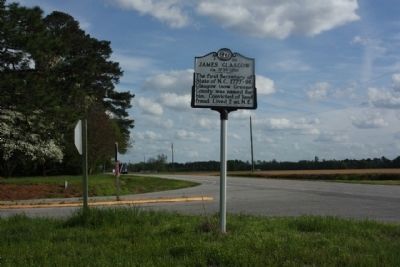
Photographed by Mike Stroud, April 18, 2013
3. James Glasgow Marker at the intersection of State Highway 58 and Sheppards Ferry Road
Credits. This page was last revised on May 10, 2023. It was originally submitted on July 12, 2013, by Mike Stroud of Bluffton, South Carolina. This page has been viewed 1,007 times since then and 30 times this year. Last updated on May 7, 2023, by Michael Buckner of Durham, North Carolina. Photos: 1, 2, 3. submitted on July 12, 2013, by Mike Stroud of Bluffton, South Carolina. • Bernard Fisher was the editor who published this page.
