
South Elmwood in Providence in Providence County, Rhode Island — The American Northeast (New England)
Bactrian Camel
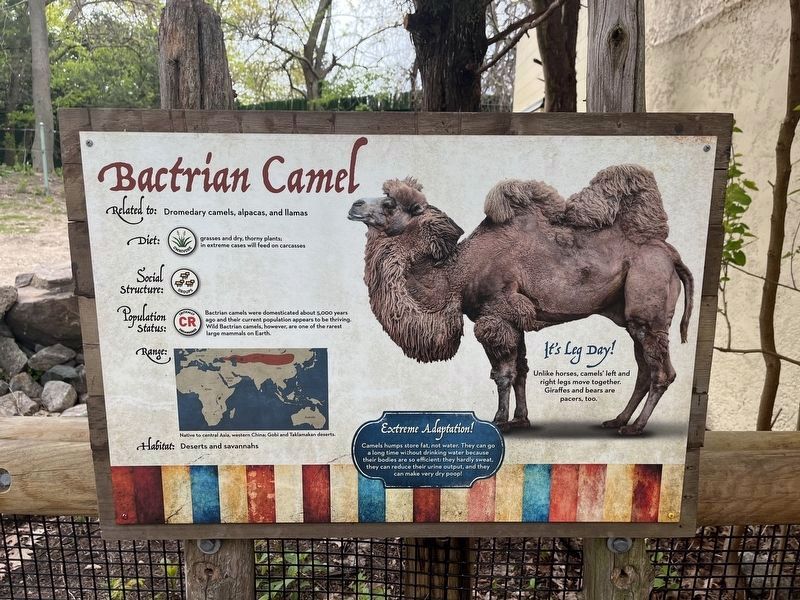
Related to: Dromedary camels, alpacas, and llamas
Diet: Omnivore grasses and dry, thorny plants; in extreme cases will feed on carcasses
Social Structure: Groups
Population status: Critically endangered Bactrian camels were domesticated about 5,000 years ago and their current population appears to be thriving. Wild Bactrian camels, however, are one of the rarest large mammals on Earth.
Range: Native to central Asia, western China; Gobi and Taklamakan deserts.
Habitat: Deserts and savannahs
Extreme Adaptation!
Camel humps store fat, not water. They can go a long time without drinking water because their bodies are so efficient: they hardly sweat, they can reduce their urine output, and they can make very dry poop!
It's Leg Day!
Unlike horses, camels' left and right legs move together. Giraffes and bears are pacers, too.
Erected by Roger Williams Park Zoo.
Topics. This historical marker is listed in these topic lists: Animals • Anthropology & Archaeology • Environment.
Location. 41° 47.204′ N, 71° 25.046′ W. Marker is in Providence, Rhode Island,
this page online

Regionally, this marker is on Rhode Island’s Narragansett Bay. It is also in the American Northeast and in New England. Globally, it is in the North Atlantic Region, North America, the Western Hemisphere, the Western World, and the Anglosphere. Historically, it finds itself in what was once one of the original Thirteen Colonies.
Other nearby markers. At least 8 other markers are within walking distance of this marker: Marco Polo's Adventure Trek (a few steps from this marker); The Sentinel (a few steps from this marker); Menagerie (within shouting distance of this marker); Land Bridges (about 300 feet away, measured in a direct line); Bald Eagle (about 300 feet away); Golden Eagle (about 300 feet away); a different marker also named Bald Eagle (about 300 feet
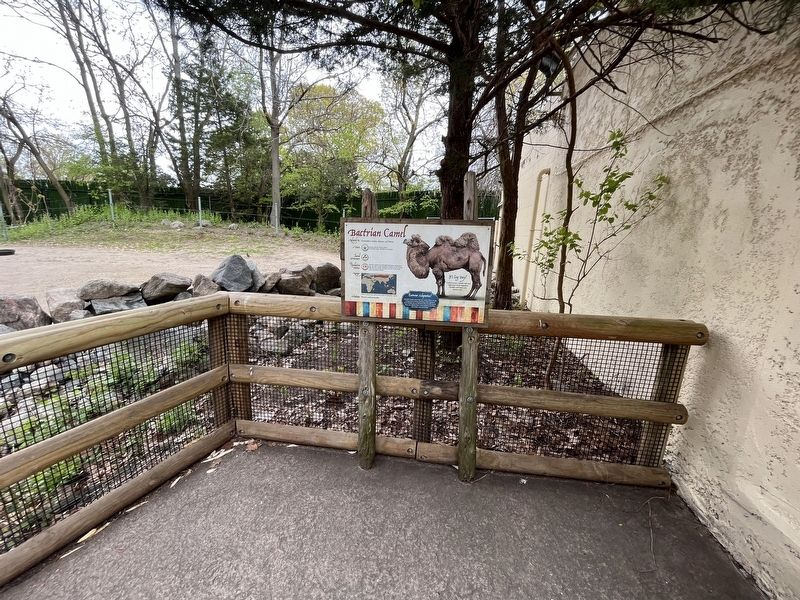
Additional commentary.
1. About the marker
Because the sign interprets the history of the Bactrian camel's interaction with humans as an adapted animal and as one that is extremely endangered in the wild, it serves as a historical marker.
— Submitted May 7, 2023, by Devry Becker Jones of Washington, District of Columbia.
Credits. This page was last revised on May 7, 2023. It was originally submitted on May 7, 2023, by Devry Becker Jones of Washington, District of Columbia. This page has been viewed 155 times since then and 9 times this year. Photos: 1, 2. submitted on May 7, 2023, by Devry Becker Jones of Washington, District of Columbia.
