Four Oaks in Johnston County, North Carolina — The American South (South Atlantic)
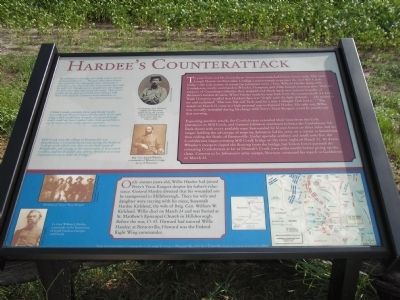
Hardee’s Counterattack
Photographed by Bill Coughlin, August 18, 2006
1. Hardee’s Counterattack
This marker is one in a series that was erected on the Battle of Bentonville for the 140th anniversary of the battle, on March 14, 2005.
Expecting another attack, the Confederates extended their lines from the Cole plantation to Mill Creek, and General Johnston continued to brace the Confederate left flank (here) with every available man. Surrounded by Union forces on three sides
this page online
Only sixteen years old, Willie Hardee had joined Terry’s Rangers despite his father’s reluctance. General Hardee directed that his wounded son be transported to Hillsborough. There his wife and daughter were staying with his niece, Susannah Hardee Kirkland, the wife of Brig. Gen. William W. Kirkland. Willie died on March 24 and was buried at St. Matthew’s Episcopal Church in Hillsborough. Before the war, O.O. Howard had tutored Willie Hardee; at Bentonville, Howard was the Federal Right Wing commander.
“We fell back to the edge of a field, where we met General Johnston…We gave him three cheers. He raised his hat and spoke some words that I failed to catch, but some that were nearer him said he told Col. Henderson to compliment the brigade for him; that they had saved the army. That set us on fire again, and we would have charged Old Nick himself if Joe Johnston as ordered us to.”
M.J.
Photographed by Bill Coughlin, August 3, 2010
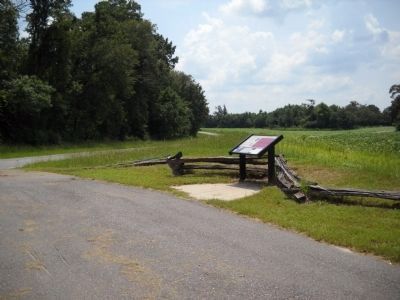
2. Marker on the Bentonville Battlefield
“I think I made a mistake there, and should rapidly have followed Mower’s lead with the whole of the right wing, which would have brought on a general battle, and it could not have resulted other than successfully to us, by reason of our vastly superior numbers.”
- Gen. William T. Sherman
Mill Creek near the village of Bentonville was described by a Confederate private during the battle as “a deep creek which runs close to the little town of Bentonville, and owing to the recent rains, is very much swollen, and not fordable any where; therefore it is very important for us to hold the bridge.”
Erected 2005 by North Carolina Civil War Trails.
Topics. This historical marker is listed in this topic list: War, US Civil. A significant historical date for this entry is March 21, 1865.
Location. 35° 20.791′ N, 78° 17.632′ W. Marker is in Four Oaks, North Carolina, in Johnston County. It is at the intersection of Westbrook Lowgrounds Road (County Route 1198) and Bentonville Road (County Route 1197), on the right when traveling east on Westbrook Lowgrounds Road. Touch for map. Marker is at or near this postal address: 121 Westbrook
Photographed by Bill Coughlin, August 3, 2010
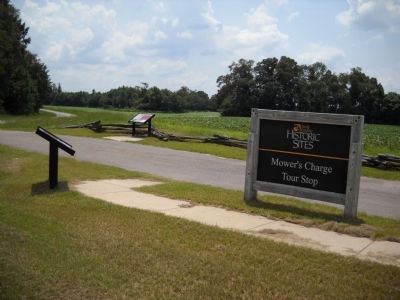
3. Mower's Charge Tour Stop
Several markers are at this tour stop. The Hardee’s Counterattack marker can be seen in the left background.

Regionally, this marker is in the Piedmont. It is also in the American South and specifically in the Upper South. Globally, it is in North America, the Western Hemisphere, the Western World, and the Anglosphere. Historically, it finds itself in what was once the territory of the Mississippian Culture, one of the original Thirteen Colonies, one of the Confederate States of America, and the Antebellum South.
Other nearby markers. At least 8 other markers are within walking distance of this marker: Mower’s Charge Reaches Johnston’s Headquarters (a few steps from this marker); Village of Bentonville (a few steps from this marker); Johnston’s Headquarters (a few steps from this marker); Johnston Establishes His Headquarters (about 400 feet away, measured in a direct line); a different marker also named Village of Bentonville (approx. ¼ mile away); Bentonville (approx. ¼ mile away); Confederate Works (approx. half a mile away); Mill Creek (approx. 0.6 miles away). Touch for a list and map of all markers in Four Oaks.
More about this marker.
Photographed by Bill Coughlin, August 18, 2006
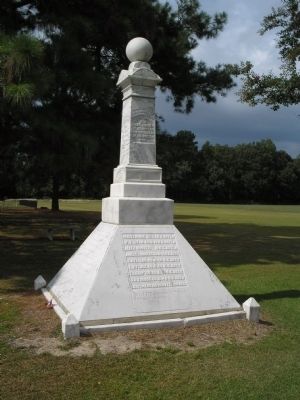
4. Confederate Mass Grave
Many of the Confederates who fell in the Battle of Bentonville, including Col. Richard Saffell, were buried in this mass grave located near the Bentonville Battlefield Visitors Center.
Related markers. Click here for a list of markers that are related to this marker. Take a tour of the Roadside Exhibits erected on the Battle of Bentonville for the 140th anniversary of the battle, on March 14, 2005.
Credits. This page was last revised on May 10, 2023. It was originally submitted on March 1, 2008, by Bill Coughlin of Woodland Park, New Jersey. This page has been viewed 2,405 times since then and 33 times this year. Last updated on May 9, 2023, by Michael Buckner of Durham, North Carolina. Photos: 1. submitted on March 1, 2008, by Bill Coughlin of Woodland Park, New Jersey. 2, 3. submitted on August 12, 2010, by Bill Coughlin of Woodland Park, New Jersey. 4. submitted on March 1, 2008, by Bill Coughlin of Woodland Park, New Jersey. • J. Makali Bruton was the editor who published this page.
