Near Four Oaks in Johnston County, North Carolina — The American South (South Atlantic)
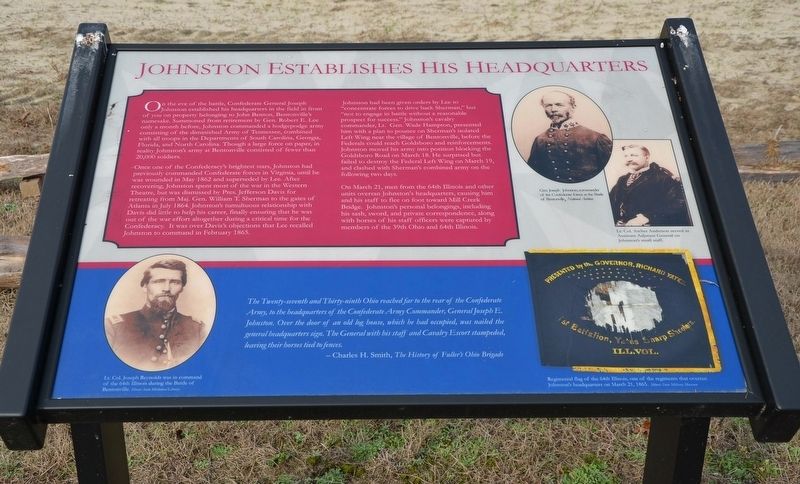
Johnston Establishes His Headquarters
Photographed by Karl Stelly, January 17, 2017
1. Johnston Establishes His Headquarters
Once one of the Confederacy's brightest stars, Johnston had previously commanded Confederate forces in Virginia, until he was wounded in May 1862 and superseded by Lee. After recovering, Johnston spent most of the war in the Western Theatre, but was dismissed by Pres. Jefferson Davis for retreating from Maj. Gen. William T. Sherman to the gates of Atlanta in July 1864. Johnston's tumultuous relationship with Davis did little to help his career, finally ensuring that he was out of the war effort altogether during a critical time for the Confederacy. It was over Davis's objections
this page online
Johnston had been given orders by Lee to "concentrate forces to drive back Sherman," but "not to engage in battle without a reasonable prospect for success." Johnston's cavalry commander, Lt. Gen. Wade Hampton, presented him with a plan to pounce on Sherman's isolated Left Wing near the village of Bentonville, before the Federals could reach Goldsboro and reinforcements. Johnston moved his army into position blocking the Goldsboro Road on March 18. He surprised but failed to destroy the Federal Left Wing on March 19, and clashed with Sherman's combined army on the following two days.
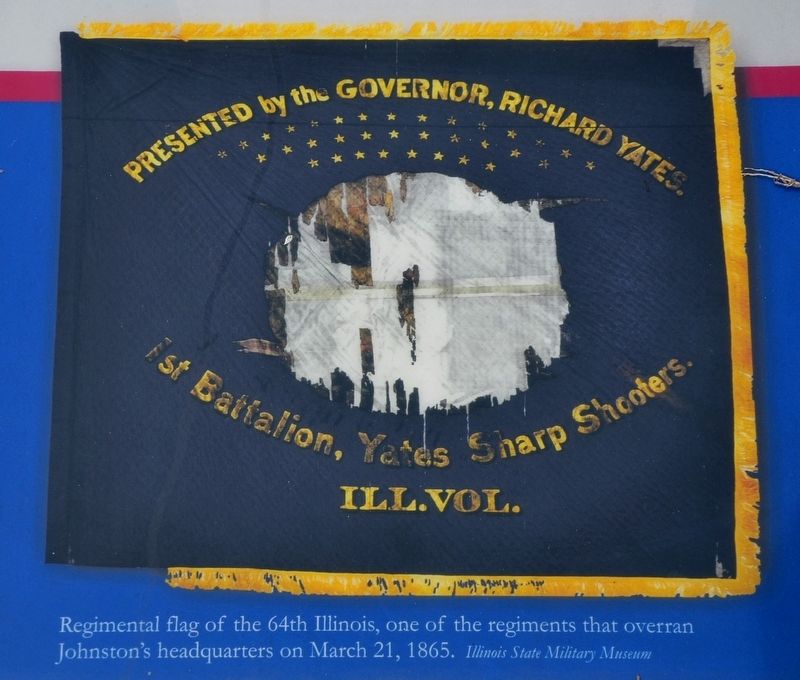
On March 21, men from the 64th Illinois and other units overran Johnston's headquarters, causing him and his staff to flee on foot toward Mill Creek Bridge. Johnston's personal belongings, including his sash, sword, and private correspondence, along with horses of his staff officers were captured by members of the 39th Ohio and 64th Illinois.
The Twenty-seventh and Thirty-ninth Ohio reached far to the rear of the Confederate Army, to the headquarters of the Confederate Army Commander, General Joseph E. Johnston. Over the door of an old log house, which he had occupied, was nailed the general headquarters sign. The General with his staff and Cavalry Escort stampeded, leaving their horses tied to fences.
—Charles
Photographed by Karl Stelly, January 17, 2017
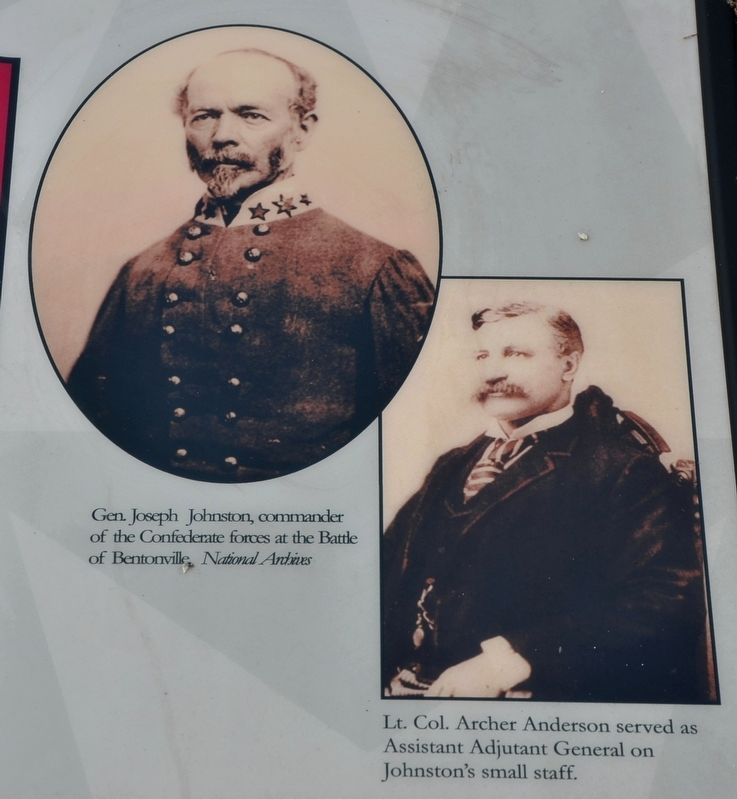
2. General Johnston & Colonel Anderson
Gen. Joseph Johnston, commander of the Confederate forces at the Battle of Bentonville. (National Archives) - Lt. Col. Archer Anderson served as Assistant Adjutant General on Johnston's small staff.
Topics. This historical marker is listed in this topic list: War, US Civil. A significant historical month for this entry is March 1865.
Location. 35° 20.838′ N, 78° 17.572′ W. Marker is near Four Oaks, North Carolina, in Johnston County. It is on Westbrook Lowgrounds Road (County Route 1189) 0 miles east of Bentonville Road (Route 1197), on the left when traveling east. Marker is located at Auto Tour Stop 7, "Johnston's Headquarters." This tour stop is only 100 yards east of the intersection with the Bentonville Road. Touch for map. Marker is at or near this postal address: 121 Westbrook Lowgrounds Rd, Four Oaks NC 27524, United States of America. Touch for directions.

Regionally, this marker is in the Piedmont. It is also in the American South and specifically in the Upper South. Globally, it is in North America, the Western Hemisphere, the Western World, and the Anglosphere. Historically, it finds itself in what was once the territory of the Mississippian Culture, one of the original Thirteen Colonies, one of the Confederate States of America, and the Antebellum South.
Other nearby markers. At
Photographed by Karl Stelly, January 17, 2017
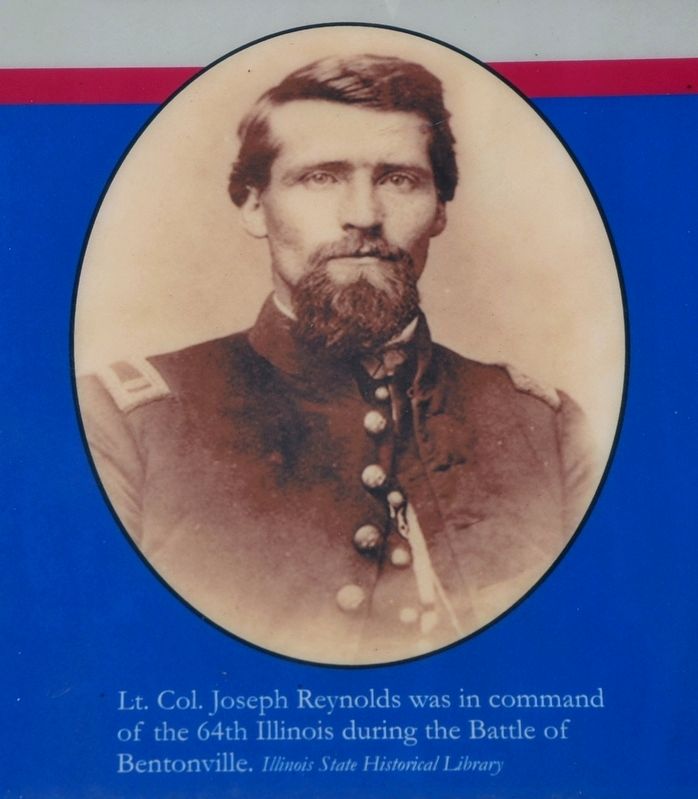
3. Lt. Col. Joseph Reynolds
Lt. Col. Joseph Reynolds was in command of the 64th Illinois during the Battle of Bentonville. (Illinois State Historical Library)
Photographed by Karl Stelly, January 17, 2017
4. Flag of the 64th Illinois Infantry
Regimental flag of the 64th Illinois, one of the regiments that overran Johnston's headquarters on March 21, 1865. (Illinois State Military Museum)
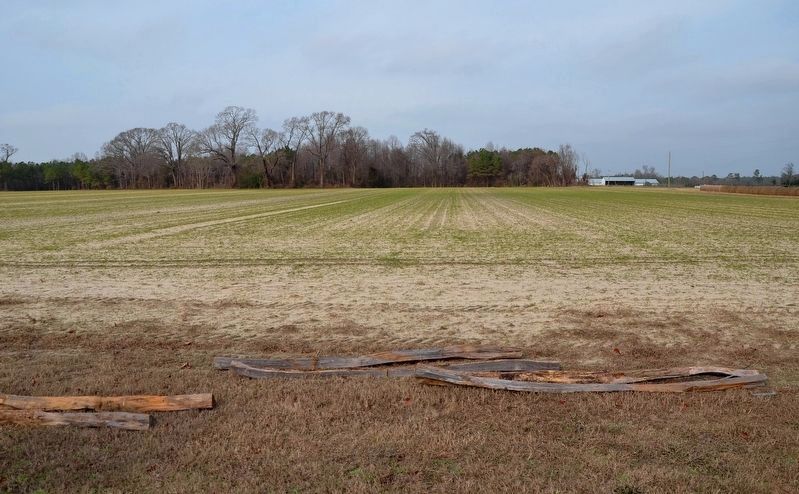
Photographed by Karl Stelly, January 17, 2017
5. Johnston Establishes His Headquarters
This view was taken standing at the marker and looking straight out behind it into the field; the direction is looking northward.
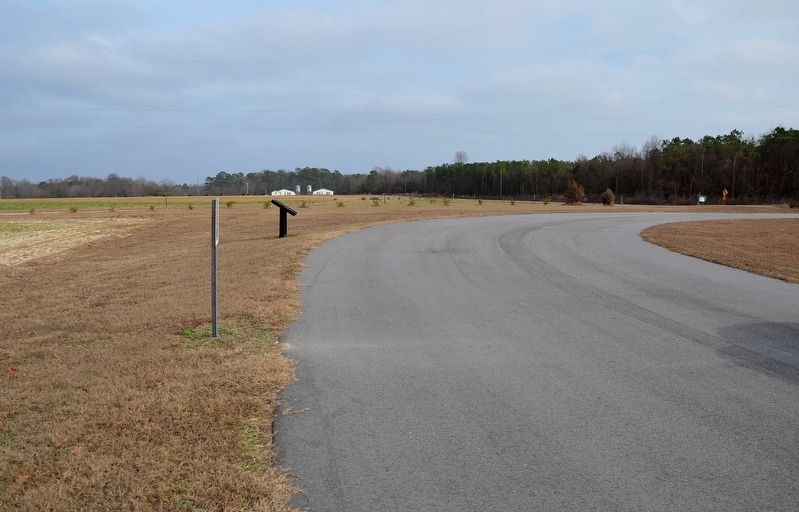
Photographed by Karl Stelly, January 17, 2017
6. Johnston Establishes His Headquarters
This view was taken standing at the marker and looking directly eastward.
Credits. This page was last revised on May 10, 2023. It was originally submitted on February 2, 2017, by Karl Stelly of Gettysburg, Pennsylvania. This page has been viewed 685 times since then and 62 times this year. Last updated on May 9, 2023, by Michael Buckner of Durham, North Carolina. Photos: 1, 2, 3, 4, 5, 6. submitted on February 2, 2017, by Karl Stelly of Gettysburg, Pennsylvania. • Bernard Fisher was the editor who published this page.
