Bishopville in Lee County, South Carolina — The American South (South Atlantic)
James Capers
Major, United States Marine Corps (ret)
Photographed by Dave W, May 9, 2023
1. James Capers Marker
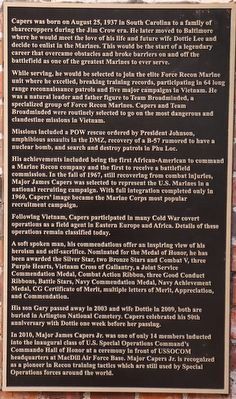
Capers was born on August 25, 1937 in South Carolina to a family of sharecroppers during the Jim Crow era. He later moved to Baltimore where he would meet the love of his life and future wife Dottie Lee and decide to enlist in the Marines. This would be the start of a legendary career that overcame obstacles and broke barriers on and off the battlefield as one of the greatest Marines to ever serve.
While serving, he would be selected to join the elite Force Recon Marine unit where he excelled, breaking training records, participating in 64 long range reconnaissance patrols and five major campaigns in Vietnam. He was a natural leader and father figure to Team Broadminded, a specialized group of Force Recon Marines. Capers and Team Broadminded were routinely selected to go on the most dangerous and clandestine missions in Vietnam.
Missions included a POW rescue ordered by President Johnson, amphibious assaults in the DMZ, recovery of a B-57 rumored to have a nuclear bomb, and search and destroy patrols in Phu Loc.
His achievements included being the first African-American to command a Marine Recon company and the first to receive a battlefield commission. In the fall of 1967, still recovering from combat injuries, Major James Capers was selected to represent the U.S. Marines in a national recruiting campaign. With full integration completed only in 1960, Capers' image became the Marine Corps most popular recruitment campaign.
Following Vietnam, Capers participated in many Cold War covert operations as a field agent in Eastern Europe and Africa. Details of these operations remain classified today.
A soft spoken man, his commendations offer an inspiring view of his heroism and self-sacrifice. Nominated for the Medal of Honor, he has been awarded the Silver Star, two Bronze Stars and Combat
this page online
His son Gary passed away in 2003 and wife Dottie in 2009, both are buried in Arlington National Cemetery. Capers celebrated his 50thanniversary with Dottle one week before her passing.
In 2010, Major James Capers Jr. was one of only 14 members inducted into the inaugural class of U.S. Special Operations Command's Commando Hall of Honor at a ceremony in front of USSOCOM headquarters at MacDill Air Force Base. Major Capers Jr. is recognized as a pioneer in Recon training tactics which are still used by Special Operations forces around the world.
Topics and series. This memorial is listed in these topic lists: African Americans • Patriots & Patriotism • War, Cold • War, Vietnam. In addition, it is included in the Medal of Honor Recipients series list.
Location. 34° 13.154′ N, 80° 14.84′ W.
Photographed by Dave W, May 9, 2023
2. James Capers Marker
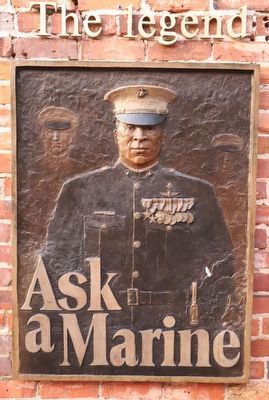
A bronze casting of the very famous "Ask a Marine" recruitment poster which Maj. Capers was featured.

Regionally, this memorial is in the Pee Dee. It is also in the American South and specifically in the Deep South. Globally, it is in North America, the Western Hemisphere, the Western World, and the Anglosphere. Historically, it finds itself in what was once the territory of the Mississippian Culture, one of the original Thirteen Colonies, one of the Confederate States of America, and the Antebellum South.
Other nearby markers. At least 8 other markers are within walking distance of this marker: Corporal James D. Heriot (here, next to this marker); Gratitude Train - Merci America (a few steps from this marker); William Apollos James House (about 500 feet away, measured in a direct line); Felix "Doc" Blanchard (about 500 feet away); Felix Anthony "Doc" Blanchard (about 500 feet away); Flag Park (about 500 feet away); Battle of Ratcliff's Bridge (about 600 feet away); Bishopville Vietnam Supreme Sacrifice Memorial (approx. 0.2 miles away). Touch for a list and map of all markers in Bishopville.
Also see . . .
1. ‘Ask a Marine’: The inspiring story of the first black man on recruitment poster. We the Mighty website entry:
In one of the old posters, a strong, black Marine standing tall in his dress blue uniform with gold jump wings stared back at me. I couldn't tell whether he was grinning or scowling—welcoming a potential recruit or warning me. Scrawled in bold typeface across the bottom third of the poster were the words "Ask a Marine." My reaction was visceral. Where do I sign?(Submitted on May 11, 2023, by Dave W of Co, Colorado.)
2. Exclusive interview with Major James Capers, Marine Recon pioneer & Medal of Honor nomimee.
Photographed by Dave W, May 9, 2023
3. James Capers Marker
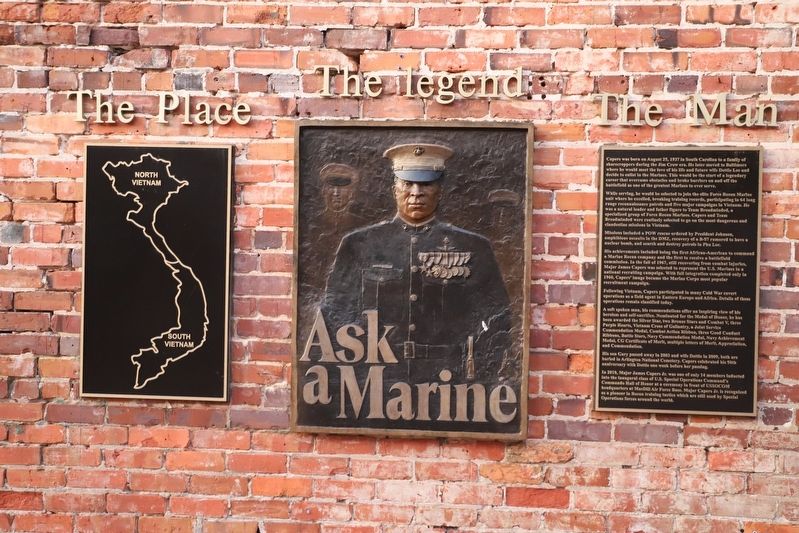
The full display on the wall in the courtyard of the Merci Train boxcar display.
If you do not know who Major James Capers is, I highly recommend that you learn about this great American and highly-decorated war hero. Capers was born in Bishopville, South Carolina in the Jim Crowe south. During the Vietnam War, just three generations removed from slavery, he became the first African American to receive a battlefield commission as part of Marine Force Recon. Capers’s team, which called themselves “Team Broadminded” conducted more than 50 classified missions in 1966 alone.(Submitted on May 11, 2023, by Dave W of Co, Colorado.)
3. James Capers, Jr. In 2026 James Capers’ Silver Star was upgraded to the Medal of Honor.
The President of the United States, in the name of Congress, takes pleasure in awarding the Medal of Honor to Major (then Second Lieutenant] James Capers, Jr. (MCSN: 0-95892), United States Marine Corps, conspicuous gallantry and intrepidity at the risk of his life above and beyond the call of duty as a Team Leader with Third Force Reconnaissance Company, Third Reconnaissance Battalion in the Republic of Vietnam from 31 March to 3 April 1967. Tasked to locate a North(Submitted on August 24, 2026, by Mark Parker of Hickory, North Carolina.)Vietnamese regimental base camp southwest of Phu Loc and provide observation for the flank of Company M, Third Battalion, Twenty-Sixth Marines, Second Lieutenant Capers maneuvered his nine-man team on a four-day patrol through rugged enemy territory. The team had contact with 20 enemy soldiers on the first day of patrol, and two additional contacts on the second day, resulting in one severely wounded team member. Despite being outnumbered by enemy forces, Second Lieutenant Capers relentlessly pursued his vigilant and tenacious adversary, and called for fire on an enemy base camp to thwart an impending attack on Company M. On the last day of the patrol, his team was engaged by a numerically superior enemy force with an initial attack from claymore mines, coupled with direct and indirect fire. Despite severe pain and blood loss caused by the multiple fragmentation and gunshot wounds he sustained, Second Lieutenant Capers bravely continued to lead his team and maintain the initiative. Even after being administered morphine, he continued to coordinate supporting fires and his team’s movement to a helicopter extraction site. While struggling to maintain consciousness and still under enemy attack, Second Lieutenant Capers maintained command of the situation to ensure all of his Marines were evacuated before he, barely able to stand, finally boarded the helicopter. By his bold leadership, undaunted courage, and complete dedication to duty, Second Lieutenant Capers reflected great credit upon himself and upheld the highest traditions of the Marine Corps and the United States Naval Service.via SOFREP, unknown4. Maj. James Capers, USMC"The Place. The Legend. The Man." at:
The Official Website of the United States Marine Corps
Click for more information.
4. He earned the Medal of Honor in Vietnam. Why did it take decades to receive it?. By Ethan Rocke, The War Horse
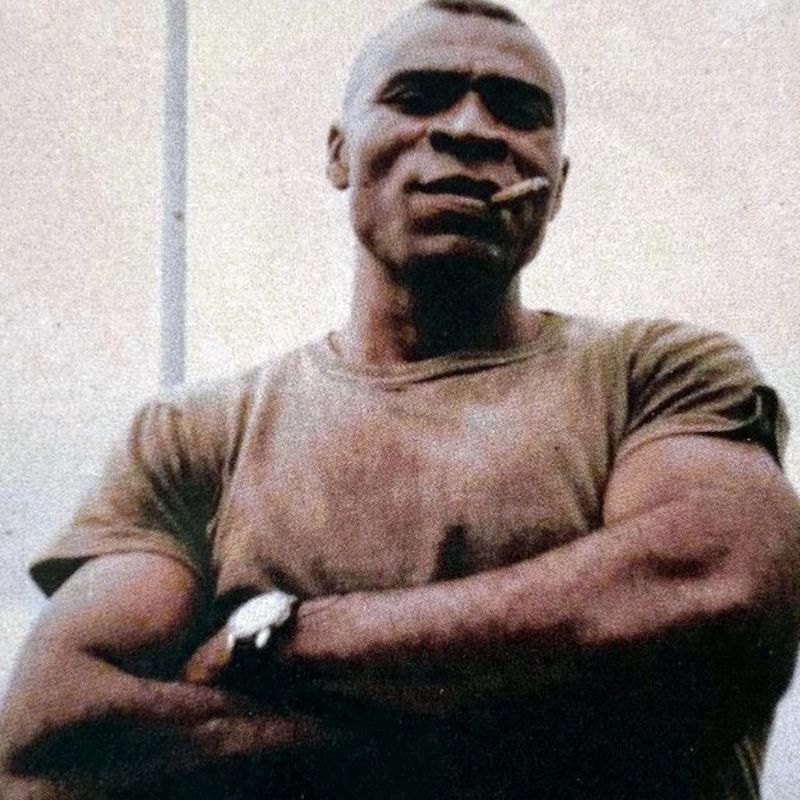
It was the fall of 2009, and Capers had come in search of a new mission. As the enlisted chief of the Marine Corps’ Hollywood liaison office, I’d been advised that Capers had been recommended for the Medal of Honor for his actions in Vietnam 42 years earlier, and he would likely soon become the first Black Marine officer to receive the nation’s highest award for battlefield valor. Our job was to support the major as he made the move from North Carolina to California, where he planned to complete his memoir and share his story in Hollywood.(Submitted on August 24, 2026, by Mark Parker of Hickory, North Carolina.)
I expected to meet a larger-than-life warrior. Instead, I met a soft-spoken, humble man who was grief-stricken over the recent loss of his wife to cancer. His eyes told the story of a wounded soul. At the time, I had no idea I was meeting him in the middle of what would become one of the longest Medal of Honor fights in American history.
That fight finally ended in June at the White House after President Donald Trump clasped a powder blue ribbon around Capers’ neck and straightened the gold, star-shaped medal over his chest. The ceremony concluded a nearly 20-year struggle that profoundly shaped the latter decades of Caper’s life — a trial marked by devastating grief, institutional rejection, deteriorating health, and extraordinary perseverance.
“Jim, the nation kept you waiting far too long,” Trump said at the ceremony. “So I say to you, congratulations. You made it.”
Credits. This page was last revised on August 27, 2026. It was originally submitted on May 11, 2023, by Dave W of Co, Colorado. This page has been viewed 1,159 times since then and 136 times this year. Photos: 1, 2, 3. submitted on May 11, 2023, by Dave W of Co, Colorado. 4. submitted on May 29, 2023, by Larry Gertner of New York, New York. • Bernard Fisher was the editor who published this page.
