Midtown - Downtown in Columbia in Richland County, South Carolina — The American South (South Atlantic)
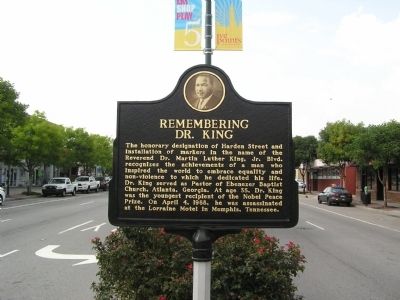
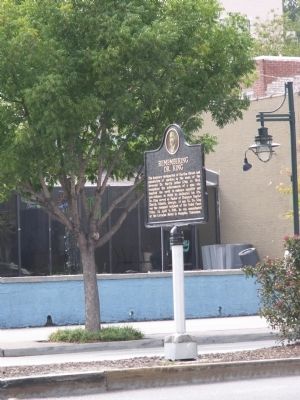
Remembering Dr. King
Photographed by Anna Inbody, August 21, 2011
1. Remembering Dr. King Marker
Front
The honorary designation of Harden Street and installation of markers in the name of the Reverend Dr. Martin Luther King, Jr. Blvd. recognizes the achievements of a man who inspired the world to embrace equality and non-violence to which he dedicated his life. Dr. King served as Pastor of Ebenezer Baptist Church, Atlanta, Georgia. At age 35, Dr. King was the youngest recipient of the Nobel Peace Prize. On April 4, 1968, he was assassinated at the Lorraine Motel in Memphis, Tennessee.
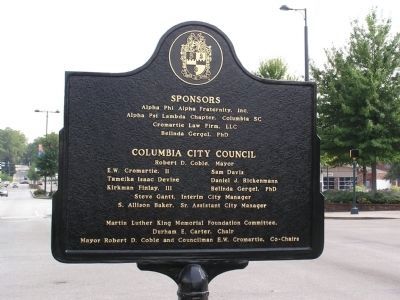
Reverse
Sponsors: Alpha Phi Alpha Fraternity, Inc.; Alpha Psi Lambda Chapter, Columbia, SC; Cromartie Law Firm, LLC; Belinda Gergel, PhD;
Columbia City Council: Robert D. Coble, Mayor; E.W. Cromartie, II; Sam Davis; Tameika Isaac Devine; Daniel J. Rickenmann; Kirkman Finlay, III; Belinda Gergel, PhD; Steve Gantt, Interim City Manager; S. Allison Baker, Sr. Assistant City Manager.
Martin Luther King Memorial Foundation Committee, Durham E. Carter, Chair; Mayor Robert D. Coble and Councilman E.W. Cromartie, Co-Chairs
Erected 2011 by Martin Luther King Memorial Foundation Committee.
Topics and series. This historical
this page online
Location. Marker has been reported missing. It was located near 34° 0.02′ N, 81° 0.996′ W. Marker was in Columbia, South Carolina, in Richland County. It was in Midtown - Downtown. It was on Harden Street near Greene Street, in the median. Touch for map. Marker was in this post office area: Columbia SC 29205, United States of America. Touch for directions.

Regionally, this marker was in the Midlands. It was also in the American South and specifically in the Deep South. Globally, it was in North America, the Western Hemisphere, the Western World, and the Anglosphere. Historically, it found itself in what was once the territory of the Mississippian Culture, one of the original Thirteen Colonies, one of the Confederate States of America, and the Antebellum South.
Other nearby markers. At least 8 other markers are within walking distance of this location: Hootie & The Blowfish
Photographed by Anna Inbody, August 21, 2011
2. Remembering Dr. King Marker Reverse
Another marker is no longer nearby. Maxcy Gregg Park (was approx. 0.3 miles away but has been confirmed missing).
Photographed by Anna Inbody
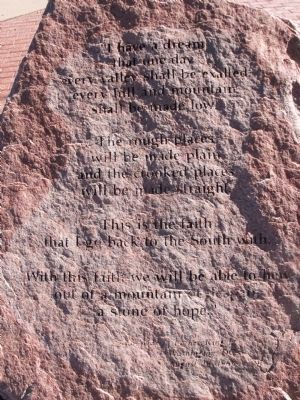
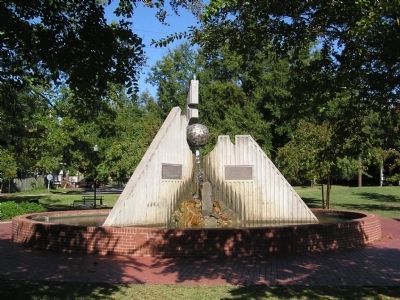
3. Stone of Hope
“I have a dream that one day every valley shall be exalted every hill and mountain shall be made low. The rough places will be made plain and the crooked places will be made straight. This is the faith that I go back to the South with. With this faith we will be able to hew ~ out of a mountain of despair, a stone of hope.” Dr Martin Luther King Jr. Washington, DC August 28, 1963
Photographed by Anna Inbody
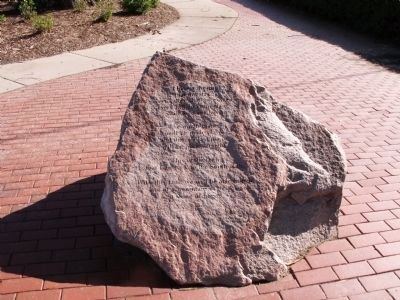
4. Stone of Hope Marker
Photographed by Anna Inbody
5. Stone of Hope Marker
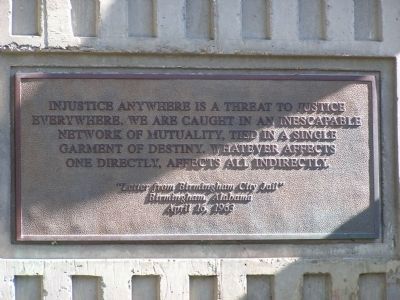
Injustice anywhere is a threat to justice everywhere. We are caught in an inescapable network of mutuality, tied in a single garment of destiny. Whatever affects one directly, affects all indirectly.
“Letter from Birmingham City Jail” Birmingham, Alabama April 16, 1963
“Letter from Birmingham City Jail” Birmingham, Alabama April 16, 1963
Photographed by Anna Inbody
6. Stone of Hope Marker
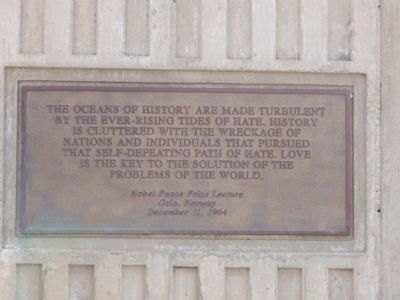
The oceans of history are made turbulent by the ever-rising tides of hate. History is cluttered with the wreckage of nations and individuals that pursued that self-defeating path of hate. Love is the key to the solution of the problems of the world.
Nobel Peace Prize Lecture Ozlo, Norway December 11, 1964
Nobel Peace Prize Lecture Ozlo, Norway December 11, 1964
Photographed by Anna Inbody
7. Stone of Hope Marker
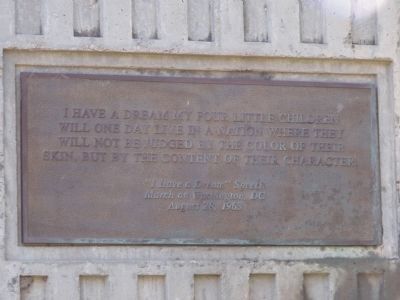
I have a dream my four little children will one day live in a nation where they will not be judged by the color of their skin, but by the content of their character.
“I have a dream” Speech March on Washington, DC August 28, 1963
“I have a dream” Speech March on Washington, DC August 28, 1963
Photographed by Anna Inbody
8. Stone of Hope Marker
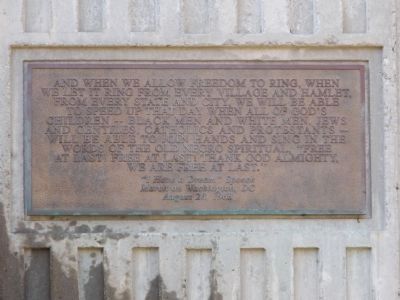
And when we allow freedom to ring, when we let it ring from every village and hamlet, from every state and city, we will be able to speed up that day when all of God’s children -- Black men and White men, Jews and Gentiles, Catholics and Protestants -- will be able to join hands and sing in the words of the old negro spiritual, “Free at last! free at last! Thank God Almighty, we are free at last.”
“I have a Dream” Speech March on Washington, DC August 28, 1963
“I have a Dream” Speech March on Washington, DC August 28, 1963
Photographed by Anna Inbody
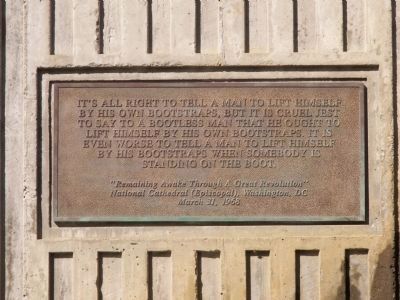
9. Stone of Hope Marker
It’s all right to tell a man to lift himself by his own bootstraps, but it is cruel jest to say to a bootless man that he ought to lift himself by his own bootstraps. It is even worse to tell a man to lift himself by his bootstraps when somebody is standing on the boot.
“Remaining Awake Through A Great Revolution” National Cathedral (Episcopal), Washington, DC March 31, 1968
“Remaining Awake Through A Great Revolution” National Cathedral (Episcopal), Washington, DC March 31, 1968
Photographed by Anna Inbody
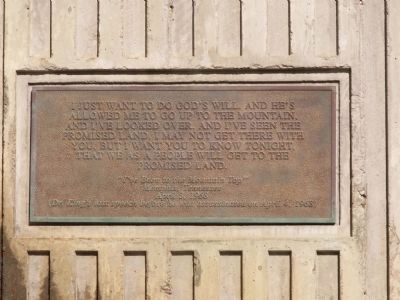
10. Stone of Hope Marker
I just want to do God’s will. And he’s allowed me to go up to the mountain. And I’ve looked over. And I’ve seen the promised land. I may not get there with you, but I want you to know tonight, that we as a people will get to the promised land.
“I’ve Been to the Mountain Top” Memphis, Tennessee April 3, 1968 (Dr. King’s last speech before he was assassinated on April 4, 1968)
“I’ve Been to the Mountain Top” Memphis, Tennessee April 3, 1968 (Dr. King’s last speech before he was assassinated on April 4, 1968)
Photographed by Anna Inbody, August 21, 2011
11. Overview
Photographed by Anna Inbody
12. Overview of Sculpture
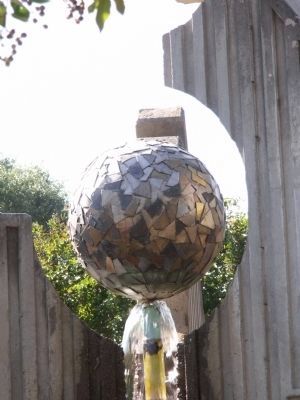
Photographed by Anna Inbody
13. "Floating" Sphere
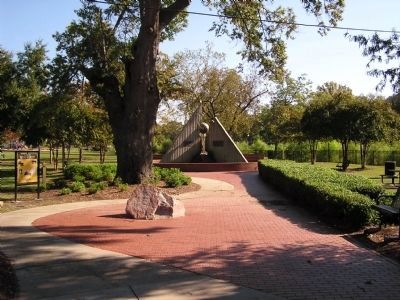
Photographed by Anna Inbody
14. Overview
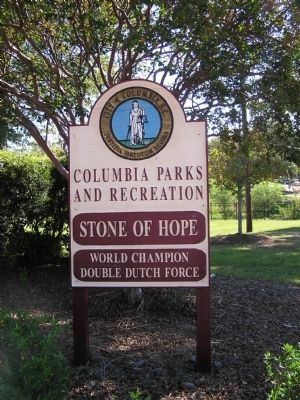
Photographed by Anna Inbody
15. Sign near entrance to marker area
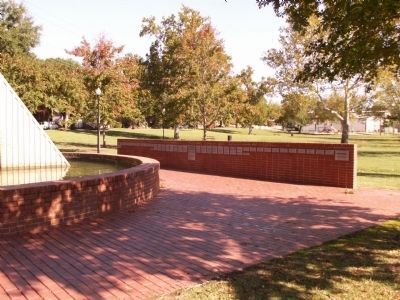
Photographed by Anna Inbody
16. Wall of plaques for Corporate Contributions
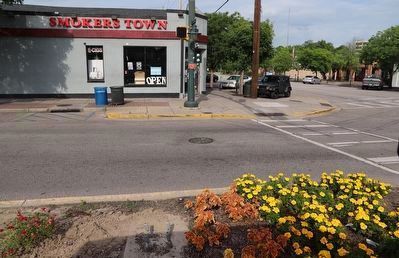
Photographed by Dave W, May 13, 2023
17. Remembering Dr. King Marker Missing
In the median the marker's pole can be seen but the marker is missing.
Credits. This page was last revised on May 16, 2023. It was originally submitted on September 28, 2011, by Anna Inbody of Columbia, South Carolina. This page has been viewed 1,117 times since then and 46 times this year. Last updated on May 14, 2023, by Dave W of Co, Colorado. Photos: 1, 2. submitted on September 28, 2011, by Anna Inbody of Columbia, South Carolina. 3, 4, 5, 6, 7, 8, 9, 10. submitted on February 26, 2012, by Anna Inbody of Columbia, South Carolina. 11. submitted on September 28, 2011, by Anna Inbody of Columbia, South Carolina. 12, 13, 14, 15, 16. submitted on February 26, 2012, by Anna Inbody of Columbia, South Carolina. 17. submitted on May 14, 2023, by Dave W of Co, Colorado. • J. Makali Bruton was the editor who published this page.
