
Rock Canyon in Provo in Utah County, Utah — The American Mountains (Southwest)
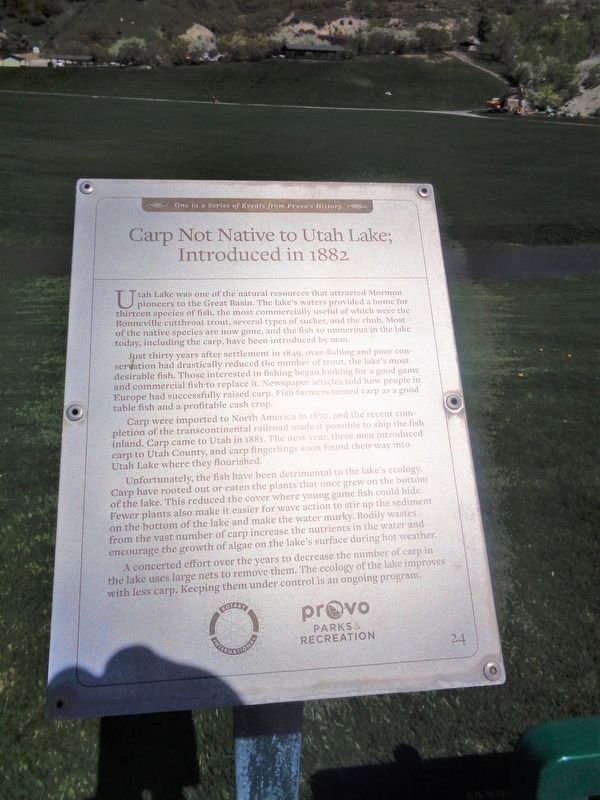
Carp Not Native to Utah Lake; Introduced in 1882
One in a Series of Events from Provo's History
Photographed by Jason Voigt, May 9, 2023
1. Carp Not Native to Utah Lake; Introduced in 1882 Marker
Just thirty years after settlement in 1849, over-fishing and poor conservation had drastically reduced the number of trout, the lake’s most desirable fish. Those interested in fishing began looking for a good game and commercial fish to replace it. Newspaper articles told how people in Europe had successfully raised carp. Fish farmers touted carp as a good table fish and a profitable cash crop.
Carp were imported to North America in 1870, and the recent completion of the transcontinental railroad made it possible to ship the fish inland. Carp came to Utah in 1881. The next year, three men introduced carp to Utah County, and carp fingerlings soon found their way into Utah Lake where they flourished.
Unfortunately,
this page online
A concerted effort over the years to decrease the number of carp in the lake uses large nets to remove them. The ecology of the lake improves with less carp. Keeping them under control is an ongoing program.
Erected by Rotary International and Provo Parks & Recreation. (Marker Number 24.)
Topics and series. This historical marker is listed in these topic lists: Animals • Parks & Recreational Areas. In addition, it is included in the Rotary International series list. A significant historical year for this entry is 1849.
Location. 40° 16.002′ N, 111° 38.203′ W. Marker is in Provo, Utah, in Utah County. It is in Rock Canyon. It can be reached from North 1200
Photographed by Jason Voigt, May 9, 2023
2. Carp Not Native to Utah Lake; Introduced in 1882 Marker
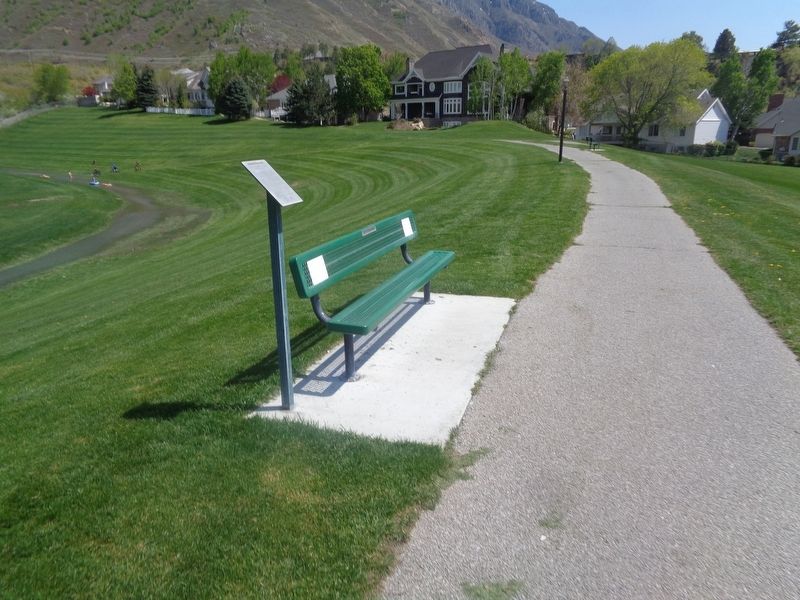
Marker is located at Rock Canyon Park.

Regionally, this marker is in Utah’s Wasatch Front. It is also in the American Mountain West and in Colorado Plateau. Globally, it is in North America, the Rocky Mountains, the Western Hemisphere, the Western World, and the Anglosphere. Historically, it finds itself in what was once New Spain and also Mexico’s Alta California.
Other nearby markers. At least 8 other markers are within walking distance of this marker: Creating the “Y” on the Mountain (within shouting distance of this marker); Provo’s North Park Had a Community Ice Skating Rink in the 1930s (within shouting distance of this marker); Choosing the Site of Provo’s First Tabernacle Caused Some Controversy (within shouting distance of this marker); Provo Had a “Pest House” for Those with Communicable Diseases (about 300 feet away, measured in a direct line); Proctor Academy Helped Educate Provo’s Youth (about 300 feet away); Provo’s First Bank was Late in Coming but Didn’t Last Long (about 400 feet away); Army Troops Caused the “Provo Riot” in 1870 (about 600 feet away); Rock Canyon Trailhead History (approx. 0.4 miles away). Touch for a list and map of all markers in Provo.
Credits. This page was last revised on May 16, 2023. It was originally submitted on May 16, 2023, by Jason Voigt of Glen Carbon, Illinois. This page has been viewed 257 times since then and 34 times this year. Photos: 1, 2. submitted on May 16, 2023, by Jason Voigt of Glen Carbon, Illinois.
