Emory Place in Knoxville in Knox County, Tennessee — The American South (East South Central)
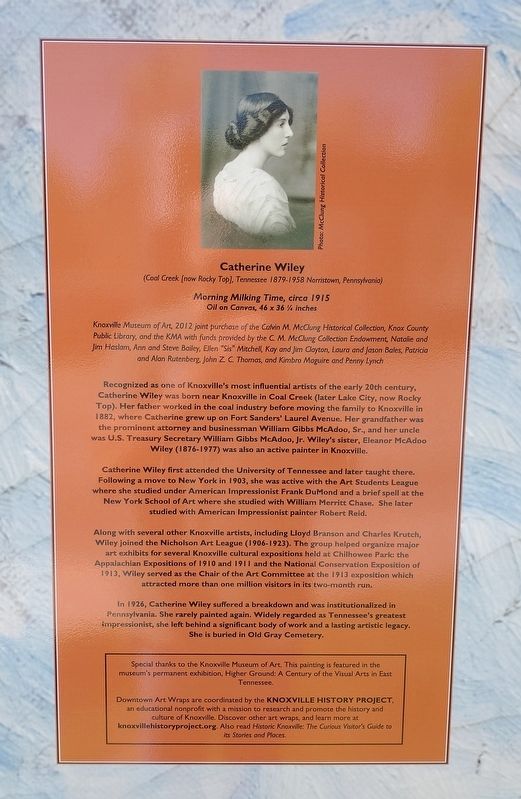
Catherine Wiley
(Coal Creek [now Rocky Top], Tennessee 1879-1958 Norristown, Pennsylvania)
Photographed by Tom Bosse, April 15, 2023
1. Catherine Wiley Marker
Oil on Canvas, 46 x 36 ¼ inches
Knoxville Museum of Art, 2012 joint purchase of the Calvin M. McClung Historical Collection, Knox County Public Library, and the KMA with funds provided by the C. M. McClung Collection Endowment, Natalie and Jim Haslam, Ann and Steve Bailey, Ellen “Sis” Mitchell, Kay and Jim Clayton, Laura and Jason Bales, Patricia and Alan Rutenberg, John Z.C. Thomas, and Kimbro Maguire and Penny Lynch.
Recognized as one of Knoxville’s most influential artists of the early 20th century, Catherine Wiley was born near Knoxville in Coal Creek (later Lake City, now Rocky Top). Her father worked in the coal industry before moving the family to Knoxville in 1882, where Catherine, and her sister and fellow artist, Eleanor McAdoo Wiley (1876-1977) grew up on Fort Sanders’ Laurel Avenue. Her grandfather was the prominent attorney and businessman William Gibbs McAdoo, Sr., and her uncle was U.S. Treasury Secretary William Gibbs McAdoo, Jr. Wiley’s sister Eleanor McAdoo Wiley, was also an active painter in Knoxville.
Catherine Wiley first attended the University of Tennessee and later taught there. Following a move to New York in 1903, she was active with the Art Students League where she studied under American Impressionist Frank DuMond. Wiley returned to Knoxville in 1905 after a brief spell at the New York School of Art where she studied with William Merritt Chase. In 1912, she returned to New York to study with American Impressionist painter Robert Reid.
Along with several other Knoxville artists, including Lloyd Branson and Krutch, Wiley joined the Nicholson Art League (1906-1923), which often met close to here at 604 South Gay Street. The group helped organize major art exhibits for several Knoxville cultural expositions held at Chilhowee Park: the Appalachian
this page online
In 1926, Catherine Wiley suffered a breakdown and was institutionalized in Pennsylvania and rarely painted again. Widely regarded as Tennessee’s greatest Impressionist, she left behind a significant body of work and a lasting artistic legacy. She is buried in Old Gray Cemetery.
museum’s permanent exhibition, Higher Ground: A Century of the Visual Arts in East
Tennessee.
Downtown Art Wraps are coordinated by the Knoxville History Project,
an educational nonprofit with a mission to research and promote the history and
culture of Knoxville. Discover other art wraps, and learn more at
knoxvillehistoryproject.org. Also read Historic Knoxville: The Curious Visitor’s Guide to its Stories and Places.
Photo: McClung Historical Collection
Erected by Knoxville History Project.
Topics and series. This historical marker is listed
Photographed by Tom Bosse, April 15, 2023
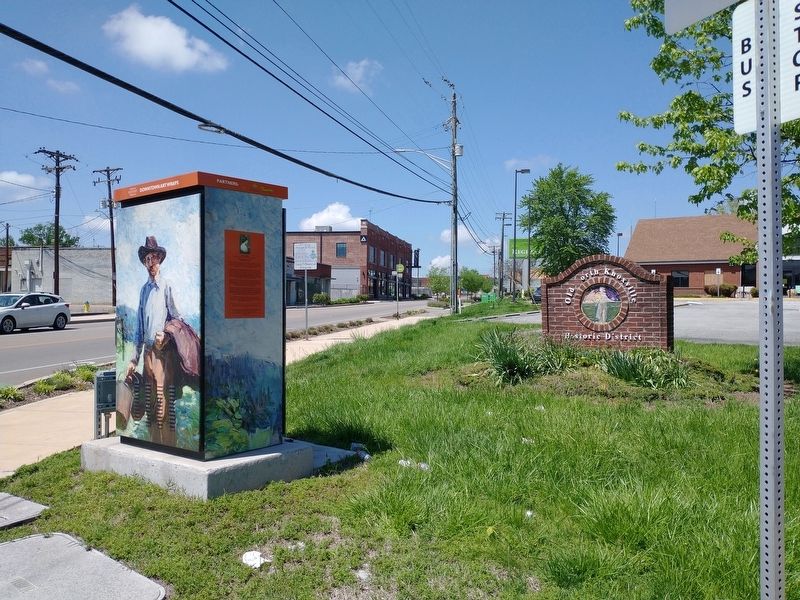
2. Catherine Wiley Marker
Location. 35° 58.581′ N, 83° 55.427′ W. Marker is in Knoxville, Tennessee, in Knox County. It is in Emory Place. It is at the intersection of North Broadway (U.S. 441) and North Central Street, on the right when traveling south on North Broadway. Touch for map. Marker is at or near this postal address: 700 N Broadway, Knoxville TN 37917, United States of America. Touch for directions.

Regionally, this marker is in East Tennessee. It is also in the American South, specifically in the Upper South, in Appalachia, and specifically in Southern Appalachia. Globally, it is in North America, the Western Hemisphere, the Western World, and the Anglosphere. Historically, it finds itself in what was once the original Cherokee Nation, the territory of the Mississippian Culture, one of the Confederate States of America, and the Antebellum South.
Other nearby markers. At least 8 other markers are within walking distance of this marker: Central United Methodist Church (about 500 feet away, measured in a direct line); St. John's Lutheran Church (approx. 0.2 miles away); Old Gray Cemetery (approx. 0.2 miles away); a different marker also named Old Gray Cemetery (approx. 0.2 miles away); Mary Boyle Temple (approx. 0.2 miles away); Knoxville National Cemetery (approx. 0.2 miles away); A National Cemetery System (approx. 0.2 miles away); Address by President Lincoln (approx. 0.2 miles away). Touch for a list and map of all markers in Knoxville.
Credits. This page was last revised on May 22, 2023. It was originally submitted on May 20, 2023, by Tom Bosse of Jefferson City, Tennessee. This page has been viewed 214 times since then and 26 times this year. Photos: 1, 2. submitted on May 20, 2023, by Tom Bosse of Jefferson City, Tennessee. • James Hulse was the editor who published this page.
