Hague in Westmoreland County, Virginia — The American South (Mid-Atlantic)
Richard Henry Lee’s Grave
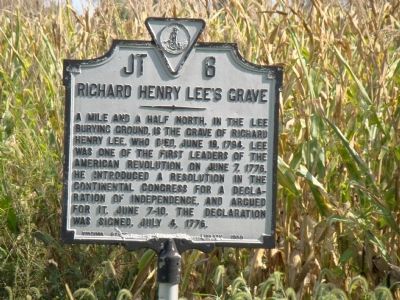
Photographed by J. J. Prats, August 30, 2009
1. Richard Henry Lee’s Grave Marker
Erected 1959 by Virginia State Library. (Marker Number JT-6.)
Topics and series. This historical marker is listed in these topic lists: Cemeteries & Burial Sites • War, US Revolutionary. In addition, it is included in the Signers of the Declaration of Independence, and the Virginia Department of Historic Resources (DHR) series lists. A significant historical date for this entry is June 19, 1794.
Location. 38° 4.205′ N, 76° 38.799′ W. Marker is in Hague, Virginia, in Westmoreland County. It is at the intersection of Cople Highway (Virginia Route 202) and Coles Point Road (County Route 612), on the right when traveling east on Cople Highway. It is across from the public library. Touch for map. Marker is in this post office area: Hague VA 22469, United States of America.
this page online

Regionally, this marker is on Virginia’s Northern Neck. It is also in the American South, specifically in the Upper South, in the Tidewater, in the Chesapeake Bay Region, and on the Eastern Seaboard. Globally, it is in the North Atlantic Region, North America, the Western Hemisphere, the Western World, and the Anglosphere. Historically, it finds itself in what was once the territory of the Mississippian Culture, one of the original Thirteen Colonies, one of the Confederate States of America, and the Antebellum South.
Other nearby markers. At least 8 other markers are within 5 miles of this marker, measured as the crow flies: Lee Hall (approx. 0.4 miles away); Zion Baptist Church (approx. 1.2 miles away); Nomini Hall (approx. 2 miles away); Yeocomico Church (approx. 2.2 miles away); Washington’s Mother (approx. 2.2 miles away); McCoy Revolutionary Soldiers (approx. 2.3 miles away); War of 1812 (approx. 2.8 miles away); The Glebe (approx. 4.2 miles away). Touch for a list and map of all markers in Hague.
Another marker is no longer nearby. The Burnt House Field (was a few steps from this
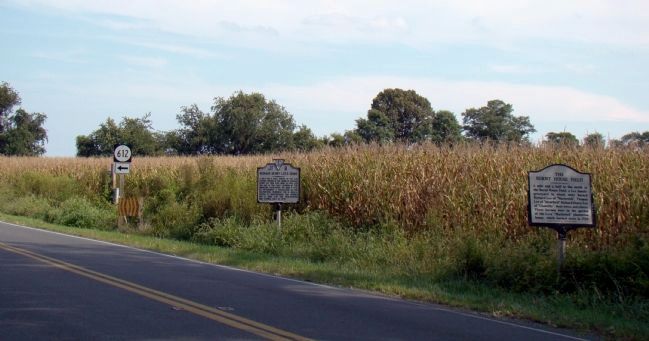
Photographed by J. J. Prats, August 30, 2009
2. Two Markers on Route 202 at Route 612 North
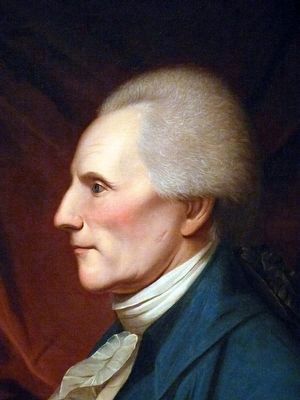
Photographed by Allen C. Browne, August 9, 2015
3. Richard Henry Lee
This 1795-1805 portrait of Richard Henry Lee by Charles Willson Peale hangs in the National Portrait Gallery, in Washington, DC.
“On June 7, 1776, it fell to Richard Henry Lee, delegate from Virginia at the Second Continental Congress, to offer the resolution that ‘these United Colonies are, and of right ought to be, free and independent States.’
Lee was a tobacco planter and a seasoned member of the Virginia House of Burgesses. An aristocrat with an innate sense of his natural rights, Lee had long fought England's attempts to undermine colonial liberties. From the time he first came to Congress, he had used his powerful oratory to unite his colleagues in resistance to British tyranny. Absent in Virginia (where he was helping with the formation of a new state government) when his resolution was adopted on July 2, Lee later returned to sign the Declaration of Independence.” — National Portrait Gallery
“On June 7, 1776, it fell to Richard Henry Lee, delegate from Virginia at the Second Continental Congress, to offer the resolution that ‘these United Colonies are, and of right ought to be, free and independent States.’
Lee was a tobacco planter and a seasoned member of the Virginia House of Burgesses. An aristocrat with an innate sense of his natural rights, Lee had long fought England's attempts to undermine colonial liberties. From the time he first came to Congress, he had used his powerful oratory to unite his colleagues in resistance to British tyranny. Absent in Virginia (where he was helping with the formation of a new state government) when his resolution was adopted on July 2, Lee later returned to sign the Declaration of Independence.” — National Portrait Gallery

Photographed by Evan Dwyer, August 8, 2025
4. Burnt House Field Lee Cemetery
The cemetery is all that remains of Burnt House Field. It is off State Route 675 and, according to a book about historic sites on the Northern Neck & Essex County (Historic Sites in Virginia's Northern Neck and Essex County: A Guide by Thomas A. Wolf, 2nd Edition, published with updates to entries up through 2020) it is open for public visitation. Driving back there, however, does not feel like a welcoming, public experience. The route, though ostensibly a state road, is gravel and the woods on both sides of the road are marked as Private Property, so sticking to the road itself is essential. The road does branch into a soybean field and go right up to the cemetery, and there are commemorative tablets on the cemetery itself - nor is the cemetery padlocked, there's just a bent nail through the hole to keep the door from swinging freely - and the interior of the cemetery is brick-floored. It is an isolated spot, surrounded entirely by soybeans.

Photographed by Evan Dwyer, August 8, 2025
5. Richard Henry Lee’s Gravestone
The stone reads,
Here was Buried Richard Henry Lee of Virginia
1732–1794.
Author of the Westmoreland Resolutions of 1766.
Mover of the Resolution for Independence.
Signer of the Declaration of Independence.
President of the Continental Congress.
United States Senator from Virginia.
“We cannot do without you.”

Photographed by Evan Dwyer, September 6, 2025
6. Burnt House Field Lee Cemetery
Wide-angle view of the cemetery in its field.
Credits. This page was last revised on October 4, 2025. It was originally submitted on September 12, 2009, by J. J. Prats of Powell, Ohio. This page has been viewed 4,000 times since then and 264 times this year. Photos: 1, 2. submitted on September 12, 2009, by J. J. Prats of Powell, Ohio. 3. submitted on August 16, 2015, by Allen C. Browne of Silver Spring, Maryland. 4, 5. submitted on August 10, 2025, by Evan Dwyer of Richmond, Virginia. 6. submitted on October 1, 2025, by Evan Dwyer of Richmond, Virginia.
Editor’s want-list for this marker. Photos of gravesite • Can you help?
