Susquehanna Township near Harrisburg in Dauphin County, Pennsylvania — The American Northeast (Mid-Atlantic)
Harrisburg State Hospital
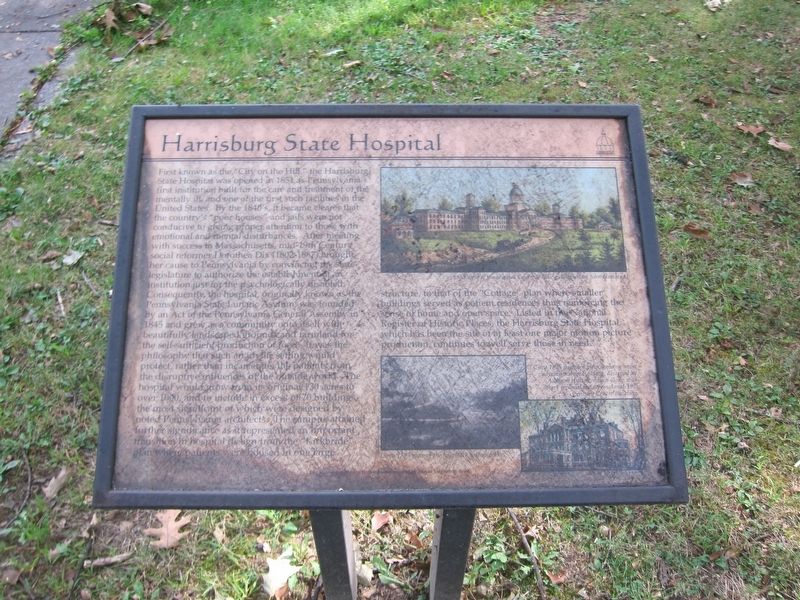
Photographed by Andrew Ruppenstein, September 28, 2016
1. Harrisburg State Hospital Marker
this page online
Erected by Harrisburg History Project.
Topics and series. This historical marker is listed in these topic lists: Architecture • Charity & Public Work • Science & Medicine. In addition, it is included in the Pennsylvania, The Harrisburg History Project series list. A significant historical year for this entry is 1851.
Location. 40° 17.052′ N, 76° 52.623′ W. Marker is near Harrisburg, Pennsylvania, in Dauphin County. It is in Susquehanna Township. It can be reached from Azalea
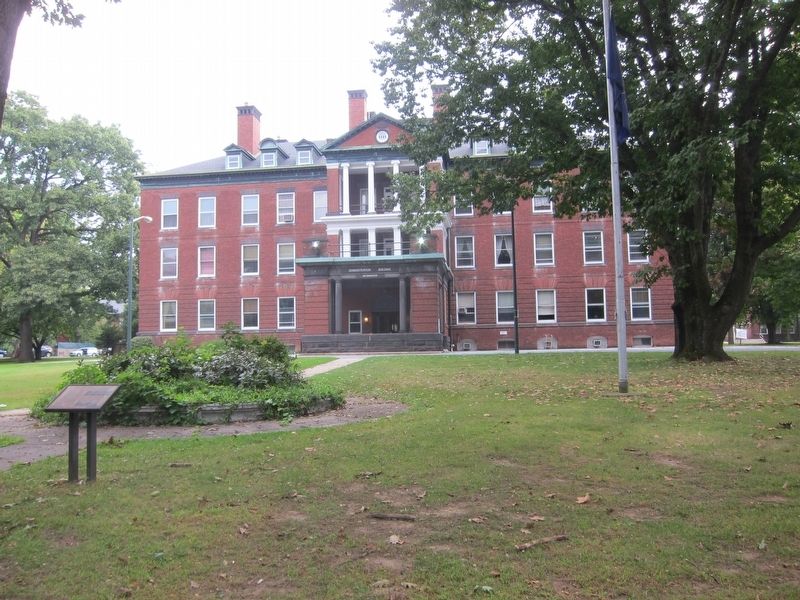
Photographed by Andrew Ruppenstein, September 28, 2016
2. Harrisburg State Hospital Administration Building and Marker

Regionally, this marker is in South-Central Pennsylvania, specifically in Pennsylvania Dutch Country, and in the Susquehanna Valley. It is also in the American Northeast and in the Mid-Atlantic. Globally, it is in North America, the Western Hemisphere, the Western World, and the Anglosphere. Historically, it finds itself in what was once the Haudenosaunee (Iroquois) Confederacy and also one of the original Thirteen Colonies.
Other nearby markers. At least 8 other markers are within walking distance of this marker: A different marker also named Harrisburg State Hospital (approx. 0.2 miles away); Pennsylvania Farm Show (approx. 0.3 miles away); Pennsylvania State Farm Show Complex (approx. 0.4 miles away); Charles Y. Petty Sr. (approx. ¾ mile away); Camp Curtin (approx. ¾ mile away); a different marker also named Camp Curtin (approx. ¾ mile away); a different marker also named Camp Curtin (approx. ¾ mile away); Camp Curtin Memorial-Mitchell United Methodist Church
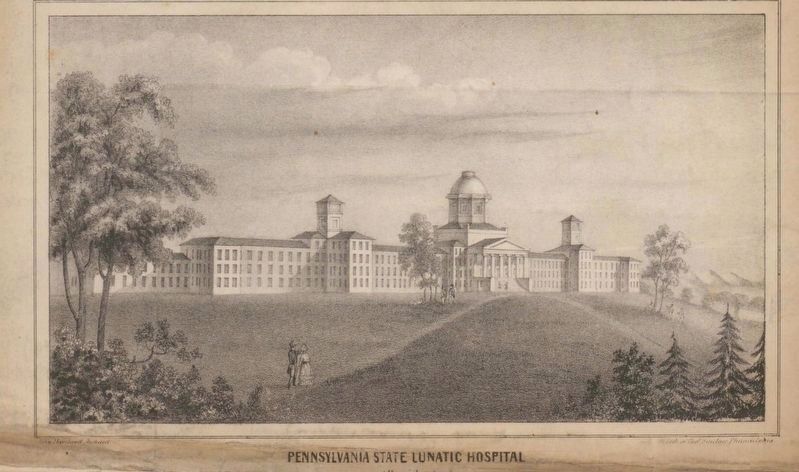
Pennsylvania State Lunatic Hospital (courtesy of the U.S. National Library of Medicine), 1851
3. Pennsylvania State Lunatic Hospital
This was the frontispiece for By-laws of the Penn'a State Lunatic Hospital, at Harrisburg : with the acts of the Legislature establishing the same (1851).
Another marker is no longer nearby. The Ladies Of Harrisburg During The Civil War (was approx. ¾ mile away but has been confirmed missing).
Regarding Harrisburg State Hospital. The hospital closed in 2006, and options for preservation and/or redevelopment are still under consideration as of 2021.
Also see . . .
1. Harrisburg State Hospital (Historic Harrisburg Association). (Submitted on January 8, 2022.)
2. Harrisburg State Hospital (Asylum Projects). Presents an extended history of the hospital dating from 1916, as well as some updated information, including identification of films and tv shows which have used the grounds.
"In 1999 Harrisburg State Hospital was used for the hospital setting in the film, Girl, Interrupted. The majority of the film was shot in the Male Convalescent Building and the Administration Building. Other various locations in Harrisburg, Pennsylvania were also used. The Harrisburg State Hospital settings were meant to resemble those of the grounds of McLean Hospital in Massachusetts. The hospital was still an active Pennsylvania state hospital during the filming of the movie...."(Submitted on January 8, 2022.)
Credits. This page was last revised on May 25, 2023. It was originally submitted on January 8, 2022, by Andrew Ruppenstein of Lamorinda, California. This page has been viewed 1,443 times since then and 69 times this year. Last updated on May 24, 2023, by Laura Klotz of Northampton, Pennsylvania. Photos: 1, 2, 3. submitted on January 8, 2022, by Andrew Ruppenstein of Lamorinda, California. • J. Makali Bruton was the editor who published this page.
