Centrum in Den Haag, South Holland, Netherlands — Northwestern Europe
Gevangenpoort
⎯⎯⎯
Captivity Gate
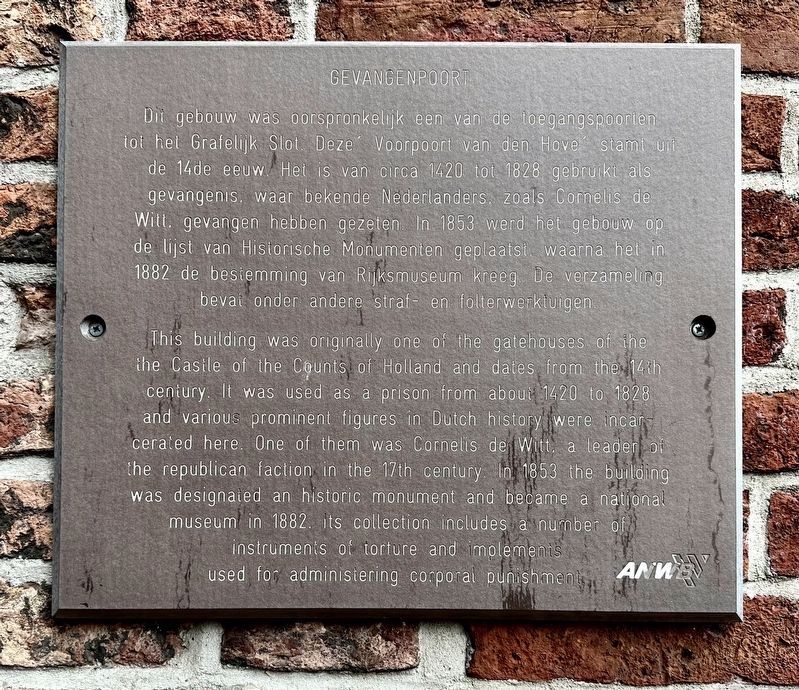
Photographed by Andrew Ruppenstein, May 8, 2023
1. Gevangenpoort / Captivity Gate Marker

Erected by The ANWB.
Topics. This historical marker is listed in these topic lists: Forts and Castles • Law Enforcement. A significant historical year for this entry is 1420.
Location. 52° 4.778′ N, 4° 18.62′ E. Marker is in Den Haag, Zuid-Holland (South Holland). It is in Centrum. It is on Buitenhof,
this page online

Regionally, it is in Europe, the European Union, Atlantic Europe, the Benelux Low Countries, the Schengen Area, Western Europe, and the Western World. Historically, it finds itself in what was once the Roman Empire and specifically also the Holy Roman Empire.
Other nearby markers. At least 8 other markers are within walking distance of this marker: Diplomatieke Missie van Oekraïne / Diplomatic Mission of Ukraine (about 120 meters away, measured in a direct line); Johan de Witt-Huis / Johan de Witt House (about 120 meters away); Gysbert Karel van Hogendorp (about 120 meters away); Lange Voorhout 1 (about 180 meters away); Lange Voorhout 3 (about 180 meters away); Koning Willem II / King William II (about 210 meters away); Paleis Kneuterdijk / Palace Kneuterdijk (about 210 meters away); General Headquarters of Supreme Commander General Winkelman (about 210 meters away). Touch for a list and map of all markers in Den Haag.
Related marker. Click here for another marker that is related to this marker.
Also see . . . Gevangenpoort (Wikipedia).
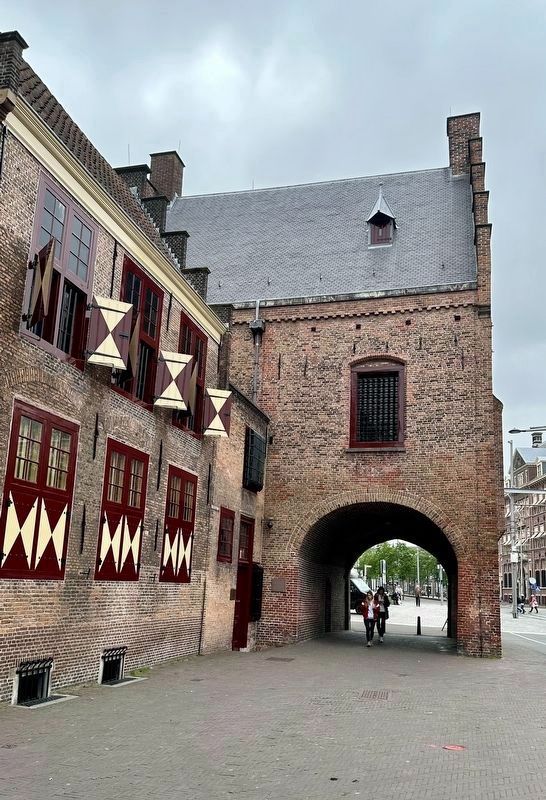
On its use as a prison: From 1420 until 1828, the prison was used for housing people(Submitted on May 25, 2023, by Andrew Ruppenstein of Lamorinda, California.)who had committed serious crimes while they awaited sentencing.Photographed by Andrew Ruppenstein, May 8, 20232. Gevangenpoort / Captivity Gate Marker - wide view, looking northThe marker is visible here just to the left of the gateway.
Its most famous prisoner was Cornelis de Witt, who was held on the charge of plotting the murder of the stadtholder. He was lynched together with his brother Johan on 20 August 1672 on the square in front of the building called groene zoodje after the grass mat used for the scaffold. When public executions went out of fashion the area was used to build the "Witte Society", a literature club that still exists today, but had to move when the street was built in 1923.
In 1882, the Gevangenpoort became a prison museum. The "gate" function was lost in 1923 when the houses adjoining the Hofvijver were taken down to build the street that now allows busy traffic, including trams.

Photographed by J.G. Happel, ‘s Gravenhage, circa 1910
3. Gevangenpoort (Prison Gate)
Taken from roughly the same perspective as that in Photo 2, with the notable difference of the presence of the buildings on the right, which were removed in order to put a road through in the 1920’s.
Photographed by Johannes Adrianus van der Drift (Via Wikimedia Commons), circa 1825
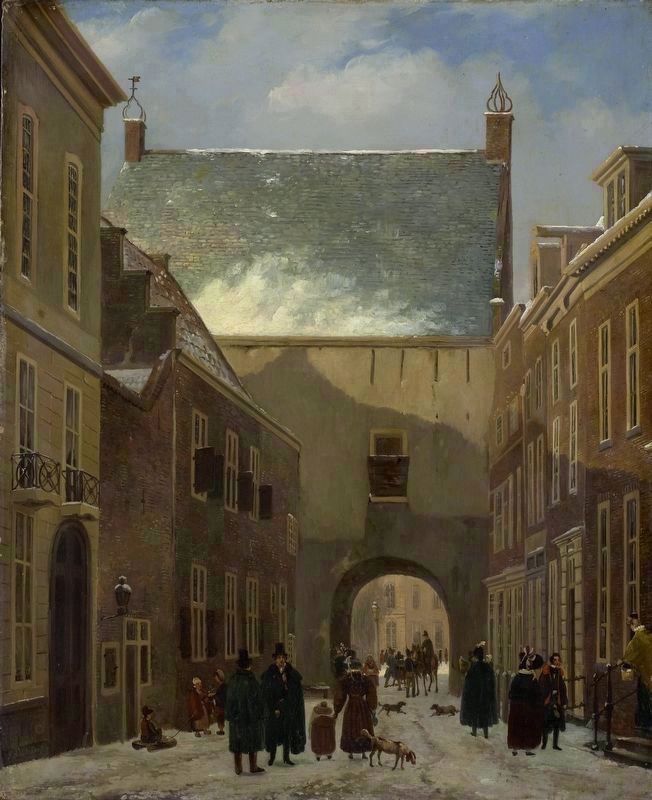
4. De Gevangenpoort te Den Haag
The same perspective as Photos 2 and 3, but painted two centuries ago.

Photographed by Andrew Ruppenstein, May 8, 2023
5. Gevangenpoort / Captivity Gate and Marker
Credits. This page was last revised on December 31, 2023. It was originally submitted on May 25, 2023, by Andrew Ruppenstein of Lamorinda, California. This page has been viewed 141 times since then and 15 times this year. Photos: 1, 2, 3, 4, 5. submitted on May 25, 2023, by Andrew Ruppenstein of Lamorinda, California.
