
Ruther Glen in Caroline County, Virginia — The American South (Mid-Atlantic)
William Clark Birthplace
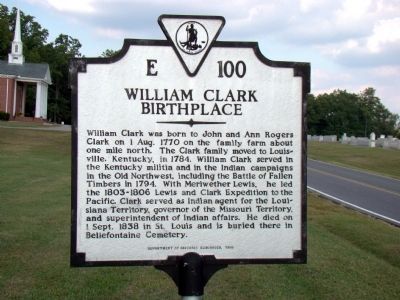
Photographed by J. J. Prats, September 19, 2009
1. William Clark Birthplace Marker
Erected 1995 by Department of Historic Resources. (Marker Number E-100.)
Topics and series. This historical marker is listed in these topic lists: Cemeteries & Burial Sites • Exploration • Wars, US Indian. In addition, it is included in the Lewis & Clark Expedition, and the Virginia Department of Historic Resources (DHR) series lists. A significant historical date for this entry is September 1, 1838.
Location. 38° 0.084′ N, 77° 35.034′ W. Marker is in Ruther Glen, Virginia, in Caroline County. It is at the intersection of
this page online

Regionally, this marker is in the Piedmont and in Central Virginia. It is also in the American South, specifically in the Upper South, and on the Eastern Seaboard. Globally, it is in the North Atlantic Region, North America, the Western Hemisphere, the Western World, and the Anglosphere. Historically, it finds itself in what was once the territory of the Mississippian Culture, one of the original Thirteen Colonies, one of the Confederate States of America, and the Antebellum South.
Other nearby markers. At least 8 other markers are within 6 miles of this marker, measured as the crow flies: York (Born ca. 1770) (here, next to this marker); Clark Family Farm (approx. 3.9 miles away); Maneuvering to the North Anna River (approx. 3.9 miles away); York: Lewis and Clark Expedition (approx. 3.9 miles away); Dickinson's Mill (approx. 4½ miles away);
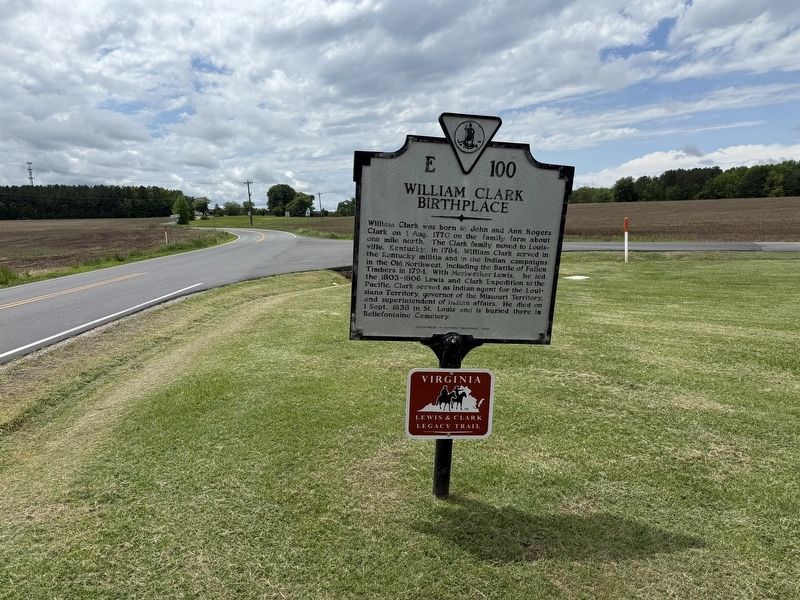
Also see . . . William Clark (explorer). Wikipedia entry. “Clark did not have any formal education, but like many of his contemporaries he was tutored at home. In later years, he was somewhat self-conscious about his convoluted grammar and inconsistent spelling—he spelled “Sioux” twenty-seven different ways in his journals of the Lewis and Clark Expedition—and sought to have his journals corrected before publication. But the spelling of American English was not standardized in Clark’s youth, and his vocabulary suggests that he was well read.” (Submitted on September 20, 2009.)
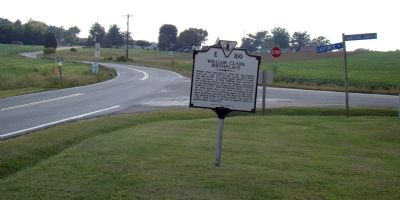
Photographed by J. J. Prats, September 19, 2009
3. William Clark Birthplace Marker
This is a photo of the marker before the Virginia Lewis & Clark Legacy Trail sign was added.
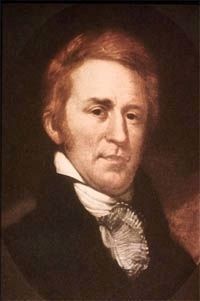
Oil by Charles Willson Peale, circa 1807
4. William Clark (1770–1838)
Credits. This page was last revised on May 9, 2025. It was originally submitted on September 19, 2009, by J. J. Prats of Powell, Ohio. This page has been viewed 4,013 times since then and 150 times this year. Photos: 1. submitted on September 19, 2009, by J. J. Prats of Powell, Ohio. 2. submitted on May 9, 2025, by Devry Becker Jones of Washington, District of Columbia. 3. submitted on September 19, 2009, by J. J. Prats of Powell, Ohio. 4. submitted on September 20, 2009, by J. J. Prats of Powell, Ohio.
