Highlands in Monmouth County, New Jersey — The American Northeast (Mid-Atlantic)
The Navesink Highlands Light Station
Photographed by Bill Coughlin, September 20, 2009
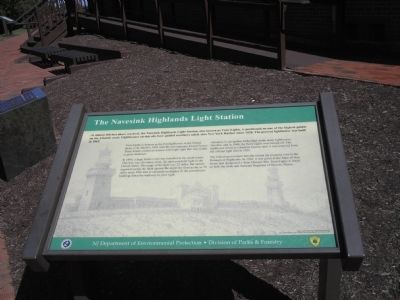
1. The Navesink Highlands Light Station Marker
At almost 200 feet above sea level, the Navesink Highlands Light Station, also known as Twin Lights, is positioned on one of the highest points on the Atlantic coast. Lighthouses on this site have guided mariners safely into New York Harbor since 1828. The present lighthouse was built in 1862.
Twin Lights is famous as the first lighthouse in the United States to be fitted in 1841 with the revolutionary Fresnel lenses. These lenses create an intense and bright light that was visible at great distances.
In 1898, a large bivalve lens was installed in the south tower. This lens was, for many years, the most powerful light in the United States. The range of the light was 22 miles, but sailors reported seeing the flash against the night sky from as far as 70 miles away. This lens is currently on display in the powerhouse building down the walkway to your right.
Advances in navigation technology made many lighthouses obsolete, and in 1949, the Twin Lights were turned off. The lighthouse stood as a daytime beacon until it was removed from the official lists in 1951.
The federal government initially turned the property over to the
this page online
Erected by NJ Department of Environmental Protection, Division of Parks & Forestry.
Topics and series. This historical marker is listed in these topic lists: Communications • Landmarks • Waterways & Vessels. In addition, it is included in the Lighthouses series list. A significant historical year for this entry is 1828.
Location. This marker has been replaced by another marker nearby. It was located near 40° 23.783′ N, 73° 59.153′ W. Marker was in Highlands, New Jersey, in Monmouth County. It was on Lighthouse Road. Marker is located in the Twin Lights Historic Site. Touch for map. Marker was in this post office area: Highlands NJ 07732, United States of America. Touch for directions.

Regionally, this marker was in Central Jersey, specifically on the Jersey Shore, and in the New York City Metropolitan Area. It was also in the American Northeast, in the Mid-Atlantic, and on the Eastern Seaboard. Globally, it was in the North
Photographed by Bill Coughlin, September 20, 2009
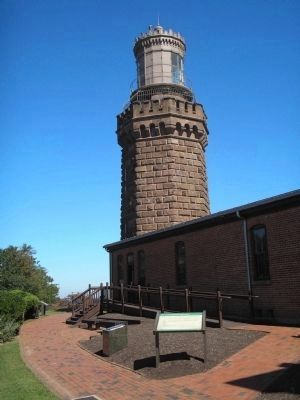
2. Marker at the Twin Lights Historic Site
The North Tower can be seen behind the marker.
Other nearby markers. At least 8 other markers are within walking distance of this location: Powerhouse (a few steps from this marker); Electric Power Station (within shouting distance of this marker); Twin Lights Mystery Cannon (within shouting distance of this marker); The Navesink Light Station (within shouting distance of this marker); a different marker also named Navesink Light Station (within shouting distance of this marker); Spermaceti Cove Lifesaving Station (within shouting distance of this marker); Spermaceti Cove Life Saving Station (within shouting distance of this marker); From the Navesink Highlands (within shouting distance of this marker). Touch for a list and map of all markers in Highlands.
Other markers no longer nearby. Spermaceti Cove Lifeboat Station (was a few steps from this marker but has been replaced with another marker now near it); Marconi at Twin Lights (was a few steps from this marker
Photographed by Bill Coughlin, September 20, 2009
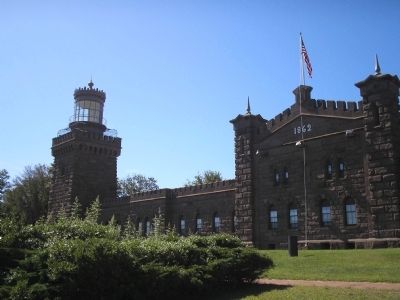
3. South Tower at Navesink Highlands Light Station
More about this marker. The background of the marker features a picture of the Twin Lights of Navesink.
Related marker. Click here for another marker that is related to this marker. This marker has been replaced with the linked marker.
Photographed by Bill Coughlin, September 20, 2009
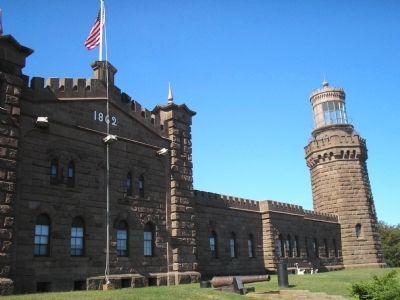
4. The Navesink Highlands Light Station North Station
Photographed by Bill Coughlin, September 20, 2009
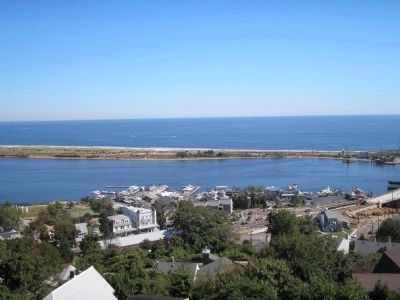
5. View from the North Tower
Sandy Hook Bay and the Atlantic approach to New York Harbor can be seen from the Twin Light's North Tower.
Photographed by Bill Coughlin, September 20, 2009
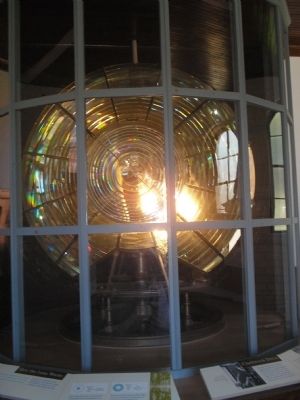
6. Fresnel lens
Twin Lights was the first lighthouse in the United States to be fitted with a Fresnel lens. This lens is on dislay at the Twin Lights Historic Site.
Credits. This page was last revised on October 19, 2022. It was originally submitted on September 20, 2009, by Bill Coughlin of Woodland Park, New Jersey. This page has been viewed 1,134 times since then and 44 times this year. Photos: 1, 2, 3, 4, 5, 6. submitted on September 20, 2009, by Bill Coughlin of Woodland Park, New Jersey.
