Riverfront in Wilmington in New Hanover County, North Carolina — The American South (South Atlantic)
Mitchell-Anderson House
1738

Photographed by Cosmos Mariner, May 15, 2023
1. Mitchell-Anderson House Marker
Oldest surviving structure in Wilmington, Georgian style house built for Edward Mitchell (d. 1744), native of Charleston, SC, carpenter and planter. Purchased in 1828 by Thomas F. Davis (1778-1846), clerk of New Hanover County Court. Inherited in 1860 by Margaret Anderson Davis (1814-1889), sister of Dr. Edwin A. Anderson (1816-1894), physician and Confederate army surgeon, who resided here as early as 1850. Remained in family until 1911. Operated as boarding house until 1963 when saved for preservation by Thomas H. Wright, Jr. (1918-1993), president of Wright Chemical Corporation; and wife, Elizabeth Labouisse (1933- ), founders of Historic Wilmington Foundation, Inc.
Erected by Historic Wilmington Foundation, Inc.
Topics and series. This historical marker is listed in these topic lists: Architecture • Colonial Era. In addition, it is included in the North Carolina, Historic Wilmington Foundation series list. A significant historical year for this entry is 1738.
Location. 34° 13.966′ N, 77° 56.892′ W. Marker is in Wilmington, North Carolina, in New Hanover County. It is in Riverfront. It is on Orange Street just
this page online

Regionally, this marker is in the Coastal Plain and on the Cape Fear Coast. It is also in the American South, specifically in the Upper South, in the Tidewater, and on the Eastern Seaboard. Globally, it is in the North Atlantic Region, North America, the Western Hemisphere, the Western World, and the Anglosphere. Historically, it finds itself in what was once the territory of the Mississippian Culture, one of the original Thirteen Colonies, one of the Confederate States of America, and the Antebellum South.
Other nearby markers. At least 8 other markers are within walking distance of this marker: Dr. Anderson's Office (a few steps from this marker); Hogg-Anderson House (within shouting distance of this marker); St. John's Lodge (within shouting distance of this marker); Salvation Army Building (within shouting
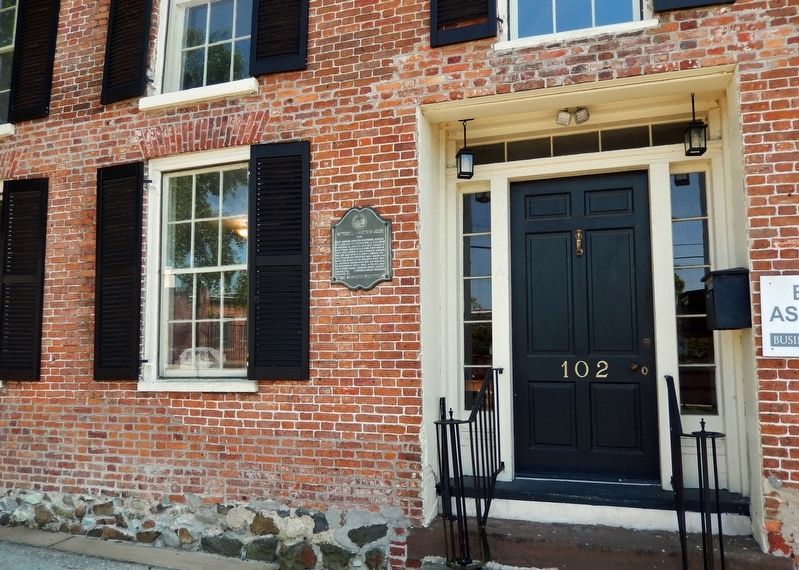
Photographed by Cosmos Mariner, May 15, 2023
2. Mitchell-Anderson House Marker
Regarding Mitchell-Anderson House. Contributing property, Wilmington Historic District (as Smith-Anderson House), National Register of Historic Places #74001364.
From the National Register Nomination:
Only one mid-eighteenth-century dwelling reported to have existed in 1758 survives today — the Smith-Anderson House. The Smith-Anderson House (ca. 1745), apparently the earliest surviving building in Wilmington, has been altered, but its unique early configuration is still discernible. Built of brick laid in Flemish bond the dwelling rises two-and-one-half stories. The gable roof is pierced by three interior end chimneys. In plan, the house has a center hall with two rooms on the east side and one room and a porch room (a unique survival though now filled in) on the west sidefacing the river.Photographed by Cosmos Mariner, May 15, 20233. Mitchell-Anderson House (north/front elevation)

Also see . . .
1. Smith-Anderson House, Wilmington, North Carolina. NC State University Library entry:
John Smith, first owner; Elizabeth Smith Bailey and James Bailey, second owner; Alexander Anderson, early nineteenth century owner; Dr. Edwin A. Anderson, mid-nineteenth century owner. The house's plan and second floor triple-hung sash windows appear to be unique among surviving Wilmington buildings. The home's style was altered to fit the Greek Revival mode in the nineteenth century, and then altered back at a later date.(Submitted on June 21, 2023, by Cosmos Mariner of Cape Canaveral, Florida.)
2. Wilmington Historic District. Wikipedia entry:
The district developed after Wilmington was laid out in 1737, and includes notable examples of Queen Anne and Bungalow / American Craftsman style architecture.(Submitted on June 21, 2023, by Cosmos Mariner of Cape Canaveral, Florida.)
Credits. This page was last revised on June 23, 2025. It was originally submitted on June 21, 2023, by Cosmos Mariner of Cape Canaveral, Florida. This page has been viewed 4,934 times since then and 516 times this year. Photos: 1, 2, 3. submitted on June 21, 2023, by Cosmos Mariner of Cape Canaveral, Florida.
