South Los Angeles in Los Angeles County, California — The American West (Pacific Coastal)
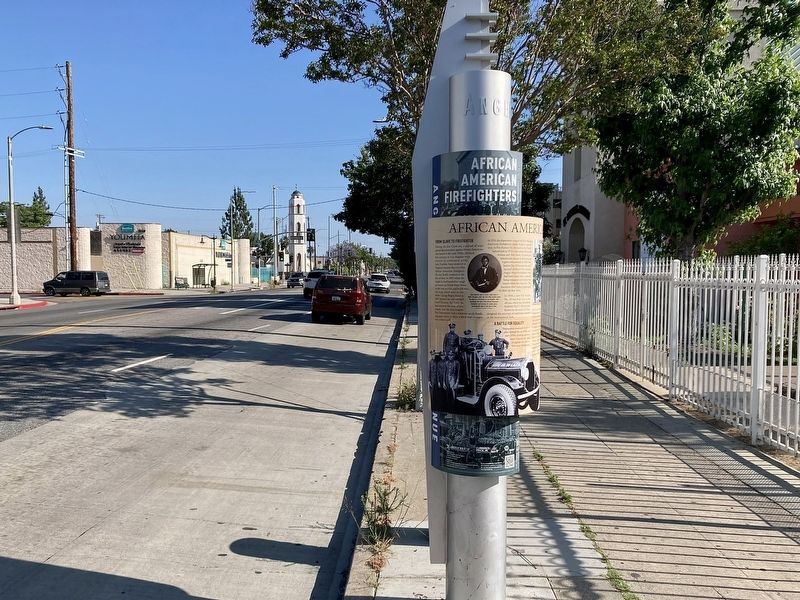
African American Firefighters

courtesy City of Los Angeles, circa 2020
1. African American Firefighters Marker
From Slave to Firefighter
During the Jim Crow era, a period of wide-spread discrimination against African Americans that lasted to the mid-1960s, all-black fire stations in Los Angeles were sources of community pride. Sam Haskins, born enslaved in Virginia, became the city's first African American firefighter. He was fatally crushed in the line of duty in 1895 when the engine he had boarded hit rough pavement on North Main Street on the way to a fire and he fell into the large wheel next to the boiler. George Bright, hired in 1897, became the city's second black fireman. By 1902, he had attained the rank of lieutenant, and the Los Angeles Fire Department had a dilemma on its hands: segregate crews or allow a black man to supervise a white staff.
In 1924, the department assigned all of its African American firefighters, under Bright's supervision, to Fire Station No. 30, built in the Prairie School style in 1913 at the corner of Central Avenue and 14th Street. As more personnel were placed in this location, it grew overcrowded. In 1936, Fire Station No. 14 became the city's second all-black fire station. Angry
this page online
A Battle for Equality
Segregation remained firmly in place through the late 1940s and early 1950s, limiting advancement beyond the rank of captain for African American firefighters.
In 1954, the U.S. Supreme Court declared "separate but equal" public schools unconstitutional. About that time, activists began campaigning to force the desegregation of other public agencies, including the fire department. African American firefighters, represented by well-known attorneys Loren Miller and Thomas Neusom with the local chapter of the NAACP, pushed a campaign for integration from 1953 to 1955.
The California Eagle, a prominent African American-owned newspaper, also embraced the cause. The city began transferring African American
Photographed by Craig Baker, June 18, 2023
2. African American Firefighters Marker
Stentorians are Established
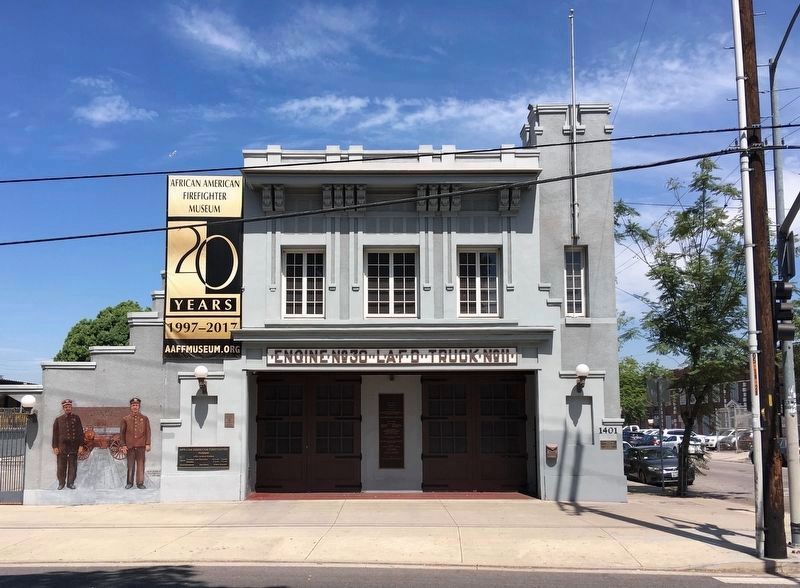
One of those who joined the battle to counter-act racism in the 1950s was Arnett Hartsfield, a firefighter from Station No. 30, who with about 30 other black firemen formed a group called the Stentorians (derived from Stentor, a Greek Trojan War herald) to support equality in hiring, transfers, and promotions. Hartsfield earned his law degree from the University of Southern California in 1955 and in 1961 quit the fire department to practice law. Since 1997, Fire Station No. 30 has housed the African American Firefighter Museum. The station has been designated a Los Angeles Historic-Cultural Monument. Stations No. 30 and No. 14 are both listed on the National Register of Historic Places.
To learn more, visit the African American Firefighter Museum, located at 1401 S. Central Avenue.

Photographed by Craig Baker, June 18, 2023
3. Marker Detail
Sam Haskins was a former slave who in 1880 (15 years after the Civil War ended) made his way as a freedman to Los Angeles. After becoming the city's first African American firefighter and serving for seven years, he tragically died in the line of duty.
Erected 2020 by City of Los Angeles.
Topics. This historical marker is listed in these topic lists: African Americans • Civil Rights.
Location. 34° 0.741′ N, 118° 15.398′ W. Marker is in Los Angeles, California, in Los Angeles County. It is in South Los Angeles. It is on Central Avenue just south of 34th Street, on the right when traveling south. Touch for map. Marker is at or near this postal address: 3415 S Central Ave, Los Angeles CA 90011, United States of America. Touch for directions.

Regionally, this marker is in the Transverse Ranges. It is also on the American Pacific Coast. Globally, it is in North America, on the Ring of Fire, on the Pacific Rim, in the Western Hemisphere, in the Western World, and in the Anglosphere. Historically, it finds itself in what was once New Spain and also Mexico’s Alta California.
Other nearby markers. At least 8 other markers are within walking distance of this marker: The Elks Club (within shouting distance of this marker); Angelus Funeral Home (about 300 feet away,
Photographed by Craig Baker, July 19, 2019
4. Fire Station 30
This historic building now houses the African American Firefighter Museum.
Related marker. Click here for another marker that is related to this marker. - African American Firefighter Museum marker.
Also see . . . African American Firefighter Museum website. (Submitted on June 22, 2023.)
Credits. This page was last revised on May 21, 2026. It was originally submitted on June 22, 2023. This page has been viewed 777 times since then and 112 times this year. Photos: 1, 2, 3. submitted on June 22, 2023, by Craig Baker of Sylmar, California. 4. submitted on July 21, 2019, by Craig Baker of Sylmar, California.
