South Los Angeles in Los Angeles County, California — The American West (Pacific Coastal)
Ralph J. Bunche

courtesy City of Los Angeles
1. Ralph Bunche Marker
Local Kid to Global Dignitary
Ralph Johnson Bunche (1904-1971) was an esteemed African American scholar and human rights activist who also had a brilliant career as a diplomat and international civil servant. Although Bunche is best remembered for being the first African American to win a Nobel Peace Prize, he also had a profound influence on the world in many other ways. A sign now marks the clapboard house at 1221 East 40th Place that was his home, a couple blocks east of Central Avenue. When his family lived there in the early 1900s, the neighborhood was predominantly white. Despite facing racial discrimination, Bunche's elders persisted in ensuring he, his sister, and his cousins received a solid education in local schools so that they could make something of themselves.
Humble Beginnings
Born in Detroit, Michigan, Bunche lived there as a boy, as well as in Ohio and New Mexico. After his mother died and his father disappeared, he and his sister moved to Los Angeles from Albuquerque with their maternal grandmother and other relatives in 1917 to start life anew. Bunche excelled academically and
this page online
Educator and Social Activist
Bunche earned a doctorate in political science and international relations from Harvard University in 1934. His studies resulted in the book A World View of Race, which focused on colonialism in Africa and international race relations, setting the foundation for his life's work. In the 1930s, Bunche taught at Howard and Harvard universities, and he became a member of President Franklin D. Roosevelt's "Black Cabinet," which the administration consulted on issues affecting minorities. Bunche helped found the National Negro Congress, whose aim was to advance the common interests of black and white workers. His collaboration was critical to the Swedish sociologist Gunnar Myrdal's pivotal 1944 study about American race relations, An American

Photographed by Craig Baker, January 14, 2022
2. Ralph Bunche Marker
International Peacemaker
During World War II, Bunche served as a senior advisor to the U.S. State Department and to the military on African colonial areas of strategic importance. In 1946, he began work at the United Nations, where he helped draft its mission and purpose statement. Bunche is probably best known for his U.N. work negotiating a ceasefire agreement to end the Arab-Israeli conflict that raged from 1948 to 1949 — an achievement for which he won the Nobel Peace Prize in 1950. He was the first person of color to be so honored. Bunche received numerous other accolades in his lifetime, including a 1963 Presidential Medal of Freedom with Special Distinction awarded by President John F. Kennedy in recognition of his efforts in the Middle East. In December 1963, soon after Kennedy's assassination, President Lyndon B. Johnson formally presented Bunche with the medal.
In the decades after winning the Nobel Prize, Bunche became one of the world's most revered public figures. UCLA recognized his accomplishments by naming
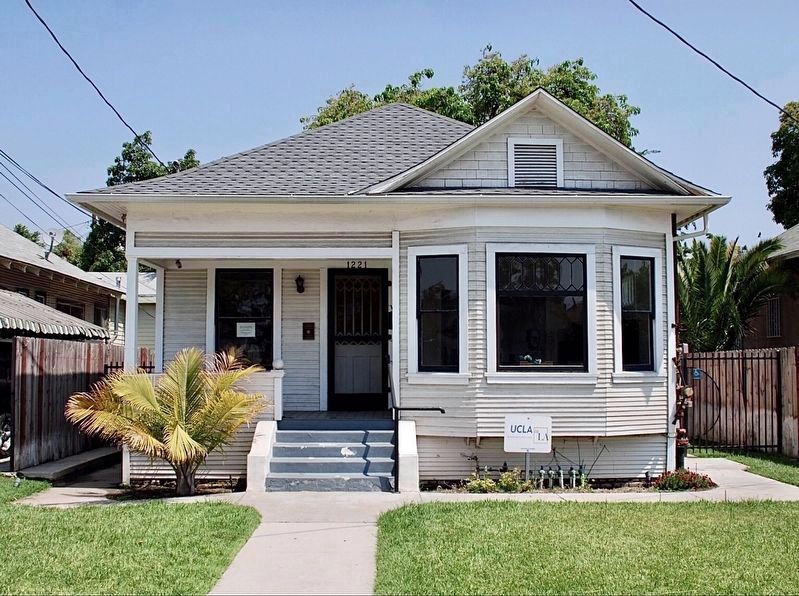
Photographed by Craig Baker
3. Ralph Bunche Home
Located two blocks east of the Ralph Bunche marker.
Erected 2020 by City of Los Angeles.
Topics. This historical marker is listed in these topic lists: African Americans • Civil Rights • Education. A significant historical month for this entry is December 1963.
Location. 34° 0.608′ N, 118° 15.384′ W. Marker is in Los Angeles, California, in Los Angeles County. It is in South Los Angeles. It is on 40th Place just east of Central Avenue, on the right when traveling east. Touch for map. Marker is at or near this postal address: 1104 E 40th Pl, Los Angeles CA 90011, United States of America. Touch for directions.

Regionally, this marker is in the Transverse Ranges. It is also on the American Pacific Coast. Globally, it is in North America, on the Ring of Fire, on the Pacific Rim, in the Western Hemisphere, in the Western World, and in the Anglosphere. Historically, it finds itself in what was once New Spain and also Mexico’s Alta California.
Other nearby markers. At least 8 other markers are within walking distance of this marker: California Eagle Building (within shouting distance of this marker); California Eagle (about 300 feet away, measured in a direct line); Black Panthers in L.A. (about 500 feet away); Florence Mills Theatre (about 500 feet away); The Elks Club (about 700 feet away); Angelus Funeral Home (about 700 feet away); Ralph Bunche Home (approx. 0.2 miles away); African American Firefighters (approx. 0.2 miles away). Touch for a list and map of all markers in Los Angeles.
Also see . . . Angels Walk L.A. Self-guided walking tours of historic neighborhoods in Los Angeles the Ralph J Bunche marker is part of the Central Avenue walk. (Submitted on March 4, 2026.)
Credits. This page was last revised on May 21, 2026. It was originally submitted on June 22, 2023, by Craig Baker of Sylmar, California. This page has been viewed 323 times since then and 47 times this year. Photos: 1, 2, 3. submitted on June 22, 2023, by Craig Baker of Sylmar, California.
